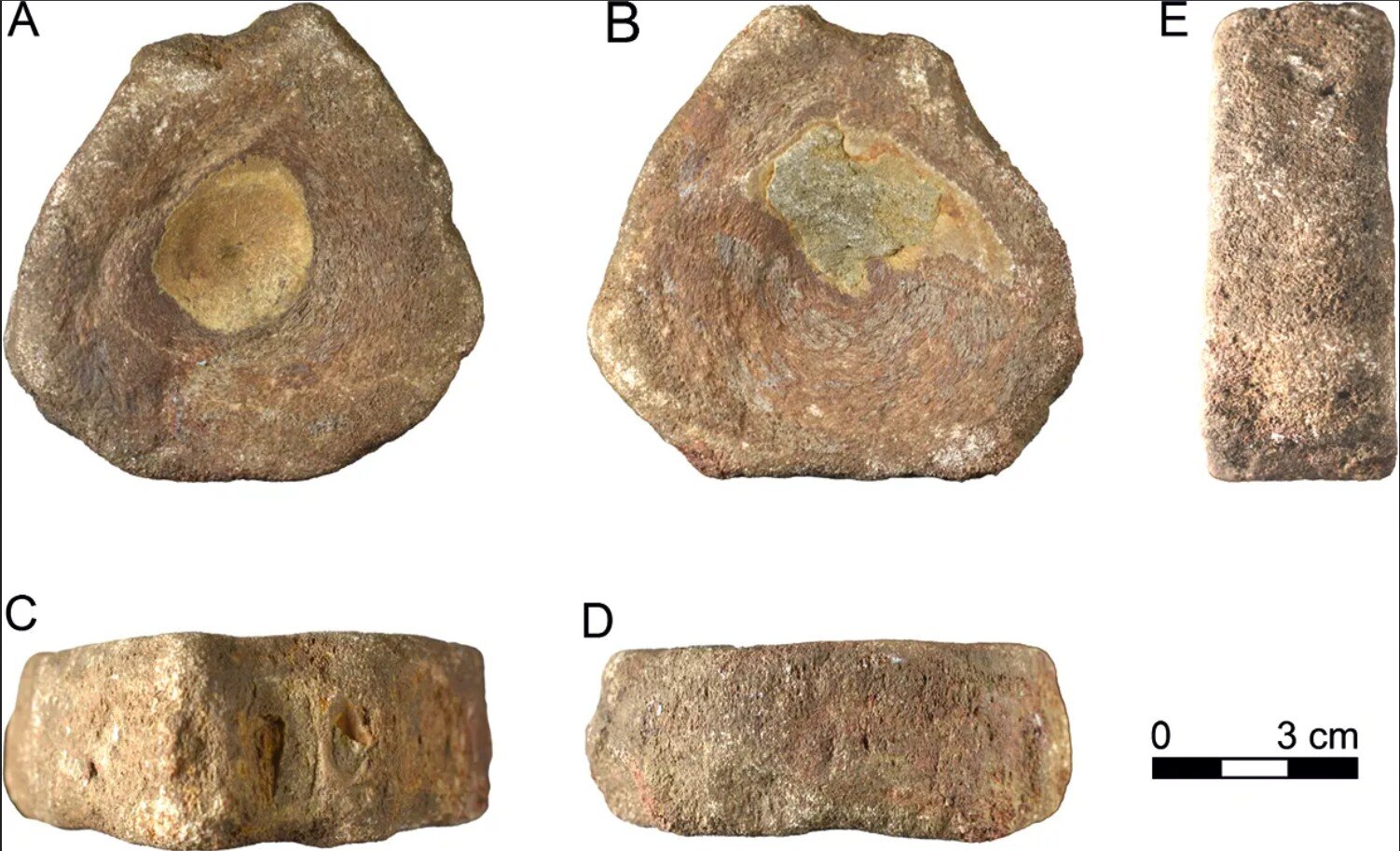
Researchers have identified the oldest known evidence of someone deliberately collecting an ichthyosaur fossil after a weathered vertebra was uncovered in a Roman-era pit in Colchester, England. Dating to around 1,800 years ago, the find suggests that people in Roman Britain may have preserved ancient fossils either because of mythology, ritual practices, or simple curiosity.
A weathered fossil that once lay on the shoreline of Roman Britain has become an extraordinary window into how ancient people viewed the distant past.
Researchers report that an ichthyosaur vertebra discovered in a Roman archaeological context represents the oldest known example of someone intentionally collecting the remains of one of these prehistoric marine reptiles. The study, published in Britannia, argues that the fossil was not simply a natural part of the site but had been picked up elsewhere and deliberately transported before eventually being deposited in a pit dating to around the second century A.D.
For archaeologists, the significance of the find lies not only in the fossil itself but also in what it reveals about human behavior nearly two millennia ago.
“In several parts of the English coastline, an isolated, perhaps heavily wave-worn, ichthyosaur vertebra washed out from the base of a cliff is a commonplace find, usually of little bearing,” said Patrick Spencer, an archaeologist at Colchester Archaeological Trust and lead author of the study. “In this instance, however, the wholly unexpected context of the vertebra made it entirely exceptional.”
An ancient fossil found in an unexpected place
The vertebra came to light during excavations in 2024 at the former Essex County Hospital in Colchester, the site of Britain’s first provincial Roman capital.
Rather than being uncovered in coastal sediments where such fossils naturally occur, the bone was recovered from a mysterious pit containing an unusual assortment of objects. Archaeologists found it alongside possible cat remains, a horse tooth, pottery fragments, and a Roman toilet spoon known as a ligula.
This unusual combination immediately distinguished the fossil from ordinary beach finds. Instead of arriving there through natural geological processes, the vertebra appears to have been intentionally carried to Colchester before being deposited.
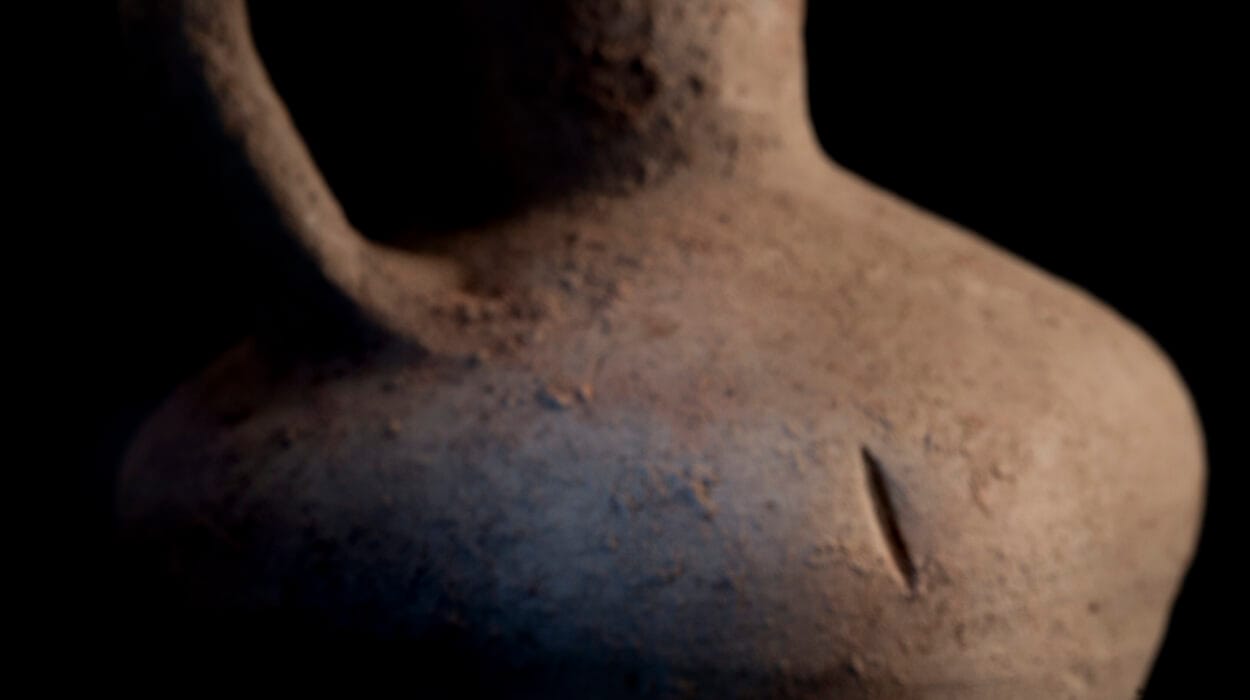
The fossil itself belonged to an ichthyosaur, a dolphin-shaped marine reptile that hunted in the oceans during the Mesozoic Era. By the time Romans handled the fossil, it was already more than 100 million years old.
Spencer noted that holding such an object effectively compresses immense spans of history into a single artifact, connecting Earth’s distant prehistoric past with Roman Britain.
He also linked the discovery to the legacy of Mary Anning, whose nineteenth-century discoveries of ichthyosaurs at Lyme Regis transformed scientific understanding of prehistoric life.
Tracing where the fossil came from
Although the vertebra had been heavily worn by exposure to waves, researchers found an important clue still attached to it.
Greenish sandy rock adhering to the fossil allowed the team to identify its likely origin along the east Kent coast between Folkestone and Hythe.
During the Roman period, this region supported an active quarrying industry that supplied greensand building stone across the area. According to Spencer, greensand served as an important construction material in Colchester throughout much of the Roman occupation.
That connection offers a plausible explanation for how the fossil reached the inland settlement. Someone involved in or traveling through the quarrying area may have encountered the unusual bone, recognized it as something distinctive, and decided to keep it.
Rather than being transported accidentally with building stone, the researchers conclude that the vertebra was deliberately collected before eventually arriving in Colchester.
Why would someone keep a worn fossil?
The fossil’s condition raises an obvious question.
Unlike a complete skeleton or a striking specimen, the vertebra was heavily weathered and visually unremarkable. Why would anyone have considered it worth carrying over such a distance?
Spencer proposes two possible explanations.
One possibility is rooted in Greco-Roman mythology. During classical antiquity, unusually large fossils were sometimes interpreted as the remains of heroes, giants, or mythical creatures. Such objects could be displayed as sacred relics because they appeared to provide tangible evidence for legendary beings.
The study points to an example from Olympia, where a giant shoulder blade displayed in a sanctuary was believed to belong to the hero Pelops.
“This may have concerned Greco-Roman folklore and mythology, with the vertebra perceived as the tangible remains of a mythological creature or a giant,” Spencer said.
The alternative explanation is considerably simpler.
People have long been drawn to unusual natural objects, and fossils may have inspired curiosity long before scientific explanations existed. Spencer notes that humans have found fossils fascinating for thousands of years, while ancient writers also commented on the existence of bones that appeared to have turned into stone.
Under this interpretation, the vertebra may simply have been an intriguing object that someone found too interesting to leave behind.
The mystery of the Roman pit
Exactly why the fossil ended up in the Colchester pit remains uncertain.
The unusual collection of objects recovered from the feature has led researchers to consider whether it could represent a ritual deposit. The presence of the ligula is regarded as particularly noteworthy in that interpretation.
Even so, Spencer emphasized that no definitive explanation has emerged.
“The reason for its deposition in this pit was not clear,” he said.
Without clearer evidence, the researchers cannot determine whether the vertebra served a ceremonial purpose, functioned as a treasured curiosity, or held some other meaning before it was discarded.
A rare glimpse into Roman Britain’s relationship with fossils
The Colchester vertebra is described as the first deliberately collected ichthyosaur fossil known from Roman Britain, making it a unique archaeological discovery.
However, it is not entirely without parallel. Researchers note that another deliberately collected Romano-British fossil, this time belonging to a plesiosaur, has previously been found in Cambridge.
Both discoveries come from eastern England, a pattern Spencer believes may prove significant.
Rather than representing isolated events, these finds may hint that Roman communities in the region occasionally recognized and collected ancient fossils for reasons that remain only partly understood.
Spencer suggested that additional discoveries could still be waiting beneath archaeological sites across Roman Britain.
“[This] might indicate more such finds are waiting to be uncovered, perhaps also elsewhere in Roman Britain,” he said.
For now, the Colchester vertebra offers a rare intersection of archaeology, paleontology, and human curiosity. Carried from a windswept coastline nearly 1,800 years ago and preserved in an unexpected archaeological setting, the fossil shows that people in Roman Britain were engaging with traces of Earth’s ancient past long before the science of paleontology existed.