Imagine waking up one morning to a world without trees, flowers, grass, fruits, vegetables, or the fresh air you breathe. Birds would have no forests to nest in, animals would lose their food sources, and humans would quickly face a crisis unlike anything in history. It sounds like the plot of a science fiction story, but this is exactly what Earth would become without one extraordinary biological process: photosynthesis.
Photosynthesis is often introduced in school as a simple equation involving sunlight, carbon dioxide, and water. While that equation is correct, it barely captures the wonder of what is actually happening. Every second of every day, billions of leaves across forests, grasslands, farms, oceans, and even tiny ponds are quietly performing one of nature’s greatest miracles. Using nothing more than sunlight, water, and carbon dioxide, plants and certain other organisms manufacture food, release oxygen, and fuel nearly every ecosystem on Earth.
This remarkable process supports almost every living creature, including humans. Every bite of food you eat, whether it comes from a salad, a loaf of bread, a piece of fruit, or even a steak, can ultimately be traced back to photosynthesis. The oxygen filling your lungs right now was also produced through this incredible process.
Photosynthesis is not just important—it is one of the fundamental reasons life as we know it exists.
In this complete beginner’s guide, you’ll discover what photosynthesis is, how it works, why it matters, where it takes place, the organisms that perform it, and how this elegant process continues to shape our planet every single day.
What Is Photosynthesis?
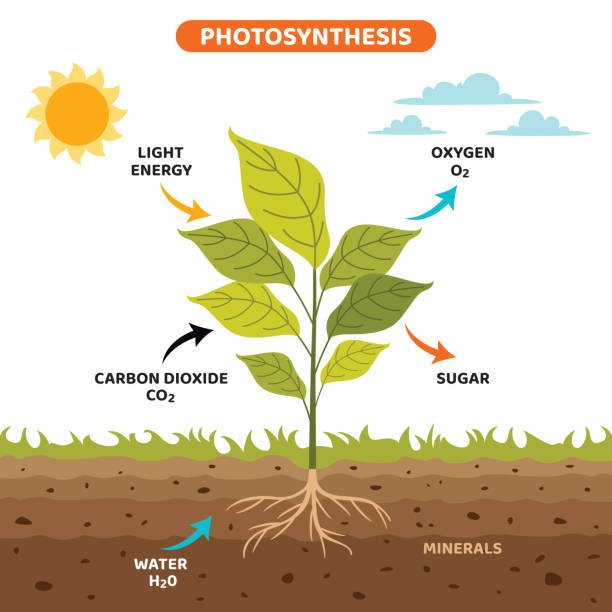
Photosynthesis is the biological process through which plants, algae, and certain bacteria convert sunlight into chemical energy. They use energy from the Sun to transform carbon dioxide from the atmosphere and water from the soil into glucose, a type of sugar that serves as food. During this process, oxygen is released into the atmosphere as a byproduct.
In simple terms, photosynthesis allows organisms to make their own food using sunlight.
Unlike animals, which must eat other organisms for energy, photosynthetic organisms produce their own energy-rich molecules. For this reason, they are known as producers or autotrophs.
The overall chemical equation for photosynthesis is often written as:
6CO₂ + 6H₂O + Light Energy → C₆H₁₂O₆ + 6O₂
This equation tells a remarkable story. Six molecules of carbon dioxide combine with six molecules of water. Using energy from sunlight, these molecules are rearranged into one molecule of glucose and six molecules of oxygen.
Although the equation looks simple, the actual process involves dozens of carefully coordinated chemical reactions occurring inside microscopic structures within cells.
Why Photosynthesis Is So Important
It is difficult to overstate the importance of photosynthesis. Without it, life on Earth would be dramatically different, and most complex organisms would not survive.
Photosynthesis provides the foundation for nearly every food chain on the planet.
Plants create food from sunlight.
Herbivores eat plants.
Carnivores eat herbivores.
Omnivores consume both.
Humans depend on all parts of this system.
Whether you enjoy fresh vegetables, rice, apples, milk, eggs, or fish, every meal ultimately owes its existence to photosynthesis.
The process also continuously replenishes Earth’s oxygen supply.
Every breath you take contains oxygen released by photosynthetic organisms.
Without ongoing photosynthesis, atmospheric oxygen would gradually decline as living organisms continued consuming it through respiration.
Photosynthesis also helps regulate Earth’s climate by removing carbon dioxide from the atmosphere. Since carbon dioxide is a greenhouse gas, this process plays an important role in Earth’s carbon cycle and climate system.
Who Performs Photosynthesis?
Many people associate photosynthesis only with green plants, but they are not the only organisms capable of performing this remarkable process.
Green plants are certainly the most familiar examples. Trees, grasses, flowers, shrubs, vegetables, and crops all rely on photosynthesis.
Algae also perform photosynthesis. These organisms range from tiny microscopic phytoplankton floating in the oceans to enormous kelp forests growing underwater.
Certain bacteria, known as cyanobacteria, also carry out photosynthesis. In fact, these ancient microorganisms were among the earliest organisms to release oxygen into Earth’s atmosphere billions of years ago.
Together, plants, algae, and cyanobacteria form the primary producers that sustain Earth’s ecosystems.
A Journey Back in Time
Photosynthesis has shaped Earth’s history for billions of years.
When our planet first formed, its atmosphere looked very different from today’s.
There was almost no oxygen.
Early life consisted mainly of simple microorganisms living in oceans.
Around 2.4 billion years ago, cyanobacteria began performing oxygen-producing photosynthesis on a massive scale.
Over millions of years, oxygen accumulated in the atmosphere.
This event, sometimes called the Great Oxygenation Event, transformed Earth’s chemistry forever.
Although many early organisms could not survive rising oxygen levels, new forms of life evolved that used oxygen for respiration.
Eventually, this paved the way for complex plants, animals, and ultimately humans.
In many ways, photosynthesis made modern Earth possible.
Where Does Photosynthesis Take Place?
Photosynthesis occurs inside specialized structures called chloroplasts.
Chloroplasts are tiny organelles found within the cells of plants and algae.
Each chloroplast contains stacks of flattened membranes called thylakoids.
Inside these membranes lies chlorophyll, the green pigment responsible for capturing sunlight.
Surrounding the thylakoids is a fluid-filled region called the stroma, where additional reactions occur.
Although chloroplasts are microscopic, each leaf contains millions of them.
A single tree possesses billions of chloroplasts working together every sunny day.
Why Are Plants Green?
Most plants appear green because of chlorophyll.
Chlorophyll absorbs mainly red and blue wavelengths of visible light.
Green wavelengths are reflected rather than absorbed.
Those reflected wavelengths reach our eyes, making leaves appear green.
Interestingly, plants do not absorb green light very efficiently.
Scientists continue studying why chlorophyll evolved this way, although it likely reflects the environmental conditions under which photosynthesis first developed.
The Amazing Role of Sunlight
Sunlight is the driving force behind photosynthesis.
The Sun continuously sends enormous amounts of energy toward Earth.
Plants capture only a tiny fraction of this energy, yet it is enough to support nearly all ecosystems.
When photons—tiny packets of light energy—strike chlorophyll molecules, electrons inside those molecules become energized.
This captured energy begins a chain of reactions that ultimately leads to glucose production.
Without sunlight, photosynthesis cannot proceed in most plants.
This explains why plants grow poorly in darkness.
The Ingredients of Photosynthesis
Photosynthesis depends on three essential ingredients.
The first is sunlight.
The second is water.
The third is carbon dioxide.
Water enters plants through their roots.
Specialized tissues transport water upward through stems into leaves.
Carbon dioxide enters leaves through tiny pores called stomata.
Sunlight reaches leaves from above.
Once all three ingredients arrive, the chloroplast begins converting them into usable chemical energy.
Understanding Stomata
Leaves contain thousands of microscopic openings called stomata.
These tiny pores act like adjustable windows.
They open to allow carbon dioxide inside.
They also release oxygen into the atmosphere.
Unfortunately, open stomata also allow water vapor to escape.
Plants therefore carefully regulate when stomata open and close.
On hot, dry days many plants partially close their stomata to conserve water.
Balancing carbon dioxide intake with water conservation represents one of a plant’s greatest daily challenges.
Water’s Essential Role
Water does much more than keep plants hydrated.
During photosynthesis, water molecules are actually split apart.
This process releases electrons needed for later chemical reactions.
It also produces hydrogen ions.
Most importantly for Earth’s atmosphere, splitting water releases oxygen gas.
That oxygen eventually exits leaves through stomata and enters the air we breathe.
Every oxygen molecule released during photosynthesis originally came from water.
Carbon Dioxide: More Than a Greenhouse Gas
Carbon dioxide often appears in discussions about climate change, but it is also an essential ingredient for life.
Plants use carbon dioxide as their carbon source.
Carbon atoms from atmospheric carbon dioxide eventually become glucose molecules.
Those carbon atoms later become leaves, roots, fruits, seeds, wood, flowers, and countless other plant structures.
When animals eat plants, the same carbon atoms become part of their bodies.
The carbon inside your muscles, bones, and organs may once have floated through Earth’s atmosphere as carbon dioxide.
Photosynthesis continuously transfers carbon from the atmosphere into living organisms.
The Two Main Stages of Photosynthesis
Although photosynthesis involves many chemical reactions, scientists generally divide it into two major stages.
The first stage depends directly on light.
The second stage uses products from the first stage to build sugars.
These stages work together seamlessly inside chloroplasts.
Neither stage alone can produce glucose.
Each depends on the other.
The Light-Dependent Reactions
The first stage occurs within the thylakoid membranes.
Here, chlorophyll absorbs sunlight.
Captured light energy excites electrons.
These energized electrons move through a series of proteins known as the electron transport chain.
As electrons travel, their energy helps produce ATP and NADPH.
ATP serves as the cell’s immediate energy currency.
NADPH carries energized electrons needed for later reactions.
Meanwhile, water molecules split apart.
Electrons replace those lost by chlorophyll.
Hydrogen ions contribute to ATP production.
Oxygen is released as a byproduct.
This stage essentially converts light energy into chemical energy.
The Calvin Cycle
The second major stage takes place in the chloroplast’s stroma.
Unlike the first stage, these reactions do not directly require light.
Instead, they use ATP and NADPH produced earlier.
The Calvin cycle captures carbon dioxide from the atmosphere.
Through multiple enzyme-driven reactions, carbon atoms gradually combine into larger molecules.
Eventually, glucose and other carbohydrates are produced.
These sugars store the Sun’s energy in chemical bonds.
Plants later use this stored energy for growth, reproduction, and survival.
What Happens to the Glucose?
Glucose is far more than food for plants.
Some glucose is immediately broken down during cellular respiration to release usable energy.
Some is converted into sucrose for transport throughout the plant.
Some becomes starch for long-term storage.
Other glucose molecules help build cellulose, the strong material forming plant cell walls.
Cellulose eventually becomes wood, stems, leaves, cotton fibers, and paper.
Every part of a plant traces back to glucose produced through photosynthesis.
Photosynthesis and Cellular Respiration
Photosynthesis and cellular respiration complement each other beautifully.
Photosynthesis stores energy.
Respiration releases energy.
Plants perform both processes.
Animals perform respiration but not photosynthesis.
During respiration, glucose combines with oxygen.
Energy is released.
Carbon dioxide and water are produced.
Those products then become ingredients for photosynthesis once again.
This elegant cycle has operated on Earth for hundreds of millions of years.
Why Leaves Change Color in Autumn
During spring and summer, chlorophyll dominates leaf color.
As autumn approaches, many trees stop producing chlorophyll.
Existing chlorophyll gradually breaks down.
Other pigments hidden beneath the green become visible.
Carotenoids create yellow and orange colors.
Anthocyanins produce brilliant reds and purples in some species.
Although photosynthesis slows dramatically during autumn, the spectacular colors remind us of the pigments normally hidden beneath chlorophyll.
Photosynthesis in Different Environments
Not all plants perform photosynthesis exactly the same way.
Most plants use the standard process known as C3 photosynthesis.
However, some species have evolved specialized adaptations.
Plants living in hot, dry environments often use C4 photosynthesis.
This system helps reduce water loss while maintaining efficient carbon dioxide capture.
Cacti and many desert plants use CAM photosynthesis.
These plants open their stomata mainly at night when temperatures are cooler.
Carbon dioxide is stored overnight and used during daylight while stomata remain mostly closed.
These remarkable adaptations help plants survive challenging environments.
Ocean Photosynthesis
Many people assume forests produce most of Earth’s oxygen.
Forests are certainly important.
However, microscopic marine phytoplankton perform an enormous share of global photosynthesis.
These tiny organisms float near the ocean surface where sunlight penetrates.
Collectively, they generate a substantial portion of Earth’s oxygen while forming the base of marine food webs.
Tiny though they are, phytoplankton help sustain life across the planet.
Photosynthesis and the Food Chain
Every ecosystem begins with producers.
Plants capture solar energy.
Herbivores eat plants.
Predators consume herbivores.
Top predators rely indirectly on plants.
Even decomposers eventually process material originally produced through photosynthesis.
Without producers, ecosystems collapse.
No matter how powerful a predator appears, its survival ultimately depends on sunlight captured by plants.
Photosynthesis and Agriculture
Human civilization depends upon photosynthesis.
Farmers grow crops by maximizing photosynthetic efficiency.
Healthy plants produce larger harvests.
Agricultural scientists study light intensity, water availability, soil nutrients, carbon dioxide, and temperature to improve crop yields.
Modern food production is essentially the management of photosynthesis on a massive scale.
Every loaf of bread, bowl of rice, apple, carrot, or tomato begins with sunlight entering a leaf.
Photosynthesis and Climate Change
Photosynthesis plays an important role in Earth’s climate.
Plants remove carbon dioxide from the atmosphere.
They store carbon in trunks, roots, leaves, and soil.
Forests therefore act as important carbon sinks.
Deforestation reduces this natural carbon storage.
Reforestation and ecosystem restoration help increase carbon capture through photosynthesis.
Although planting trees alone cannot solve climate change, healthy forests remain an important part of broader climate strategies.
Factors That Affect Photosynthesis
Photosynthesis depends on several environmental conditions.
Light intensity strongly influences photosynthetic rate.
Too little light limits energy capture.
Carbon dioxide concentration also matters.
More available carbon dioxide often increases photosynthesis up to certain limits.
Temperature affects enzyme activity.
Extremely cold or hot conditions slow the process.
Water availability is equally critical.
Drought causes stomata to close, reducing carbon dioxide intake.
Nutrient availability also influences chlorophyll production and plant health.
When all conditions are favorable, photosynthesis proceeds efficiently.
Can Artificial Photosynthesis Be Created?
Scientists hope to imitate photosynthesis using technology.
Artificial photosynthesis aims to capture sunlight and convert water and carbon dioxide into useful fuels.
Although researchers have made significant progress, natural photosynthesis remains astonishingly efficient in many ways.
If artificial systems become practical, they could provide renewable fuels while reducing atmospheric carbon dioxide.
Nature continues inspiring engineers around the world.
Common Misconceptions About Photosynthesis
Many people believe plants produce oxygen all day and all night.
Actually, oxygen production occurs only during photosynthesis, which generally requires light.
Plants also perform cellular respiration continuously, including at night.
Another misconception is that only leaves perform photosynthesis.
Although leaves are the primary photosynthetic organs, green stems and some other plant tissues can also photosynthesize.
Some believe plants absorb food from soil.
In reality, plants obtain water and minerals from soil, but they manufacture their own sugars through photosynthesis.
The soil supplies nutrients—not food.
Why Photosynthesis Is One of Nature’s Greatest Innovations
Photosynthesis transformed Earth from a world dominated by simple microorganisms into a planet filled with forests, coral reefs, grasslands, insects, birds, mammals, and humans.
It created oxygen-rich air.
It built food chains.
It stabilized climate.
It enabled biodiversity.
It stores solar energy inside every piece of fruit, every grain of wheat, every towering tree, and every field of wildflowers.
Every leaf quietly performs chemistry so elegant that scientists continue discovering new details even today.
Few natural processes have influenced our planet so profoundly.
Conclusion
Photosynthesis is far more than a biological process taught in school—it is the engine that powers life on Earth. By capturing sunlight and transforming it into chemical energy, plants, algae, and certain bacteria create the food that supports nearly every ecosystem while releasing the oxygen that countless organisms depend upon for survival. Every forest, every farm, every flower, and every breath of fresh air reflects the quiet work of photosynthesis.
From the microscopic chloroplasts inside a single leaf to vast rainforests stretching across continents and tiny phytoplankton drifting through the oceans, photosynthesis connects every corner of the living world. It links the Sun to plants, plants to animals, animals to humans, and all living things through the continuous movement of energy and carbon.
As scientists continue exploring this remarkable process, they not only deepen our understanding of life but also search for new ways to address some of humanity’s greatest challenges, including food security, renewable energy, and climate change. Yet despite all our technological advances, no human invention has matched the elegant simplicity and global impact of the photosynthesis performed every day by the green organisms that surround us.
The next time you walk beneath a tree, admire a garden, or simply breathe deeply on a sunny day, remember that you are witnessing one of the greatest miracles of nature—a process that has quietly sustained life on Earth for billions of years and continues to make our planet a living world.