Hidden for decades under a simple “feline” label, a nearly complete fossil skull has been identified as one of North America’s earliest known saber-toothed cats. The discovery reshapes scientists’ understanding of how these predators evolved, suggesting their iconic oversized fangs emerged gradually before becoming an evolutionary specialization that may have contributed to their extinction.
A fossil that spent years overlooked in a museum collection has become an important new piece of the saber-toothed cat family tree. Identified by UC Berkeley postdoctoral fellow Narimane Chatar, the remarkably complete skull belongs to Adelphailurus kansensis, an enigmatic predator that lived in North America more than 5 million years ago.
The specimen, preserved with its skull, teeth and much of its lower jaw, provides the first complete view of a species previously known only from scattered jaw fragments and isolated teeth. Its discovery gives researchers a rare opportunity to examine an early saber-toothed cat in detail and compare it with later, more specialized species such as Smilodon fatalis, California’s state fossil.
The findings were published online June 19 in the Journal of Vertebrate Paleontology.
An overlooked fossil becomes a key discovery
Chatar found the fossil while examining museum collections at the American Museum of Natural History in New York. The skull had been labeled Pseudaelurus, a catch-all name often assigned to unidentified fossils that resemble cats.
What immediately caught her attention was how different it looked from modern felines.
“I was a bit intrigued because the cranium was quite complete and had a fragmentary mandible with the whole dentition,” Chatar said. “And in the drawer I also found upper canines. When I saw that they were laterally compressed, I knew it was not a cat or a tiger.”
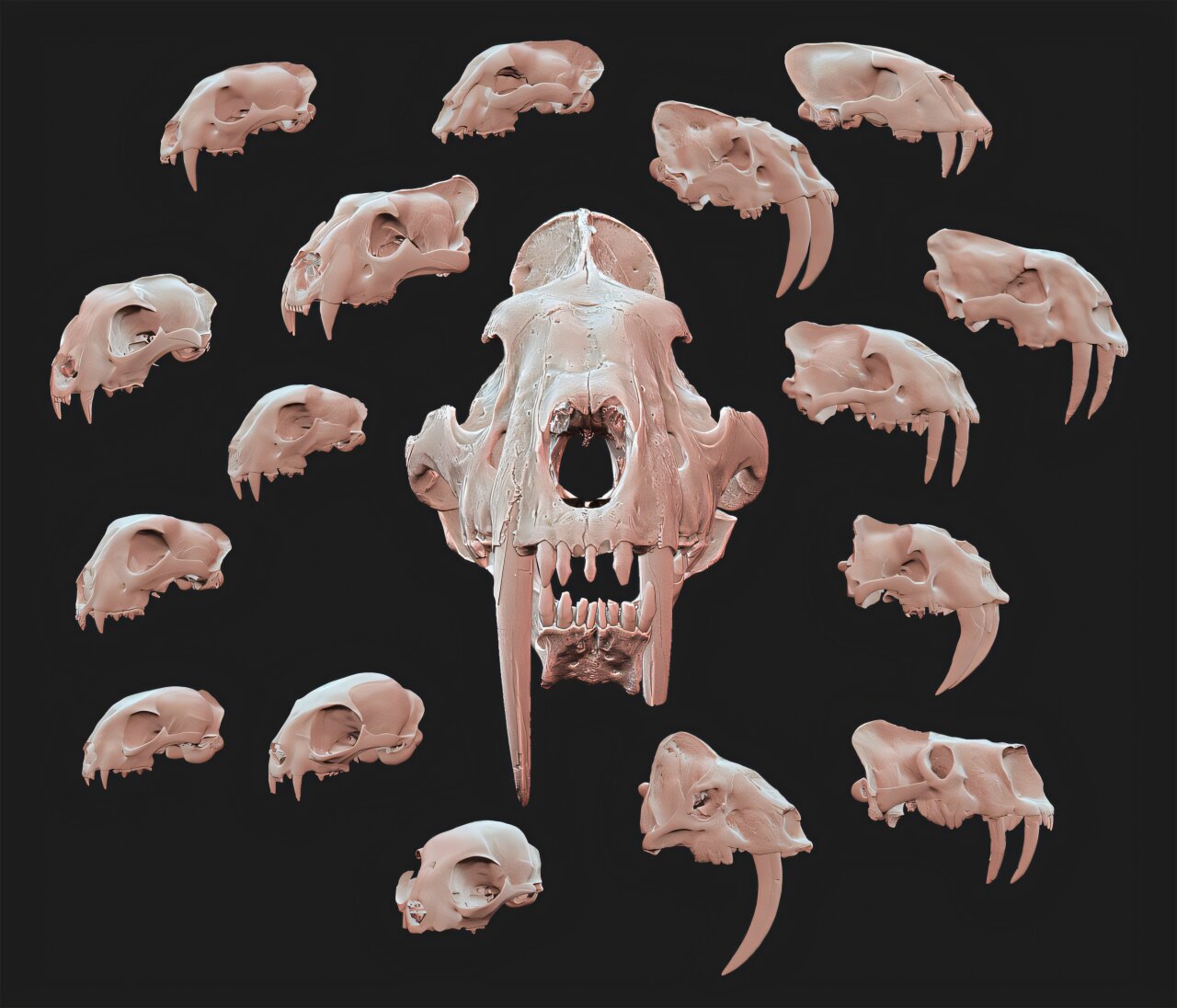
Rather than having the rounded canine teeth seen in living cats, the fossil’s upper canines were flattened from side to side, forming blade-like structures characteristic of saber-toothed predators.
Chatar scanned the specimen but did not immediately investigate it further. Only later, while studying a cast of the original Adelphailurus kansensis fossil at the Yale Peabody Museum, did she recognize the striking similarities. That comparison ultimately revealed that the overlooked museum specimen represented the same rare species.
Filling a major gap in the saber-toothed family tree
The newly identified skull allows researchers to place Adelphailurus kansensis more confidently within the evolutionary history of saber-toothed carnivores.
For decades, the public image of saber-toothed cats has been dominated by Smilodon, famous for carrying upper canines that reached 7 inches (18 centimeters) in length. But Chatar says the broader evolutionary picture is far more diverse.
“Back in the days when we thought about sabertooths, we thought ‘Smilodon’ and that’s it. We thought that all species that exhibited a somewhat saber-like tooth morphology must have hunted like Smilodon and behaved like Smilodon,” she said.
“We are now starting to see a great disparity within those animals, and especially in the early diverging taxa, like Adelphailurus kansensis.”
The new skull shows that early members of the group possessed noticeably shorter saber teeth than their later relatives. It also reveals distinctive anatomical features, including a long, narrow snout and teeth bearing slight serrations along their edges, characteristics not shared by every saber-toothed species.
Deadly teeth came with a cost
The research strengthens an emerging picture of saber-toothed evolution: these predators gradually developed increasingly specialized killing tools.
Unlike the canines of lions, tigers and domestic cats, saber-toothed canines were flattened like knives, making them highly effective for slicing flesh and severing arteries. Their premolars also functioned as cutting tools, adapted for chopping and shredding meat.
Yet those same adaptations came with important weaknesses.
Chatar has investigated the performance of saber-toothed teeth through experiments using 3D-printed replicas. In simulations, the reconstructed teeth penetrated flesh-like material exceptionally well but proved vulnerable when striking bone.
Among the species tested, Smilodon performed best when piercing soft tissue but worst when encountering simulated bone, demonstrating the tradeoff between cutting efficiency and structural strength.
“Slicing and crushing are basically the two main things a carnivorous mammal’s teeth can do,” Chatar said. “But for saber-toothed animals, there’s a clear tradeoff. Those upper canines were extremely efficient but also break very easily.”
Specialization may have limited their future
The new fossil also supports Chatar’s broader hypothesis about why saber-toothed predators ultimately disappeared.
Although several different groups independently evolved saber-like teeth—including true saber-toothed cats, scimitar-toothed cats, South American marsupials known as thylacosmilids and the ancient nimravids—the trend repeatedly followed a similar pattern. Early species had relatively modest canines, while later descendants evolved dramatically elongated fangs.
According to Chatar, researchers have never documented a lineage that reversed this trend after becoming highly specialized.
“We’ve never found any lineage that started developing long upper canines and then stopped and went back to a less specialized state; once a group starts, they (the fangs) go crazy and then they go extinct,” she said.
She describes this pattern as a macroevolutionary ratchet. As species evolve highly specialized anatomy that excels at one task, reversing course may become difficult even if environmental conditions change.
For saber-toothed carnivores, that specialization may have become a liability after the last Ice Age, when the large herbivores they depended on—including bison and camels—disappeared. Predators with sturdier, rounder teeth and bone-crushing molars may have been better equipped to adapt as available prey changed.
Museums may still hold major discoveries
The fossil’s story also highlights the scientific value of museum collections that have been assembled over generations.
During her doctoral research, Chatar visited museums around the world carrying a portable laser scanner, creating detailed digital models of saber-toothed fossils. That experience eventually led her to recognize the significance of the mislabeled specimen tucked away in a museum drawer.
The newly described skull joins earlier fragmentary remains from Kansas and comparable fossils later found in Nebraska, Texas and Mexico, providing the most complete picture yet of Adelphailurus kansensis.
For Chatar, the discovery serves as a reminder that important scientific breakthroughs do not always begin with new excavations in the field.
“It highlights the need to go back to those old collections and open every single drawer and look at those specimens, because there might be amazing fossils like this one just hidden somewhere, labeled cat or Pseudaelurus or something else, that just need to be described,” she said.