Body size in human evolution did not increase in a simple, gradual march toward modern humans, according to new research. By analyzing 386 fossils across 21 hominin species, scientists found that the most dramatic increase in body mass occurred roughly 2–2.5 million years ago within the genus Homo, while some relatives remained surprisingly small.
For decades, scientists have debated a seemingly straightforward question: Did our ancestors steadily grow larger over time, or did human evolution experience a major growth spurt at a specific moment?
New research suggests the answer is more complicated—and far more interesting.
In a study published in PNAS, researchers from the University of Reading and the University of Oxford found that the largest increase in body size among human ancestors occurred around 2–2.5 million years ago, with the emergence of Homo rudolfensis or Homo erectus/ergaster. Rather than following a smooth upward trend, human body size appears to have evolved through a combination of gradual changes and a significant evolutionary leap.
The findings challenge the long-standing assumption that hominins simply became larger and larger over millions of years on a direct path toward modern humans.
A More Complex Story of Human Growth
The research paints a picture of human evolution that is far from uniform.
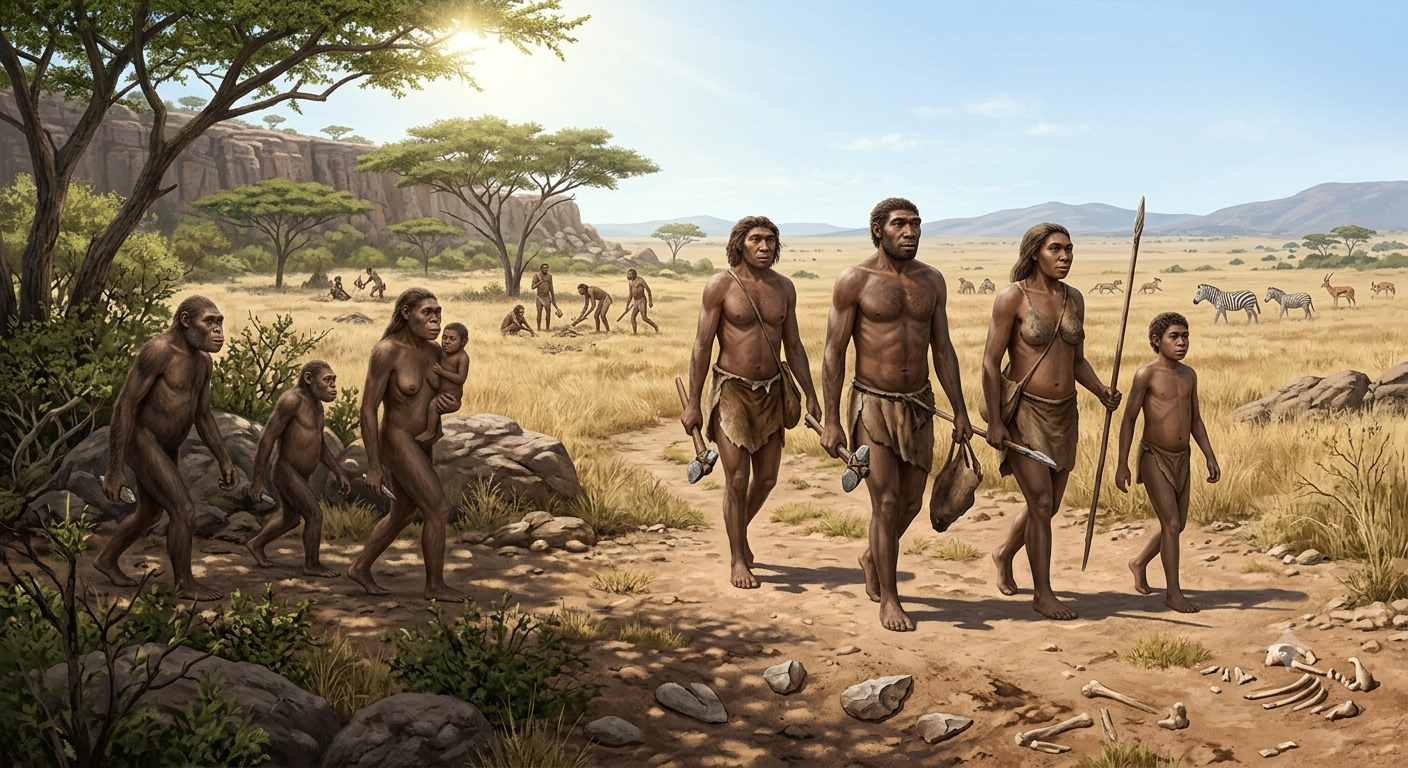
Some hominin species remained remarkably small. The early hominin Australopithecus weighed about 40 kilograms (88 pounds) on average and reached a height comparable to that of a child. Even much later species such as Homo floresiensis and Homo naledi did not follow the trend toward larger bodies.
Meanwhile, other branches of the human family tree grew substantially bigger.
According to the study, Homo erectus/ergaster became the first hominins to reach average body weights of around 60 kilograms (132 pounds) or more—placing them within the range of many people today.
This pattern indicates that body size evolution was not a single, continuous process shared by all human relatives. Instead, different branches followed different paths.
Solving a Long-Running Scientific Debate
Researchers say conflicting conclusions from previous studies helped fuel uncertainty about how body size evolved.
Some earlier investigations focused primarily on species such as Australopithecus, while others concentrated on later members of the genus Homo. Different studies also relied on varying methods for estimating body weight from fossil remains.
As a result, scientists often ended up examining different parts of the evolutionary story.
Lead author Dr. Jacob Gardner of the University of Reading explained that researchers were effectively working with separate pieces of a much larger puzzle.
By bringing together fossil evidence from across the hominin family tree and evaluating multiple competing explanations within a single framework, the team was able to produce a more comprehensive picture of body size evolution.
Their analysis suggests that earlier studies were not necessarily contradicting one another. Instead, they were highlighting different evolutionary patterns occurring at different times.
Examining Hundreds of Fossils
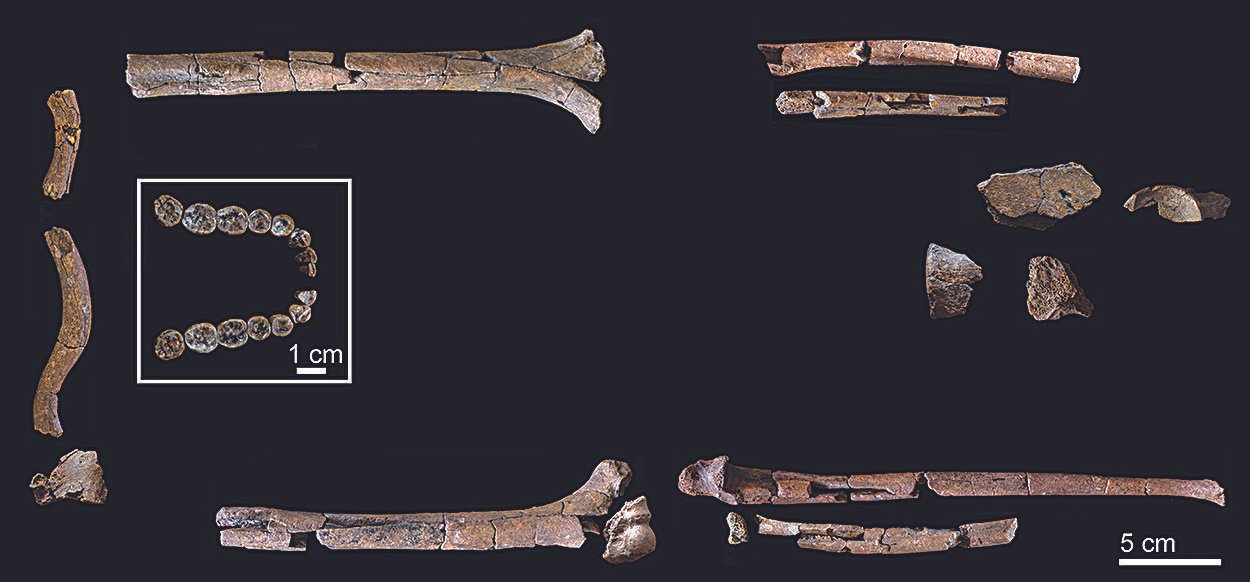
To investigate the question, researchers analyzed body weight estimates from 386 fossils representing 21 hominin species.
Using statistical models, they tracked changes in body size over millions of years while accounting for important sources of uncertainty.
One challenge in studying ancient human relatives is that the fossil record is incomplete. Scientists do not always know with certainty which fossils belong to which species, and evolutionary relationships among species can also affect how body size patterns are interpreted.
The researchers incorporated these uncertainties into their models and considered how species were related to one another. This broader approach helped reveal trends that may have been obscured in previous studies.
The results showed that body weight increased gradually among earlier hominins such as Australopithecus. However, a much larger shift occurred later within the genus Homo.
A Growth Spurt Linked to Major Lifestyle Changes
The timing of this dramatic increase in body size is particularly notable because it coincides with several important developments in later Homo species.
These ancestors moved more efficiently on two legs than earlier hominins. They also consumed more meat and traveled across larger territories in search of food and suitable environments.
Researchers suggest that a larger body may have supported these changes.
Greater body mass could have made long-distance travel easier and helped individuals survive while exploiting a broader range of food resources. The findings indicate that increases in body size were closely connected to broader ecological and behavioral changes rather than occurring in isolation.
In other words, becoming bigger was not simply an evolutionary trend—it may have been part of a wider transformation in how these early humans lived and interacted with their environments.
Different Branches, Different Outcomes
One of the most striking conclusions of the study is that not all human relatives followed the same evolutionary trajectory.
While some Homo species became substantially larger, others remained small despite belonging to the same broader human family.
This diversity challenges simplified views of evolution as a straight line leading inevitably toward larger bodies and modern humans.
Instead, the human family tree appears to be characterized by experimentation and variation, with different species adapting to different circumstances in different ways.
Co-author Dr. Thomas Puschel of the University of Oxford emphasized that body mass generally increased throughout human evolutionary history, but the most important change occurred later within Homo. He noted that this shift aligned with broader changes in movement, environmental use, and ecological behavior.
Why This Matters
The study offers one of the clearest pictures yet of how body size evolved across the human family tree. By combining evidence from 386 fossils and 21 species, researchers show that human evolution was not a simple story of continuous growth.
Instead, the evidence points to a major body-size expansion around 2–2.5 million years ago, alongside significant changes in behavior and ecology. At the same time, several hominin species remained small, demonstrating that evolution did not push every branch of the family tree in the same direction.
Understanding when and how these changes occurred helps scientists better reconstruct the lives of our ancient relatives and reveals that the path to modern humans was far more diverse and complex than a straightforward progression toward larger bodies.