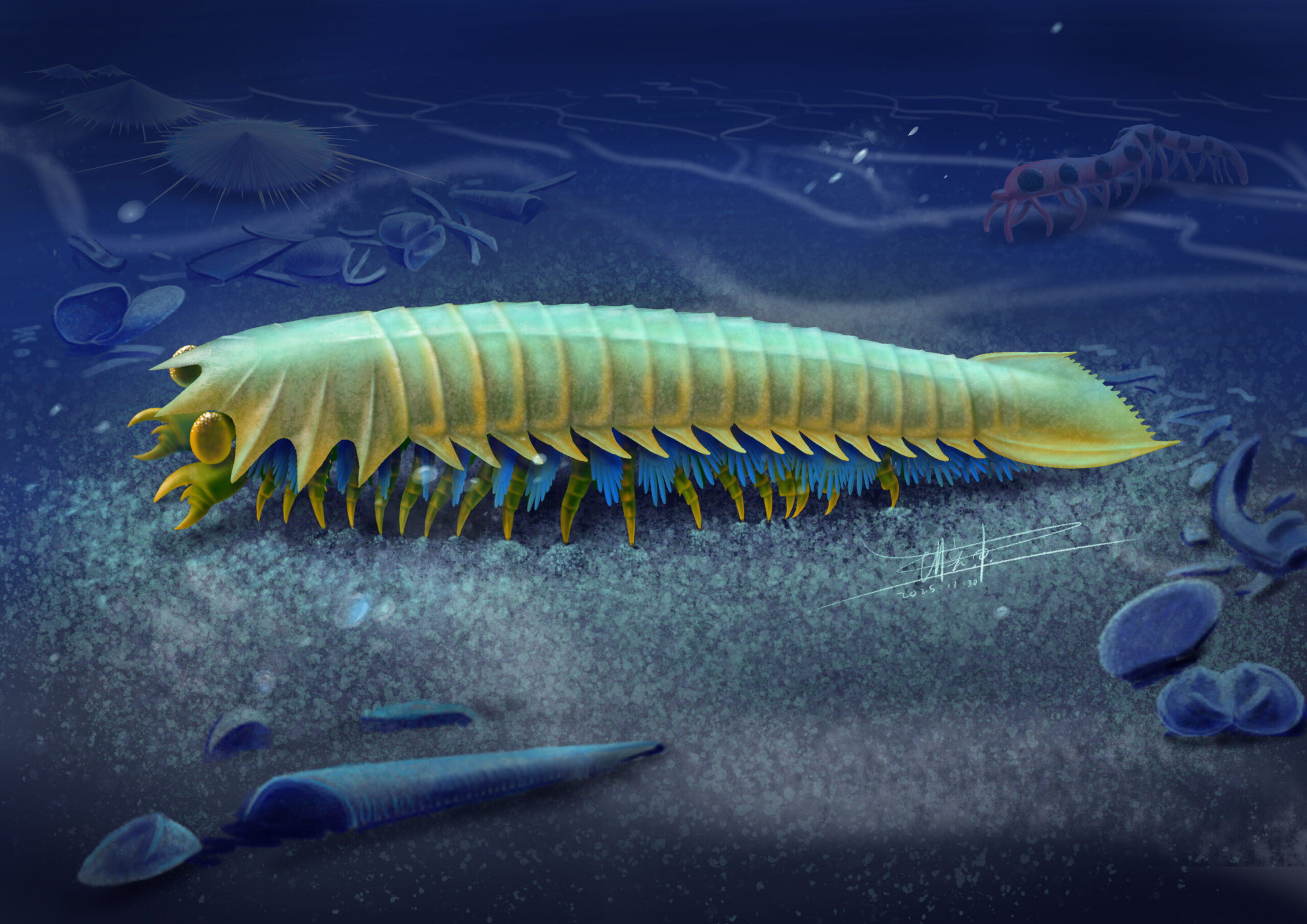
The earliest known evidence of the structures that evolved into spider fangs has been identified in the 518-million-year-old fossil Urokodia, offering an unprecedented glimpse into the origins of one of nature’s most recognizable hunting tools. The discovery, made using advanced X-ray analysis, pushes the evolutionary history of chelicerae deep into Earth’s distant past and sheds new light on how early chelicerates evolved.
Spiders have long captured the human imagination, whether through their reputation as skilled predators or their place in popular culture. Yet the defining feature that makes them such effective hunters—their specialized fangs—has remained difficult to trace through the fossil record.
Now, scientists from the University of Leicester and Yunnan University have uncovered the earliest known evidence of these remarkable structures in the ancient fossil Urokodia, a creature that lived 518 million years ago. Their findings, published in the journal Nature, reveal the earliest known appearance of the evolutionary beginnings of the chelicerae, the specialized appendages that later became the fangs and pincers of modern spiders, scorpions, ticks, and their relatives.
A Tiny Fossil With an Extraordinary Story
Although Urokodia measured only about 2–3 centimeters (0.8–1.2 inches) in length, it has provided scientists with an outsized contribution to understanding animal evolution.
The fossil was recovered from the renowned Chengjiang fossil site in Yunnan Province, southern China. The new research was published on the 42nd anniversary of the discovery of this fossil-rich location, which continues to reveal exceptionally preserved remains of early animal life.
At first glance, Urokodia looks very different from the spiders and scorpions that exist today. It possessed a slender, segmented body, jointed limbs extending beneath it, and large eyes mounted on stalks projecting from the front of its head.
Despite these differences, the fossil preserved a critical evolutionary clue hidden beneath the surrounding rock.
X-Ray Scans Revealed Hidden Soft Anatomy
Rather than relying only on the fossil’s outer appearance, researchers used X-ray tomography to peer inside the rock that had enclosed the animal for hundreds of millions of years.
The scans revealed that much of Urokodia’s soft anatomy remained remarkably preserved. This level of preservation allowed scientists to examine body structures that are normally lost during fossilization.
Most importantly, the imaging exposed two pincer-like limbs positioned just behind the animal’s eyes. Researchers identified these structures as the earliest known evolutionary beginnings of chelicerae—the specialized appendages that serve as pincers or fangs in modern chelicerates.
The discovery provides direct fossil evidence showing how one of the defining features of spiders and their relatives first appeared.
Understanding the Origins of Chelicerates
Spiders belong to a much larger group of invertebrates known as chelicerates, which also includes scorpions and ticks. Today, this diverse group contains more than 100,000 described species.
Chelicerates are distinguished by their jointed limbs, external skeletons, and especially their chelicerae, specialized appendages located at the front of the body. Depending on the species, these structures function as grasping pincers or piercing fangs used to capture prey.
The discovery of these primitive structures in Urokodia pushes the known evolutionary history of chelicerae much farther back than previously documented.
The fossil also revealed additional features on the animal’s legs that suggest they functioned as book gills for breathing, resembling those found in modern aquatic chelicerates such as horseshoe crabs.
These characteristics provide a snapshot of an early stage in chelicerate evolution, before many of the familiar features seen in modern spiders had fully developed.
An Ancient Predator From a Thriving Marine Ecosystem
The findings also place Urokodia within a rich and complex marine environment that flourished more than 500 million years ago.
According to the researchers, the Chengjiang ecosystem contained more than 200 different types of animals, making it one of the most important windows into early animal evolution.
Co-author Professor Mark Williams of the University of Leicester explained that Urokodia lived among this extraordinary diversity of marine life during a pivotal period in Earth’s history. He noted that these exceptionally preserved fossils provide valuable insights into how life was evolving during the earliest stages of animal diversification.
The fossil demonstrates that the ancestors of today’s chelicerates were already developing specialized feeding structures hundreds of millions of years before modern spiders appeared.
Researchers Recognized the Discovery Immediately
The research was led by Professor Yu Liu of Yunnan University, who also serves as a visiting professor at the University of Leicester.
Liu explained that while the team was using X-ray tomography to reveal soft anatomy hidden inside the fossil, they unexpectedly observed the pincer-like appendages at the front of the animal.
According to Liu, the researchers immediately realized they were looking at an exceptionally important fossil representing a distant ancestor of living chelicerates, including spiders and scorpions.
That moment transformed what appeared to be another small fossil into one carrying profound evolutionary significance.
Ancient Hunters, Modern Perspective
Chelicerates have become one of the most successful groups of animals to inhabit both land and sea. Modern species include some of nature’s most efficient predators, using specialized appendages to seize or pierce prey.
While spiders are often portrayed in films and popular culture as dangerous threats to humans, the researchers note that the overwhelming majority are harmless to people. Their venom and bites evolved primarily to subdue much smaller prey rather than large animals.
The discovery of Urokodia highlights just how ancient these predatory adaptations are, showing that the evolutionary roots of these hunting structures extend back more than half a billion years.
Why This Matters
The identification of the earliest known evidence of spider fang ancestors in Urokodia provides an important new chapter in the evolutionary history of chelicerates. By revealing primitive chelicerae preserved inside a 518-million-year-old fossil, the study offers rare insight into how one of the defining features of spiders, scorpions, and their relatives first emerged.
Beyond illuminating the origins of these familiar animals, the discovery demonstrates the extraordinary scientific value of exceptionally preserved fossils and advanced X-ray tomography. Together, they allow researchers to uncover hidden anatomical details that would otherwise remain locked inside ancient rocks, helping reconstruct how some of Earth’s earliest animal groups evolved during the dawn of complex life.