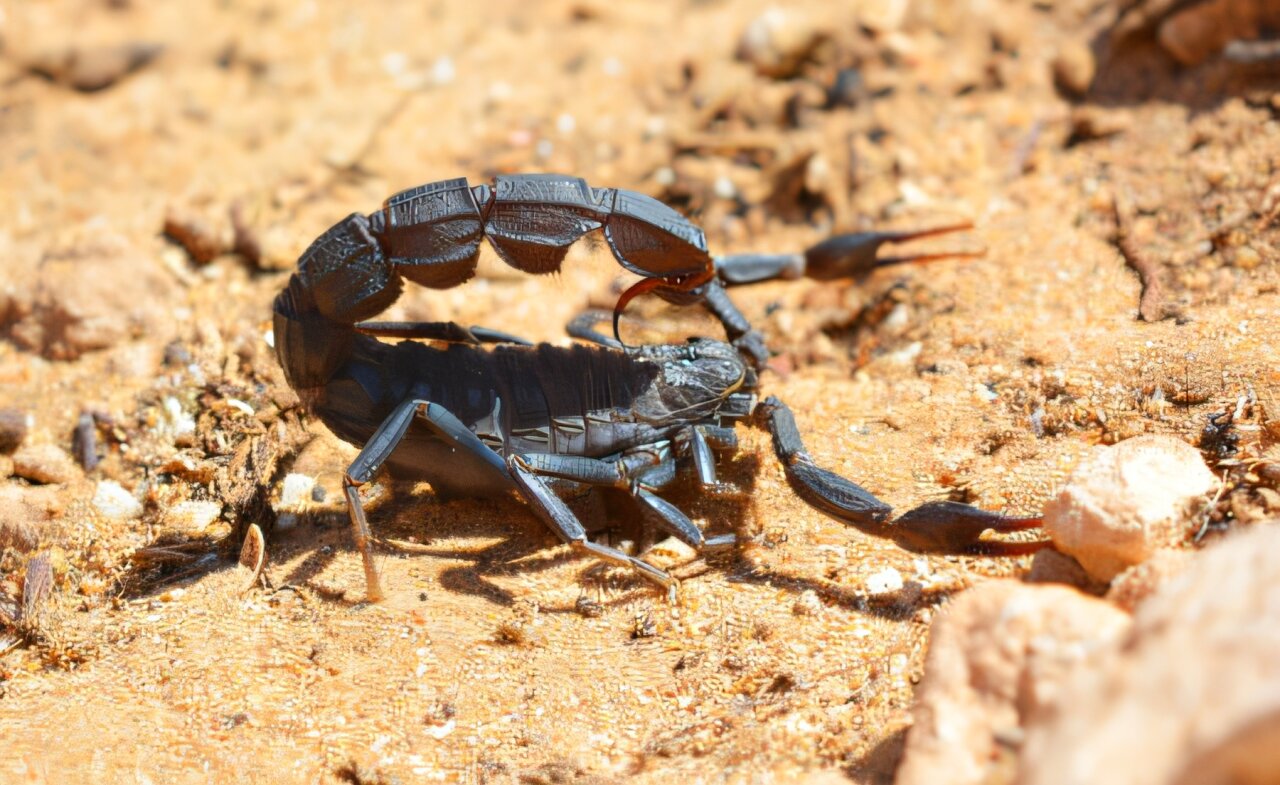
In landscapes where human footsteps cross dusty ground and heat shimmers across the horizon, danger often hides in places no one thinks to examine closely. Beneath stones, within cracks of dry earth, and in the subtle chemistry of soil itself, some of the world’s most dangerous scorpions quietly choose where to live.
For decades, their presence has felt unpredictable—appearing suddenly, striking unexpectedly, leaving communities wondering why certain places seem cursed by repeated stings while others remain untouched. Now, an international team of scientists has revealed something extraordinary. The distribution of lethal scorpions is not random at all. It follows environmental patterns that can be mapped, modeled, and even predicted.
Their discovery transforms an ancient fear into something measurable. The ground itself holds clues about where venom thrives.
Where the Ground Tells a Story
The researchers set out to understand what determines where venomous scorpions live. They combined real-world field observations with powerful computer modeling, searching for environmental signals that shape the hidden geography of risk.
Their findings revealed a surprisingly strong pattern. The most important factor guiding where many scorpions settle is soil type. The very composition of the earth—its texture, structure, and physical properties—largely determines where these arachnids establish their habitats.

But soil is not the only force shaping their distribution. Temperature also plays a crucial role, especially for certain species. Both the average temperature and the seasonal variation influence where some scorpions can survive. In other words, it is not simply how hot a place gets, but how its climate changes over time that helps determine which species can endure there.
Yet the story grows more complex. Not all scorpions respond to the environment in the same way. Some species show remarkable flexibility, spreading widely across varied conditions. Others live within narrow ecological boundaries, appearing only where specific environmental requirements are met. These specialized species create highly localized risk zones, areas where danger concentrates intensely but unevenly.
This variation helps explain why scorpion stings often cluster in certain regions while nearby areas remain comparatively safe. The pattern is ecological—but until now, it has been largely invisible.
A Landscape Marked by Stings
The research focused on Morocco, particularly its central region, which stands among the most severe global hotspots for scorpion stings. Here, encounters between humans and venomous species are not rare accidents. They are recurring public health emergencies.
Every year around the world, more than two million people are stung by scorpions. Most survive with pain and swelling. But for some victims—especially children and older adults—the venom can trigger severe illness or death. Globally, scorpion stings are estimated to claim the lives of more than 3,000 children annually.
Despite the availability of antivenoms for several species, treatment is often complicated by a critical problem: doctors frequently cannot identify which scorpion caused the sting. Without knowing the species, medical teams struggle to deliver the most effective therapy quickly.
Understanding where dangerous species are most likely to occur could transform that uncertainty into preparedness. It could allow communities to anticipate risk instead of reacting to tragedy.
Mapping the Invisible with Mathematics
To reveal the environmental patterns shaping scorpion distribution, scientists turned to a sophisticated computer-mapping method known as Maximum Entropy. This modeling approach uses environmental data—such as soil characteristics and temperature patterns—to estimate where species are most likely to occur.
By feeding the model with field observations from Africa and combining them with globally available environmental datasets, the researchers created predictive maps of where dangerous scorpions could thrive.
What emerged was not just a description of existing hotspots, but a tool capable of identifying new ones—even in regions where detailed biological records are scarce. The model can highlight potential danger zones across tropical regions worldwide, from Brazil to the Middle East and India.
The implications are profound. Instead of waiting for sting incidents to reveal risk, scientists and health authorities can now predict where danger is likely to emerge.
Science Without Borders
This research represents the combined effort of scientists working across continents. The study was conducted by an international collaboration led by the University of Galway in partnership with the University Ibn Zohr. Their findings were published in Environmental Research Communications.
Among the leading voices behind the work is Dr. Michel Dugon, head of the Venom Systems Lab at the Irish university. He describes the findings in stark, human terms: identifying where dangerous scorpions appear could help save lives.
By mapping high-risk areas, health authorities can focus awareness campaigns, improve medical training, and direct prevention efforts precisely where they are needed most. Communities can be warned before patterns of injury emerge. Medical workers can prepare before emergencies arrive.
Most importantly, vulnerable populations—especially children—can be better protected.
The Power of Ecological Knowledge
The research also highlights something deeper about the relationship between biodiversity and human health. According to Fouad Salhi, a doctoral researcher at the Moroccan university and first author of the study, ecological data can directly shape public health policy.
By combining long-term fieldwork with advanced ecological modeling, the team demonstrated how understanding species distribution can guide prevention strategies and medical preparedness. The goal is not simply academic knowledge, but real-world impact.
The researchers emphasize that progress requires collaboration across many disciplines. Public health specialists, clinicians, zoologists, and local communities all play essential roles in understanding scorpions, their venom, and the best ways to respond to stings.
Even today, scientists acknowledge that much remains unknown about scorpion ecology, venom biology, and optimal treatment strategies. The work is only beginning.
A Hidden Crisis Comes into Focus
Scorpion stings represent what researchers describe as a hidden global public health crisis, particularly across tropical and subtropical regions. The danger often goes underreported, overshadowed by more visible health threats. Yet millions are affected every year.
What makes the new research remarkable is that it does not merely document harm—it reveals structure. It shows that scorpion risk follows environmental rules that can be measured and predicted.
The ground beneath our feet is not neutral terrain. It shapes where danger lives.
Why This Discovery Matters
This research changes how humanity can respond to one of nature’s most persistent and overlooked hazards. By identifying the environmental conditions that allow dangerous scorpions to thrive, scientists have created a way to anticipate risk instead of reacting to it.
Predictive mapping means health authorities can focus prevention efforts where they matter most. Medical teams can prepare for specific threats. Communities can be informed before encounters occur. Researchers can design better diagnostic tools and more effective antivenoms by understanding which species dominate particular regions.
In practical terms, this knowledge could reduce injuries, improve treatment outcomes, and save lives—especially among children, who face the greatest risk from severe envenomation.
More broadly, the work demonstrates the power of combining field ecology, data modeling, and international collaboration to address urgent health challenges. It reveals that understanding biodiversity is not only about conserving nature. It is also about protecting human life.
The discovery reframes scorpions not as unpredictable killers, but as creatures bound by environmental logic. Once that logic becomes visible, prevention becomes possible.
And in regions where venom has long struck without warning, prediction may be the first step toward safety.
Study Details
Fouad Salhi et al, Ecological niche modelling and distribution of scorpion fauna in central Morocco: a MaxEnt study, Environmental Research Communications (2026). DOI: 10.1088/2515-7620/ae3fef