The scent of history is rarely something we imagine. When we think of ancient mummies, we picture linen wrappings, silent tombs, and the passage of thousands of years. But what if the story of mummification is not only preserved in what we can see—but in what we can smell?
A recent study published in the Journal of Archaeological Science has taken an unusual path into the past. Led by Wanyue Zhao and her colleagues, the research explores how the odors emitted by ancient mummies may carry chemical clues about how they were preserved. By analyzing volatile organic compounds, or VOCs, the team has shown that scent itself can serve as a scientific record—one that reveals how embalming methods changed across centuries and even how different parts of the same body were treated.
This is not simply a study of smell. It is a study of memory, chemistry, and the enduring human desire to preserve the dead.
When Preservation Began as an Accident of Nature
Long before elaborate rituals and carefully prepared embalming mixtures existed, preservation happened by chance. In the early eras of Ancient Egypt, bodies placed in scorching desert sand naturally dried out, becoming preserved through the environment itself. These early preserved remains date back to the Pre-Dynastic period, when mummification was not yet a deliberate practice but an outcome of burial conditions.
Over time, however, preservation became intentional. Embalming evolved into a carefully controlled process, sustained for more than 2000 years. Substances such as vegetable oils, animal fats, beeswax, bitumen, and various resins were applied to bodies. Each of these materials contains distinctive biomarkers, chemical traces that allow researchers to identify what was used long after the original substances have transformed.
Traditionally, scientists have relied on solvent extraction combined with techniques like gas chromatography/mass spectrometry (GC/MS) and pyrolysis-GC/MS to detect these biomarkers. These methods are powerful—but slow and complex. The process of isolating compounds from ancient remains can take significant time and careful preparation.
The research team began to wonder whether there might be another path—one that started not in the laboratory, but in the air surrounding the mummies themselves.
The Moment When Smell Became a Scientific Question
Anyone who has stood close to a mummy has noticed something striking: they have a powerful scent. This odor is not random. It is distinct, persistent, and often surprisingly intense. For Zhao and her colleagues, this observation sparked a simple but profound idea.
If embalming materials have known chemical compositions, and if mummies release volatile compounds into the air, then perhaps those airborne molecules reflect the substances used in preservation. The smell, in other words, might be chemically meaningful.
Rather than replacing traditional analytical methods, the researchers aimed to extend them. They sought to determine whether the sensory experience of encountering a mummy could be translated into measurable chemical data. Could odor become evidence? Could the chemistry of smell reveal the hidden recipe of embalming?
To answer these questions, they needed a wide range of samples—and a timeline stretching across the full history of mummification.
Gathering Voices from Thousands of Years
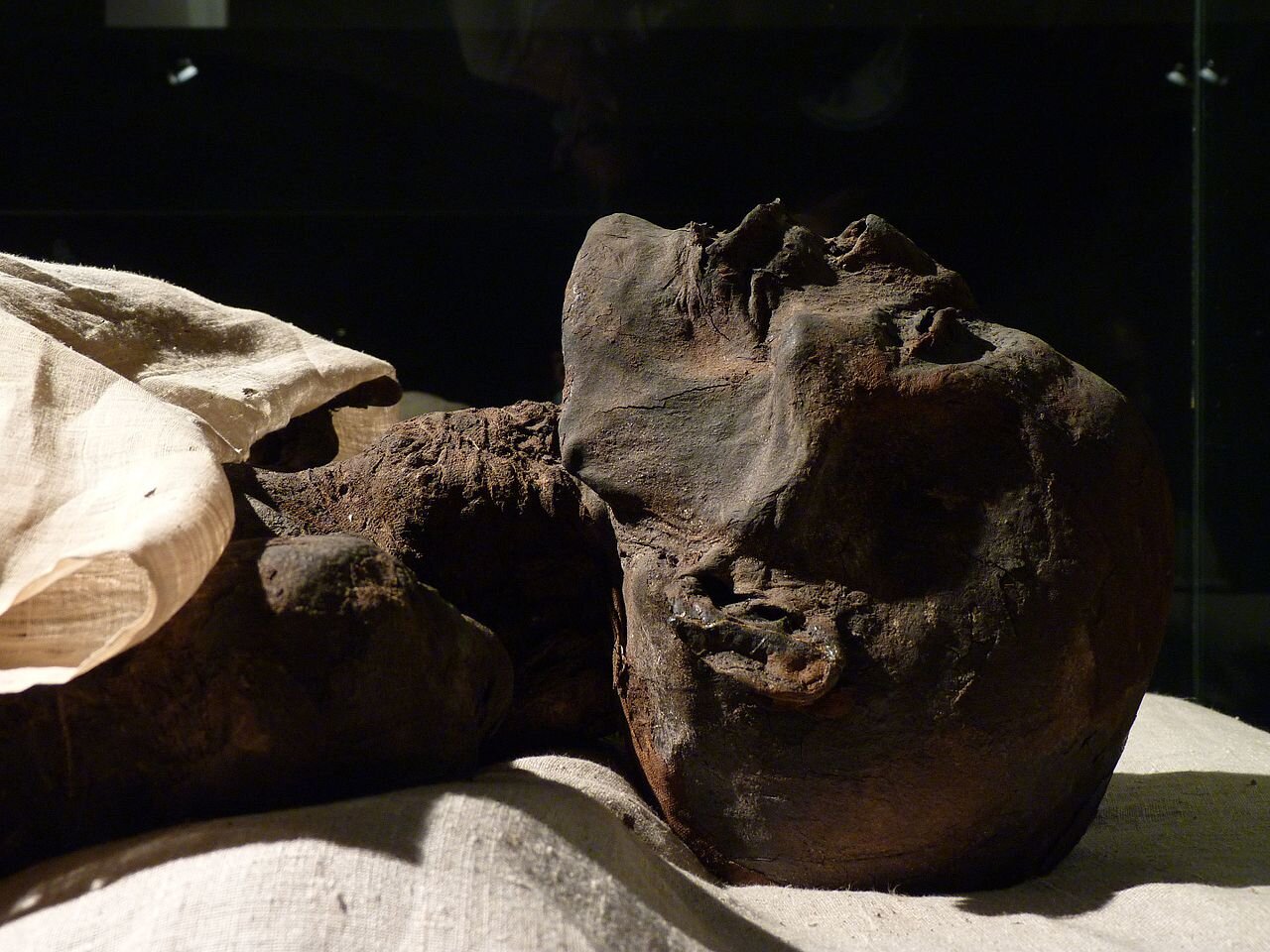
The research team examined 35 samples from 19 mummies, dating from approximately 2000 BC to 295 AD. This range spans nearly the entire known period of Egyptian mummification practices, allowing the scientists to track changes over time.
By analyzing the volatile compounds released from these remains, the researchers identified patterns that mirror historical shifts in embalming techniques. Early mummies from the Pre-Dynastic and Old Kingdom periods relied almost entirely on simple fat and oil compounds. These substances formed the foundation of early preservation efforts.
As time passed, however, embalming grew increasingly sophisticated. Later mummies—spanning the New Kingdom, Ptolemaic, and Graeco-Roman periods—contained far more complex mixtures. Their chemical signatures revealed the presence of beeswax, conifer resins, and bitumen, materials associated with more elaborate and refined preservation practices.
The scents rising from these ancient remains thus trace a timeline of technological and cultural development. They reveal that embalming was not static. It evolved, becoming more intricate and chemically diverse over centuries.
But the most intriguing discoveries did not come from broad historical trends. They emerged from unexpected details hidden within individual samples.
A Mystery Inside the Simplest Recipes
One surprising finding emerged from samples believed to contain only fat and oil. These should have been chemically straightforward. Yet the researchers detected abundant aromatic volatile compounds—molecules that produce strong scents and typically appear only in small quantities in traditional chemical extracts.
Their presence raises a fascinating puzzle. Where did these aromatic compounds originate?
They might come from plant-based materials used during embalming. But they could also derive from entirely different sources, such as the bandage materials wrapped around the body or even from wooden coffins that slowly degraded over time. Chemical interactions across centuries may have produced new compounds or altered existing ones.
This uncertainty highlights a key strength of VOC analysis: it captures not only original embalming substances but also the complex environmental history of the mummy. The scent reflects layers of time, material, and transformation.
It is not simply a chemical fingerprint of embalming—it is a record of everything that happened afterward as well.
The Body Is Not Chemically Uniform
Another remarkable discovery emerged when researchers compared different parts of the same mummy. Even when samples came from individuals who lived in the same period, different body regions displayed distinct volatile compound signatures.
This suggests that preservation was not always applied uniformly.
Some tissues may have received different embalming substances, possibly for practical reasons or symbolic ones. At the same time, the body itself is not chemically consistent. Variations in tissue type, degradation, and preservation conditions influence how compounds are absorbed, retained, and released.
A limb might preserve volatile molecules differently than the torso. Internal tissues may respond differently to embalming than external surfaces. Over centuries, these variations become chemically visible through the compounds that continue to evaporate into the air.
With a larger dataset, the researchers believe it may become possible to determine whether these differences reflect intentional treatment, natural preservation processes, or a combination of both.
Smell as a New Tool for Archaeology
The findings demonstrate that VOC analysis can complement traditional solvent-based methods. Rather than replacing established techniques, scent analysis offers a new layer of insight—one that is immediate, non-destructive, and rich in chemical information.
By studying airborne molecules, researchers can explore embalming materials without needing extensive extraction procedures. The method captures both original substances and the complex interactions that have unfolded over centuries.
Looking ahead, Zhao and her team hope to broaden their research to include mummies from other regions and time periods. A larger and more diverse dataset could reveal how volatile profiles vary across geography, chronology, and even characteristics such as age or gender.
With enough data, specific volatile biomarkers might one day help identify where a mummy originated or when it was prepared—based purely on the chemistry of its scent.
Why This Research Matters
This study reshapes how we think about preservation, memory, and the material traces of human history. It shows that the past does not only survive in visible artifacts or chemical residues locked inside tissues. It also persists in the invisible molecules drifting through the air.
By demonstrating that odor can be chemically decoded, the research opens a new sensory dimension in archaeology. Smell becomes evidence. Volatile compounds become historical documents.
More importantly, this work reveals the dynamic nature of mummification itself. Preservation was never a single fixed technique. It was an evolving practice shaped by changing knowledge, materials, and cultural meanings. Through VOC analysis, scientists can now trace that evolution with unprecedented subtlety.
The study also reminds us that human remains are complex systems shaped by time. Every scent released by a mummy reflects layers of intention, environment, and transformation. The chemical signals drifting from these ancient bodies carry stories that have remained hidden for millennia.
In listening to those signals, researchers are not merely analyzing molecules. They are uncovering how past societies cared for their dead, how preservation techniques advanced, and how materials interacted across thousands of years.
The air around a mummy is no longer empty space. It is a living archive—one that science is only just beginning to read.
Study Details
Zhao et al, Volatile compounds reveal the composition of embalming materials used in Egyptian mummification, Journal of Archaeological Science (2026). DOI: 10.1016/j.jas.2026.106490