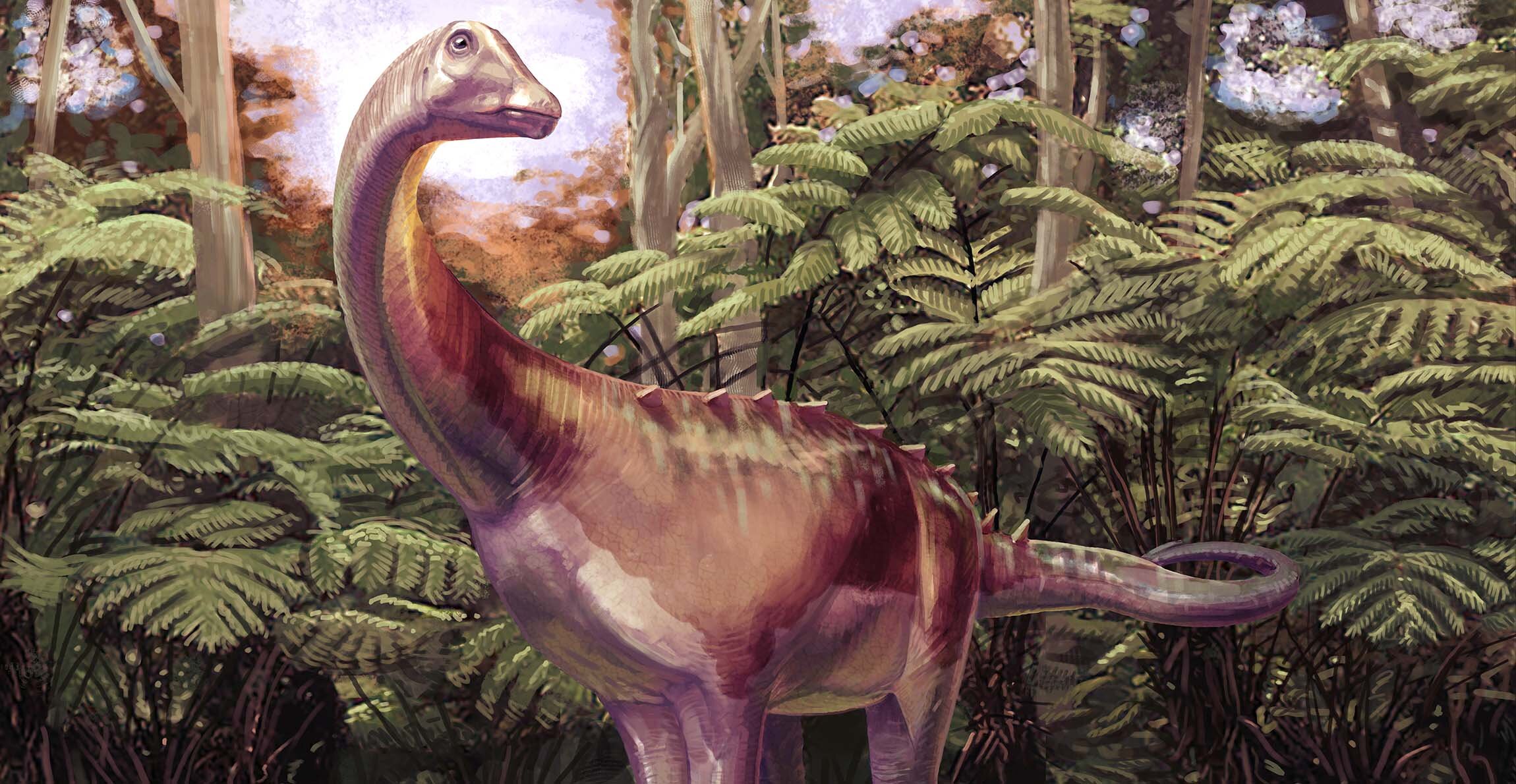
Discovered during a British Antarctic Survey expedition in 1985, the first dinosaur fossil ever found on the Antarctic continent has now been scientifically identified as a titanosaurian sauropod. The fossilized vertebra, preserved in marine rocks dating to about 82 million years ago, provides new evidence that these long-necked dinosaurs inhabited Antarctica’s ancient temperate forests and may have helped connect dinosaur populations across the southern continents.
For nearly four decades, a single fossil bone collected from Antarctica sat in a scientific collection without being recognized for what it truly was. Now, researchers have confirmed that the vertebra represents the first dinosaur fossil ever discovered on the Antarctic continent, marking a milestone in the history of Antarctic paleontology.
The fossil, recovered during a 1985 British Antarctic Survey (BAS) expedition, has been identified as belonging to a titanosaurian sauropod, a group of long-necked plant-eating dinosaurs that included some of the largest land animals ever to exist. The research appears in the journal Acta Palaeontologica Polonica.
A historic discovery recognized decades later
The vertebra was originally collected by Dr. Mike Thomson while leading geological work on the Antarctic Peninsula. The expedition’s primary goal was not to search for dinosaurs but to document rock layers for future geological and paleontological research.
Scientists focused mainly on invertebrate fossils such as ammonites because they are widespread in the fossil record and are valuable for determining the ages of rock formations.
Although Thomson recognized that the fossil belonged to a large reptile, its true identity remained uncertain for many years.
That changed after Dr. Mark Evans, paleontologist and manager of the geological collections and laboratories at the British Antarctic Survey, revisited the specimen.
“When I first spotted this bone in our collections a few years ago, I suspected it was a dinosaur,” Evans said. “After looking at it properly, I thought it was probably a titanosaur tail vertebra.”
He added that Thomson’s original field notes proved remarkably insightful.
“Looking back at Mike’s notebooks, he knew it was a large reptile—so it’s very special to confirm his find 40 years later. We’ve also been able to compare it against dinosaur fossils that have been found since.”
Rare evidence from Earth’s least accessible continent
Antarctica preserves the sparsest dinosaur fossil record of any continent because nearly all of its land surface is buried beneath thick ice. Geological exploration is therefore limited to relatively small areas where rock is naturally exposed.
Most dinosaur discoveries have come from either the Transantarctic Mountains or the Antarctic Peninsula and nearby islands. The newly described vertebra was recovered from shoreline outcrops on the peninsula.
Its geological context makes the fossil especially significant. It is the only dinosaur fossil known from the Santa Marta Formation, a sequence of marine rocks dating to the Late Cretaceous, approximately 82 million years ago.
Because the surrounding rocks formed on the seafloor, researchers conclude that the dinosaur likely died on land before its body drifted out to sea, where the remains eventually settled, were buried, and became fossilized.
A smaller member of a giant dinosaur family
The fossil belongs to Titanosauria, the dinosaur group famous for producing some of the largest animals ever to walk on land. Mature titanosaurs commonly exceeded 15 tons in weight.
This Antarctic individual, however, appears to have been much smaller.
Based on the preserved vertebra, researchers estimate the dinosaur measured only about 6–7 meters (20–23 feet) in length. The relatively modest size suggests it was either a juvenile or possibly belonged to a dwarf species.
Even so, it would have been a long-necked herbivore living in an environment very different from the frozen landscape associated with Antarctica today.
Antarctica was once home to temperate forests
The fossil offers a glimpse of Antarctica during the Late Cretaceous, when the continent supported ecosystems capable of sustaining large plant-eating dinosaurs.
“At first glance, this appears to be an unremarkable fossil, but it holds an important place in the history of Antarctic exploration as the first dinosaur fossil found on the continent,” said Prof. Paul Barrett, merit researcher at the Natural History Museum, London.
He noted that the environment inhabited by this dinosaur bore little resemblance to modern Antarctica.
“At the time this animal lived, we know Antarctica would have been covered in lush temperate forest, providing ample food for large herbivores.”
Barrett also emphasized that the continent’s dinosaur record is likely still incomplete.
“There are likely many more dinosaurs to be discovered on the continent. As climate change causes ice to retreat, we may indeed find further evidence of this past biodiversity.”
Clues to dinosaur movements across Gondwana
Beyond documenting Antarctica’s first dinosaur fossil, the discovery may also help researchers understand how dinosaurs dispersed across the southern continents.
During the Late Cretaceous, Antarctica formed part of the ancient southern landmass known as Gondwana. Despite lying at the South Pole, the continent remained warm because heavy volcanic activity contributed carbon dioxide to Earth’s atmosphere.
Researchers note that no titanosaurs have yet been discovered in Australia, while evidence from New Zealand remains limited. Confirming that titanosaurs lived in Antarctica makes it more plausible that these animals moved through the continent as they spread between connected southern landmasses.
Although the new fossil consists of only a single vertebra, its scientific value extends far beyond its size. It fills an important gap in Antarctica’s sparse dinosaur record while strengthening evidence that titanosaurs inhabited the high southern latitudes during the Late Cretaceous.
The discovery also underscores the enduring importance of museum collections. A bone collected in 1985, carefully preserved and later reexamined with fresh knowledge and additional fossil comparisons, has now secured its place as one of Antarctica’s most historically significant dinosaur finds.