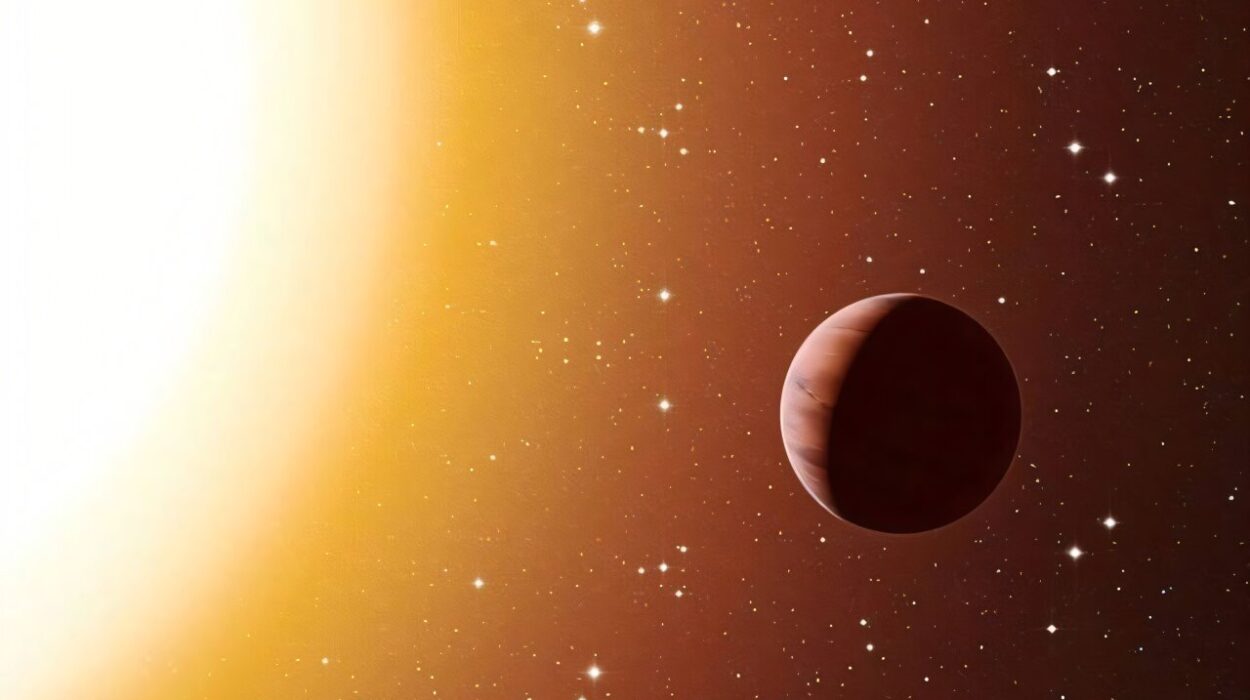
Hidden within years of noisy stellar data, astronomers have uncovered a temperate super-Earth orbiting the nearby red dwarf Ross 318. The newly detected planet, called Ross 318 b, is at least 6.21 times the mass of Earth and sits inside the star’s conservative habitable zone, making it a compelling future target for atmospheric studies with the James Webb Space Telescope (JWST).
For years, Ross 318 appeared to be exactly the kind of star that frustrates planet hunters. The nearby red dwarf is intensely magnetically active, producing signals that can easily mimic or hide the presence of orbiting worlds. But after combining more than a decade of observations from multiple instruments, astronomers managed to separate the star’s chaotic behavior from the subtle gravitational pull of a real planet.
The result is the discovery of Ross 318 b, a temperate super-Earth orbiting one of the Sun’s nearby stellar neighbors.
Magnetic Activity Nearly Hid the Planet From Detection
Ross 318, also known as Gliese 48 or TIC 379084450, lies just 28 light-years from Earth. Classified as an M3.5V red dwarf, the star has an effective temperature of 3,450 K and rotates on a period of roughly 51.5 days.
While nearby red dwarfs are attractive targets in the search for exoplanets, Ross 318 presented a major obstacle. Its strong magnetic activity creates distortions in stellar measurements, especially in radial velocity observations, which astronomers use to detect the tiny motions caused by orbiting planets.
To overcome that challenge, a research team led by Giuseppe Conzo from the Gruppo Astrofili Palidoro (GAP) conducted a detailed re-analysis of archival and modern observations. The study combined data from the CARMENES spectrograph, long-term observations from the High Resolution Echelle Spectrometer (HIRES), and photometric measurements collected by NASA’s Transiting Exoplanet Survey Satellite (TESS).
The researchers analyzed more than 15 years of spectroscopic data to determine whether a genuine planetary signal was hidden beneath the star’s activity.
Planetary Signal Emerges From Years of Data
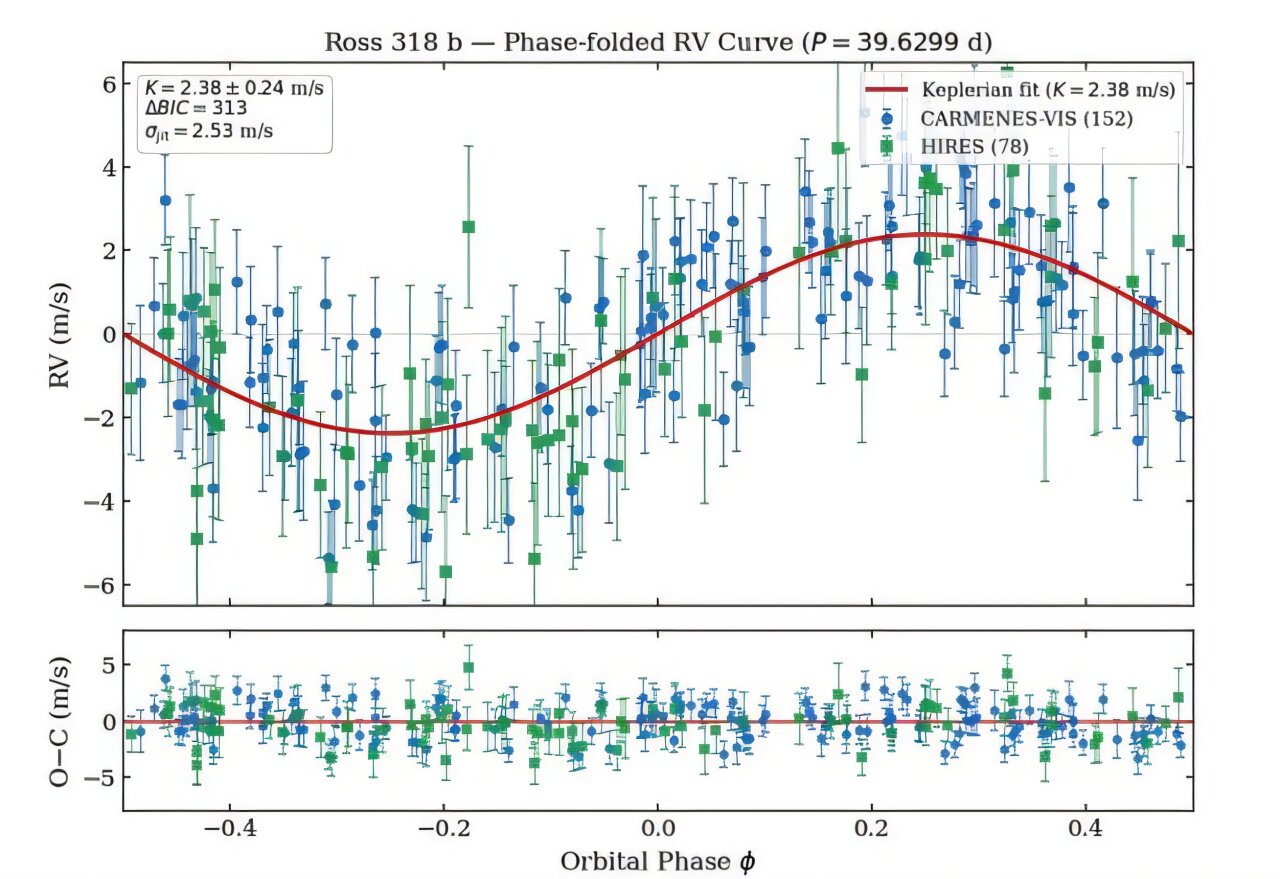
The analysis revealed a repeating signal that could not be explained by stellar activity alone.
Astronomers determined that Ross 318 b completes an orbit around its host star every 39.63 days. The planet orbits at a distance of approximately 0.16 AU from the star.
Based on the observations, the newly discovered world has a minimum mass of 6.21 Earth masses, placing it in the category of super-Earths. Researchers estimate its radius to be around 1.74 Earth radii.
The planet’s equilibrium temperature is estimated at approximately 237 K, giving it a relatively temperate environment compared to many previously discovered rocky exoplanets orbiting red dwarfs.
A Potentially Atmosphere-Rich World
One of the most intriguing aspects of Ross 318 b is the possibility that it could retain a substantial atmosphere.
Because of its orbital characteristics and the relationship between the planet’s orbit and the star’s rotation, the researchers suggest the planet is likely tidally locked. In that scenario, one side of the planet would permanently face the star while the other side would remain in darkness.
Normally, tidal locking can create extreme temperature differences between the day and night sides of a planet. However, the team notes that a thick atmosphere could efficiently redistribute heat across the planet’s surface.
That possibility places Ross 318 b within the star’s conservative habitable zone, a region where conditions may allow relatively stable temperatures.
The scientists describe the planet as one of the more interesting temperate super-Earths for future atmospheric characterization efforts. In particular, they highlight the potential for transmission spectroscopy studies using the James Webb Space Telescope.
Such observations could eventually help researchers determine the composition and structure of the planet’s atmosphere.
Solving the Problem of Stellar Activity
The discovery also demonstrates how astronomers are improving planet-detection techniques around active stars.
Red dwarfs are among the most common stars in the galaxy, but their magnetic behavior often complicates efforts to confirm planets. Starspots and activity cycles can create misleading signals that resemble planetary signatures.
According to the researchers, the Ross 318 b discovery shows how combining multiple observational methods can help resolve those ambiguities.
By integrating high-precision spectroscopy with space-based photometry, the team was able to distinguish the true planetary signal from false signals caused by stellar activity. The researchers say this approach helps mitigate “spot-induced aliases,” a common problem in radial velocity measurements of active M-dwarfs.
The work may therefore improve future searches for temperate rocky worlds orbiting magnetically active stars.
Why This Matters
Ross 318 b stands out not only because it is relatively nearby, but because it was discovered around a star previously considered difficult to study reliably.
The finding suggests that potentially important exoplanets may still be hidden within existing datasets, especially around active red dwarfs that were once viewed as problematic targets.
The planet’s estimated temperature, super-Earth size, and possible atmosphere also make it an appealing candidate for future observations aimed at understanding how temperate rocky worlds evolve around small stars.
Perhaps most importantly, the discovery demonstrates that astronomers are becoming increasingly effective at separating real planetary signals from stellar noise. As those methods continue to improve, more nearby worlds like Ross 318 b could emerge from the data already sitting in astronomical archives.
Study Details
G. Conzo et al, Detection and Characterization of the Temperate Super-Earth Ross 318 b, arXiv (2026). DOI: 10.48550/arxiv.2605.11123