Deep beneath the Pacific Ocean, molten iron in Earth’s outer core unexpectedly reversed direction in 2010, shifting from a slow westward drift to a powerful eastward flow. Satellite missions led by the European Space Agency helped scientists track the dramatic change, revealing that Earth’s deep interior may be far more unstable and dynamic than previously believed.
For decades, scientists thought they had a reasonable understanding of how liquid metal moves inside Earth’s outer core. The enormous layer of swirling molten iron, buried roughly 2,200 kilometers beneath the surface, appeared to follow relatively stable long-term patterns. Then something changed.
In 2010, a massive region of iron-rich fluid beneath the equatorial Pacific abruptly reversed course.
Instead of continuing its usual westward movement, the flow suddenly accelerated eastward. Researchers still do not know exactly why it happened, but newly analyzed satellite and ground-based observations are now offering one of the clearest views yet into the hidden dynamics operating at the center of the planet.
Satellites Revealed a Hidden Shift Deep Inside Earth
The new research, published in the Journal of Studies of Earth’s Deep Interior, examined magnetic field data collected between 1997 and 2025. Scientists combined observations from ground stations with measurements from several satellite missions, including ESA’s Swarm and CryoSat, along with data from the German CHAMP mission and the Ørsted satellite.
These missions allowed researchers to monitor subtle variations in Earth’s magnetic field, which is generated by the movement of electrically conducting molten iron in the outer core.
By studying those changes, scientists reconstructed flow patterns occurring at the boundary between Earth’s core and mantle. That analysis revealed the unexpected Pacific reversal.
The study found that the broad Pacific region switched from moving weakly westward to moving strongly eastward in 2010, challenging earlier assumptions that the outer core behaves in a largely stable and predictable manner over long periods.
Earth’s Magnetic Shield Depends on This Flow
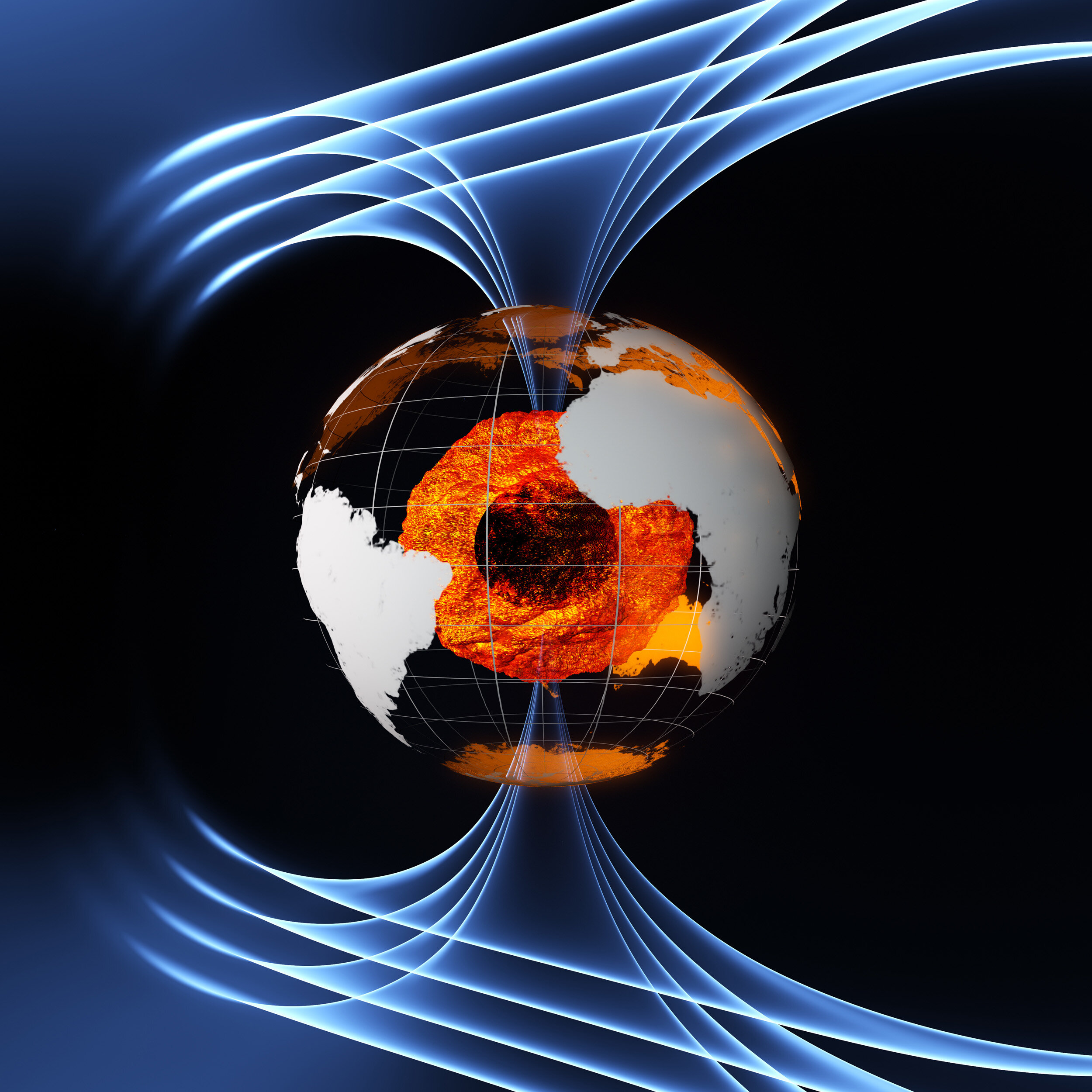
Earth’s magnetic field exists because of constant motion inside the liquid outer core. As molten iron circulates around the solid inner core, it creates the planet’s geodynamo—the process responsible for generating the magnetic field that surrounds Earth.
That magnetic shield plays a critical role in protecting the planet from charged particles streaming from the Sun. Without it, Earth’s atmosphere and technological systems would be far more vulnerable to harmful solar radiation.
Although the newly observed reversal poses no threat to people or the climate, scientists say understanding these internal changes is extremely important.
The magnetic field is constantly evolving. Even gradual changes can influence navigation systems, spacecraft operations, and models used to predict space weather near Earth.
Swarm Satellites Provided Crucial Clues
Launched in 2013, ESA’s three Swarm satellites were designed specifically to map Earth’s magnetic field with exceptional precision. Their highly sensitive magnetometers can separate signals originating deep within the core from magnetic effects produced by the crust, oceans, ionosphere, and magnetosphere.
Because the satellites operate in carefully coordinated orbits, researchers were able to track how magnetic patterns evolved over time.
The observations helped scientists identify not only the Pacific reversal itself, but also later disturbances, including the 2017 geomagnetic jerk, a rapid shift in Earth’s magnetic field behavior.
According to ESA Swarm Mission Manager Anja Stromme, the long-term dataset from Swarm has been especially valuable because it provides continuous global coverage over many years rather than relying solely on scattered ground observatories.
That continuous monitoring allowed researchers to observe how core dynamics changed after the 2010 reversal and follow the evolution of the eastward flow over time.
Scientists Think the Reversal May Already Be Weakening
Lead study author Frederik Dahl Madsen said the sudden reversal raises major new questions about the behavior of Earth’s deep interior.
Researchers are now trying to determine whether the event was a temporary fluctuation, part of a repeating oscillation, or the beginning of a new stable circulation pattern within the core.
Interestingly, the team’s model suggests the strong eastward flow beneath the Pacific has already weakened since around 2020.
The satellite data also revealed rapidly changing flow structures and wave-like accelerations that might have remained undetected in older or noisier datasets. Those findings hint that Earth’s core may undergo far more short-term regional variability than scientists previously recognized.
Frederik Dahl Madsen also noted that the timing of the Pacific flow reversal coincides with changes inferred within Earth’s inner core from geodesy and seismology studies. Researchers now suspect there could be a connection between processes occurring in multiple deep-Earth layers.
Deep Earth May Be More Connected Than Expected
Scientists involved in the study say the findings could reshape how researchers think about interactions between Earth’s outer core, inner core, and lower mantle.
ESA Swarm Mission Scientist Elisabetta Iorfida explained that the Pacific reversal challenges the long-standing idea that westward circulation dominates the outer core in a stable way.
Instead, the study suggests major regional changes can emerge surprisingly quickly—even within a single decade.
That possibility is especially important because the boundary between the core and mantle is considered one of the most critical regions governing deep-Earth dynamics. Understanding how those layers influence one another could help scientists build more accurate models of how Earth’s interior evolves over time.
Why This Matters
The discovery highlights how little scientists still know about the moving metal ocean hidden beneath Earth’s surface. What once appeared to be a relatively stable system may actually be capable of rapid and unexpected reorganizations.
Thanks to long-duration satellite missions like Swarm, researchers can now monitor Earth’s magnetic engine in near real time, capturing subtle changes that were previously invisible. Those observations are becoming increasingly important as scientists work to understand how Earth’s magnetic field evolves and how deep planetary processes remain interconnected.
The Pacific reversal may ultimately prove to be temporary. Or it could signal that Earth’s core operates in a much more variable and complex way than researchers once imagined. Either way, the event has opened a new window into one of the least accessible regions of our planet.
Study Details
Frederik Dahl Madsen et al, Principal component analysis of the 2010 reversal of core-surface flow beneath the Pacific Ocean, Journal of Studies of Earth’s Deep Interior (2026). DOI: 10.46298/jsedi.17268