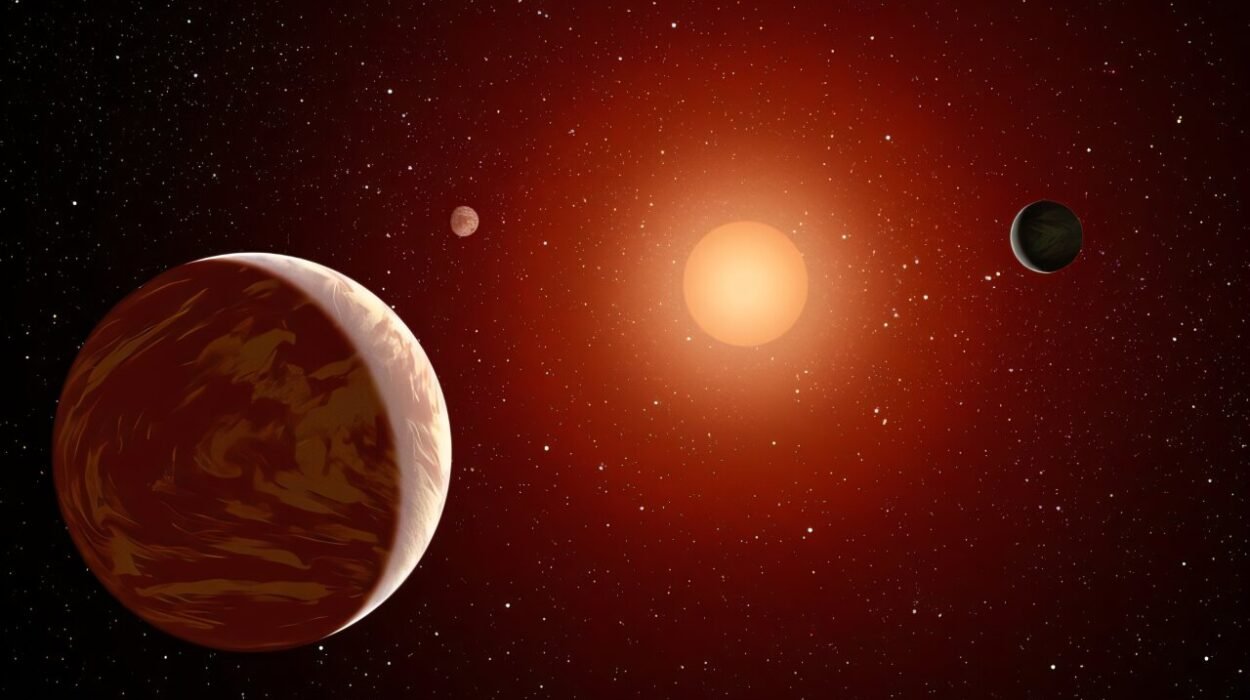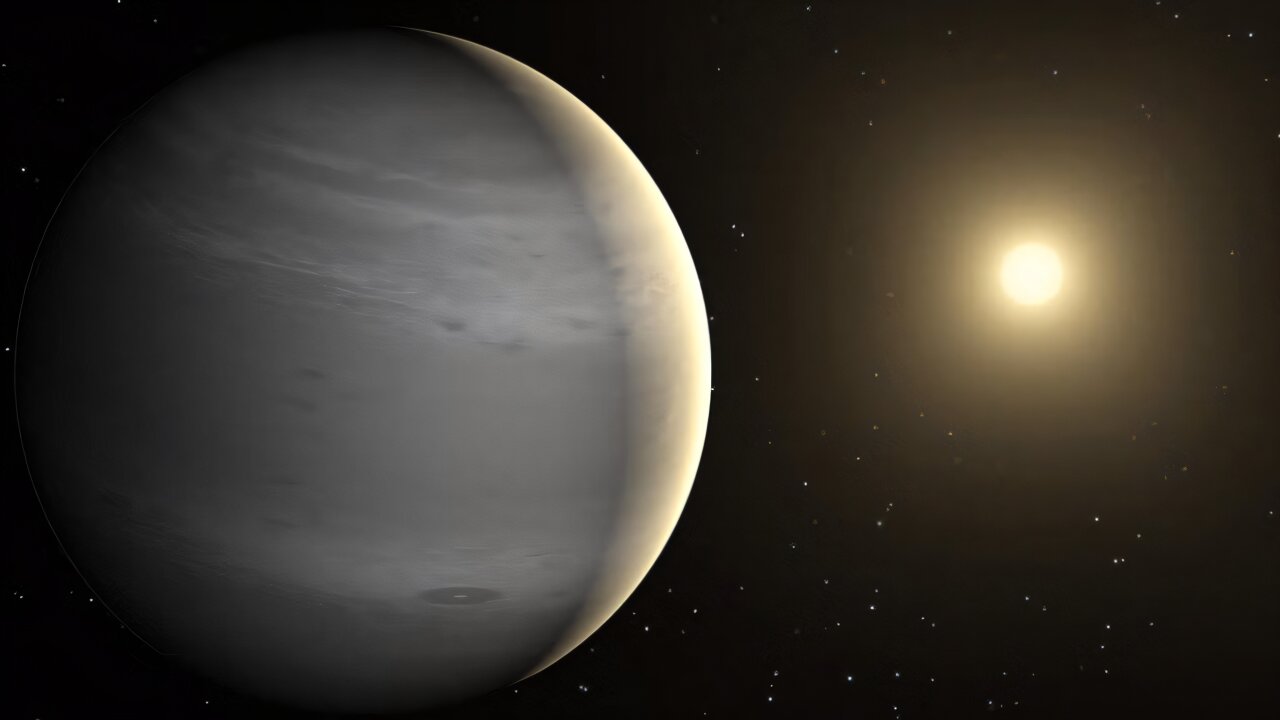
NASA’s James Webb Space Telescope has captured the clearest look yet at the atmosphere of a rare “temperate” giant exoplanet, revealing strong signs of methane and possible traces of ammonia and carbon dioxide. The planet, known as TOI-199b, is roughly the size of Saturn but has temperatures far milder than the blistering “hot Jupiters” typically studied beyond our solar system.
For decades, astronomers have cataloged thousands of planets orbiting distant stars, but most atmospheric studies have focused on worlds that are either scorching hot or deeply frozen. Now, researchers have finally examined the atmosphere of a giant planet that exists in a far more moderate environment — and the findings could reshape how scientists study planetary formation and atmospheric evolution.
The planet at the center of the discovery, TOI-199b, lies more than 330 light-years from Earth and circles its star roughly once every 100 days. While its atmosphere still reaches about 175 degrees Fahrenheit, researchers describe it as unusually temperate compared with many giant exoplanets that can climb to thousands of degrees.
The study, led by scientists from Penn State and NASA’s Jet Propulsion Laboratory, was published in The Astronomical Journal.
Rare Type of Planet Finally Reveals Its Atmosphere
Astronomers have discovered thousands of exoplanets since the first confirmed detection in 1992, but giant planets with relatively moderate temperatures remain uncommon. Even rarer are those positioned perfectly for atmospheric analysis.
According to the research team, TOI-199b is one of only a small number of known temperate giant planets, making it a valuable target for observation.
Renyu Hu explained that studying worlds unlike those in our own solar system allows scientists to test ideas about how planetary systems form and evolve.
Unlike the cold gas giants in our solar system or the intensely heated hot Jupiters orbiting close to their stars, TOI-199b exists in a middle ground that astronomers have rarely been able to explore in detail.
That balance made it an ideal candidate for the powerful instruments aboard the James Webb Space Telescope.
How James Webb Studied the Alien Atmosphere
To uncover what surrounds the planet, researchers relied on a technique called transmission spectroscopy.
As TOI-199b passed in front of its host star, some of the starlight filtered through the planet’s atmosphere before reaching the telescope. Molecules in the atmosphere absorb specific wavelengths of light, leaving behind recognizable patterns — effectively chemical fingerprints.
The telescope observed the system continuously for about 20 hours to establish a baseline measurement of the star’s light. The planetary transit itself lasted roughly seven hours, significantly longer than the brief transits commonly seen with hot Jupiters.
Aaron Bello-Arufe said the telescope separated the starlight into different wavelengths, allowing researchers to compare the baseline observations with the transit data.
That comparison revealed that portions of the light had been absorbed by methane, providing the strongest evidence yet that the atmosphere contains the gas.
Methane Discovery Confirms Longstanding Predictions
The methane signal stood out because scientists had already predicted that temperate gas giants should contain substantial amounts of the molecule.
The new observations provide one of the clearest confirmations so far that those theoretical models are accurate.
Methane is especially difficult to detect in many hotter giant exoplanets because extreme temperatures can destroy or alter it. TOI-199b’s milder conditions appear to preserve the molecule more effectively, giving astronomers a clearer opportunity to study its atmospheric chemistry.
Researchers also found hints that the atmosphere may contain ammonia and carbon dioxide, though additional observations will be needed to confirm their abundance.
The findings represent the first detailed atmospheric analysis of a temperate giant exoplanet, opening a category of worlds that scientists previously struggled to examine.
Scientists Want to Study More Worlds Like TOI-199b
The research team says the discovery is only the beginning.
Future observations could help determine the exact proportions of gases in TOI-199b’s atmosphere, producing a more complete understanding of how these planets develop over time.
Scientists hope that comparing multiple temperate giant planets could reveal whether TOI-199b is unusual or part of a broader class of worlds sharing similar atmospheric properties.
That matters because planetary atmospheres preserve clues about how planets formed, how they evolved, and how chemical systems behave under different conditions.
The researchers also noted that the successful observations demonstrate the growing power of the James Webb Space Telescope to study increasingly diverse exoplanets, not just the easiest and hottest targets.
Why This Matters
The discovery marks an important shift in exoplanet science. Until now, most detailed atmospheric studies focused on giant planets with extreme temperatures that do not resemble conditions found anywhere near Earth.
By analyzing the atmosphere of a more moderate giant planet, astronomers are beginning to bridge the gap between scorching hot Jupiters and the colder gas giants in our own solar system.
The detection of methane in TOI-199b not only confirms key predictions about temperate exoplanets, but also provides new data that could improve models of atmospheric chemistry and planetary evolution. Researchers say those improved models may eventually deepen scientific understanding of how atmospheres — including Earth’s — develop and change over time.
Study Details
Aaron Bello-Arufe et al, Methane on the Temperate Exo-Saturn TOI-199 b, The Astronomical Journal (2026). DOI: 10.3847/1538-3881/ae4fba