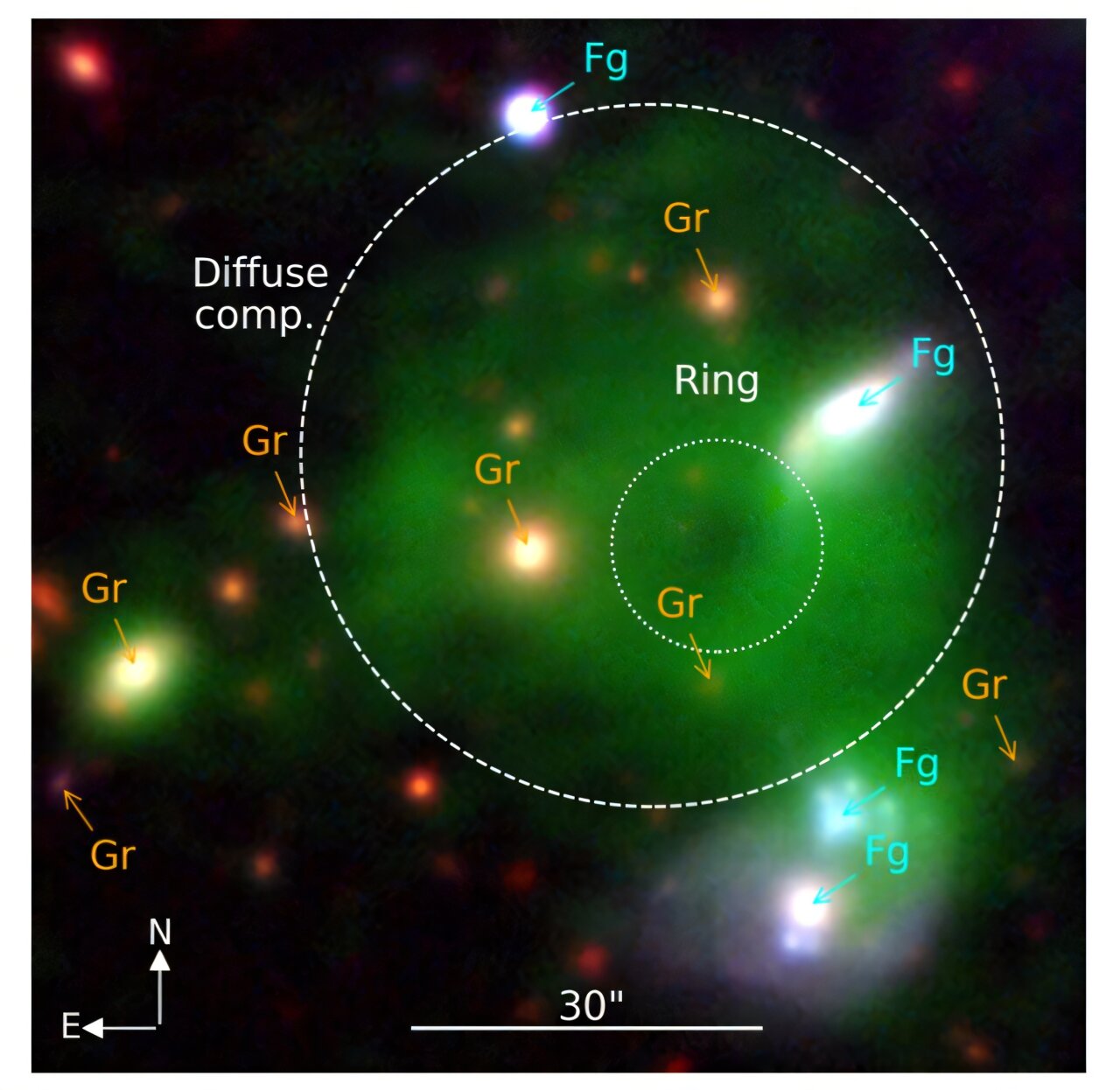
Astronomers may have uncovered the smallest-known example of an “odd radio circle,” a bizarre class of giant cosmic rings visible only in radio waves. The newly identified object, called J1248+4826, breaks several expectations about these mysterious structures and could reveal that many smaller versions have been hiding undetected across the universe.
Something unusual appeared in the radio sky while astronomers combed through survey data from one of the world’s largest radio astronomy projects. What they found was not just another faint radio source, but a compact ring-shaped structure unlike anything previously confirmed.
The object, known as J1248+4826, may belong to the puzzling category of cosmic phenomena called odd radio circles, or ORCs. These enormous radio rings were first reported in 2021 and remain one of astronomy’s biggest unresolved mysteries. Unlike galaxies, stars, or nebulae that shine across multiple wavelengths, ORCs appear only in radio observations, making them exceptionally difficult to study.
Now, researchers led by M. Polletta of INAF say this newly discovered source could dramatically expand what astronomers know about these strange structures.
A Tiny Ring Compared to Other ORCs
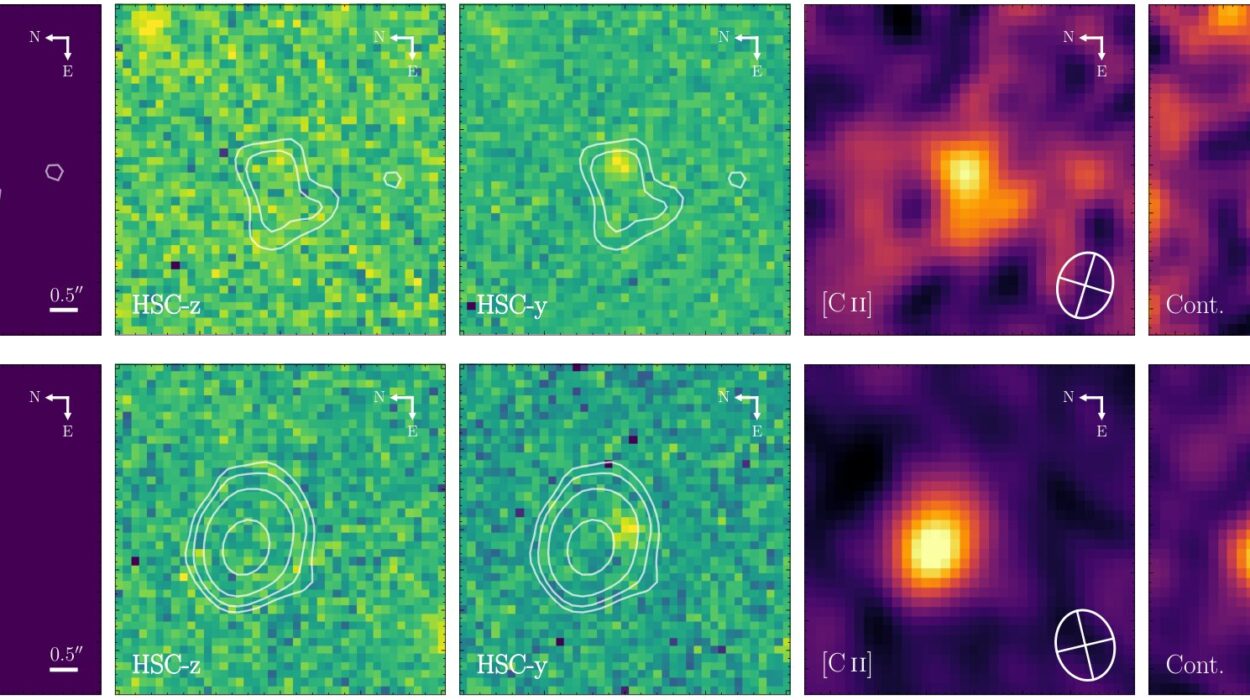
J1248+4826 was identified during an inspection of data from the LOFAR Two Meter Sky Survey, a major radio survey designed to map the universe in unprecedented detail.
What immediately stood out was the ring’s size.
The structure has a radius of only about 9 arcseconds, corresponding to roughly 30 kiloparsecs across physically. Previously known ORCs typically range between 44 and 365 kiloparsecs, making this object far smaller than expected for the class.
Despite its compact dimensions, the source shares many characteristics with known ORCs. It appears as an edge-brightened radio ring surrounded by a faint diffuse envelope extending out to around 100 kiloparsecs. That broader envelope resembles features already seen in other members of the ORC population.
The discovery paper, posted to the arXiv preprint server on May 6, suggests the object could represent the smallest ORC candidate detected so far.
An Odd Radio Circle That Breaks the Rules
The object’s unusual size was not the only surprise.
Most previously identified ORCs contain a massive host galaxy positioned directly at the center of the ring. In J1248+4826, however, the host galaxy sits near the edge of the structure instead.
That offset makes the source difficult to classify cleanly.
Researchers compared the object with several other types of diffuse radio emissions, including radio halos and mini halos, which can sometimes produce similar sizes and brightness levels. But those structures usually become brightest at their centers, while ORCs are known for their bright outer rims.
J1248+4826 fits the ORC pattern more closely than the alternatives, even if it does not fully resemble previously known examples.
Because of its unusual properties, the team says the source could potentially represent an entirely new class of diffuse radio object rather than a standard ORC.
Clues Point to Ancient Radio Plasma
Astronomers also investigated what physical process could have produced the strange ring.
One possibility involved radio lobes, enormous clouds of radio-emitting material launched by energetic jets from galaxies hosting supermassive black holes. Under certain viewing angles, these lobes can appear ring-like.
But the researchers found no sign of a second lobe, weakening that explanation.
They also ruled out the possibility that the structure is powered by an active black hole jet or represents the fading remains of a traditional radio galaxy.
“The absence of ongoing AGN activity in the host, together with the radio morphology and spectral shape of the diffuse emission, disfavor as possible origin of J1248+4826 a currently active radio galaxy or a classical dying radio galaxy,” the researchers wrote.
Instead, the evidence points toward a different scenario involving fossil radio plasma.
According to the study, ancient plasma likely expelled during earlier activity from an active galactic nucleus may have later been re-energized by shock waves generated through galaxy interactions or mergers within the nearby galaxy group.
Researchers suggest that turbulence, galaxy motions, and ongoing dynamical activity inside the group likely helped shape the radio ring into its current form.
Why ORCs Remain So Mysterious
Ever since their discovery, ORCs have resisted simple explanations.
Scientists have proposed several ideas for their origin, including leftover magnetized plasma ejected by supermassive black holes roughly a billion years ago, remnants of intense starburst activity, mergers between galaxy groups, or massive outflows driven by active galactic nuclei.
None of those theories has yet fully explained all observed ORCs.
J1248+4826 adds another layer of complexity because it stretches the category toward much smaller physical scales while also displaying an unusual geometry.
Its discovery hints that astronomers may have been overlooking smaller ORCs simply because they are harder to detect.
If confirmed, the finding would suggest that these mysterious radio rings are more diverse than previously believed.
More Observations Will Be Needed
The researchers stress that much more work is needed before astronomers can fully understand the source.
Future studies involving spectral mapping, polarization measurements, and X-ray observations could help distinguish between competing formation scenarios. Expanding the sample of ORC-like objects will also be essential for determining whether J1248+4826 is truly an odd radio circle or something entirely different.
The team argues that broader surveys across different environments and size ranges may ultimately reveal how these strange radio structures fit into the larger lifecycle of plasma within galaxy systems.
Why This Matters
J1248+4826 could reshape how astronomers think about one of the universe’s most enigmatic radio phenomena.
If the object is confirmed as an ORC, it would show that these structures can exist on far smaller scales than previously known. That possibility suggests many more compact ORCs may be scattered throughout the cosmos, hidden below current detection limits.
More importantly, the discovery offers a rare glimpse into how ancient radio plasma, galaxy interactions, and large-scale cosmic environments may continue evolving long after black hole activity has faded. Each new ORC candidate gives astronomers another opportunity to understand how galaxies shape — and are shaped by — the invisible radio universe surrounding them.
Study Details
M. Polletta et al, A Compact Radio Ring with a Diffuse Envelope in LOFAR: Odd Radio Circle or Distinct Phenomenon?, arXiv (2026). DOI: 10.48550/arxiv.2605.05174