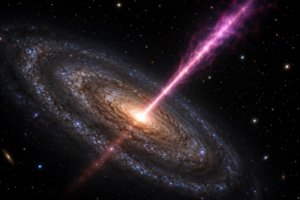
Exceptionally persistent radio emission from the nearby galaxy SDSS J110546.07+145202.4 has revealed a rapidly growing, relatively low-mass black hole behaving in ways usually associated with the early universe. Researchers say the long-lived outburst provides a rare opportunity to investigate how powerful particle jets form and how young black holes grow.
A galaxy located about 1.8 billion light-years from Earth has astonished astronomers by producing an unusually powerful burst of radio emission that has remained bright for more than eight years—far longer than similar events previously observed. The prolonged activity has allowed scientists to examine a rare stage of black hole evolution that is typically seen only in the distant, early universe.
The international research team, led by Stefanie Komossa of the Max Planck Institute for Radio Astronomy (MPIfR), combined new observations with archival data spanning radio wavelengths through high-energy X-rays to investigate the unusual source. Their findings, published in The Astrophysical Journal, suggest that a sustained increase in material falling into the galaxy’s central black hole triggered a powerful particle jet, producing the extraordinary radio emission.
An unusually long-lived radio outburst
Short-lived bursts of radio waves, known as radio transients, are sometimes produced near supermassive black holes at the centers of galaxies. These events arise under extreme physical conditions but typically fade after only days or weeks.
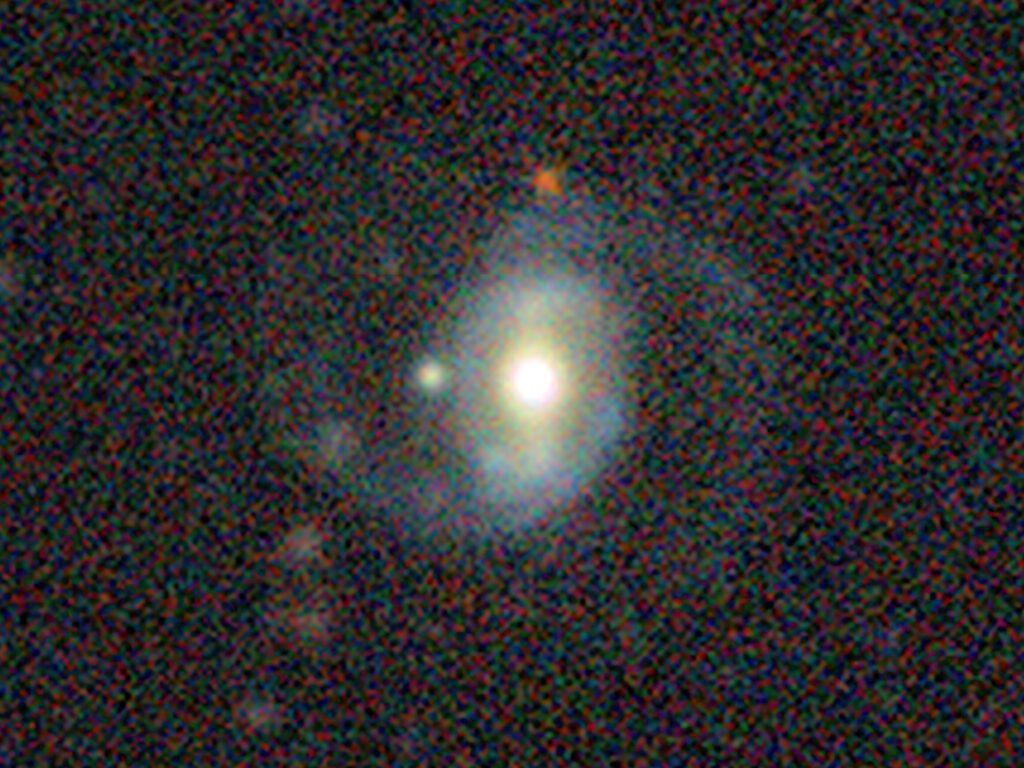
The galaxy SDSS J110546.07+145202.4 breaks that pattern.
Located in the constellation Leo, the spiral galaxy experienced a rapid increase in radio brightness, with its radio emission becoming more than 20 times stronger over a short period. Instead of fading, however, the signal has remained exceptionally bright for more than eight years, reaching an intensity of about 10 quadrillion (10¹⁶) times that of the Sun in the radio part of the spectrum.
“We are dealing with the prototype of a new class of galaxies that undergo rapid changes in radio emission,” said co-author Phil Edwards from Australia’s national science agency, CSIRO.
According to the researchers, no comparable example of such a long-lasting radio-bright state has previously been observed.
A rapidly growing lightweight black hole
The source of the persistent radio emission lies close to the galaxy’s central black hole. Unlike the enormous black holes often associated with powerful radio galaxies, this one has a comparatively low mass while growing at an exceptionally rapid pace through the accretion of surrounding matter.
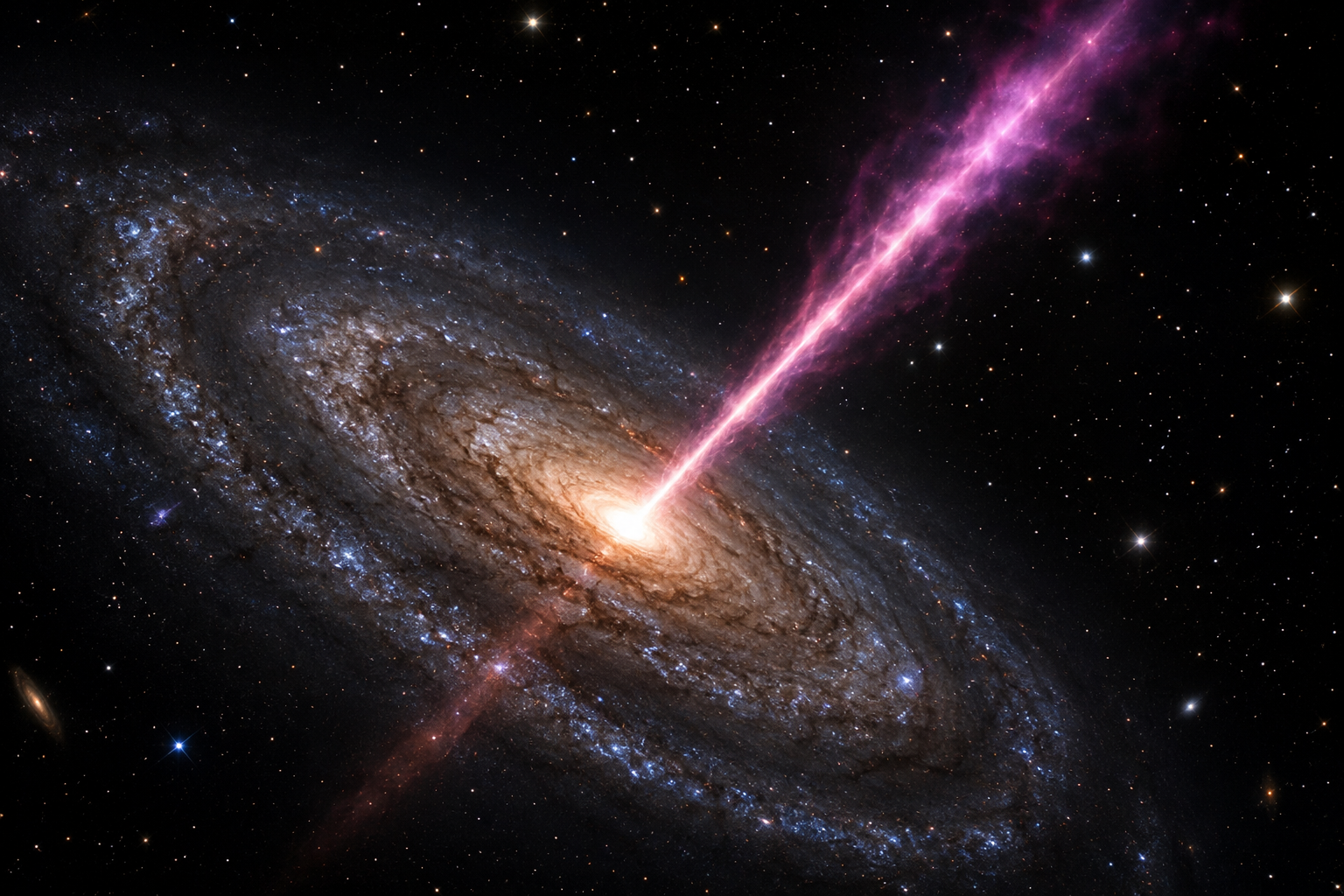
The research team believes that an increased supply of material has been falling into the black hole for several years. That prolonged feeding episode appears to have launched a jet—a narrow stream of particles traveling at nearly the speed of light that generates intense radiation across multiple wavelengths.
Exactly why the black hole began accreting more matter, or why the outburst has persisted for so long, remains uncertain.
“Luminous radio radiation from rapidly growing, lightweight black holes is rare to begin with. Their transition into a long-lasting, radio-bright state has never been observed before,” Komossa said.
The discovery relied on observations from multiple facilities, including the 100-meter radio telescope in Effelsberg, CSIRO’s Australia Telescope Compact Array, and space-based observatories. These combined observations confirmed that the source possesses characteristics unlike previously known radio transients.
“Follow-up observations with numerous telescopes, including the 100-meter radio telescope in Effelsberg, CSIRO’s Australia Telescope Compact Array and satellites in space, confirm the source’s unique properties,” added co-author Alexander Kraus.
A nearby stand-in for the early universe
One reason the discovery is particularly valuable is that the black hole shares characteristics normally expected in galaxies that existed much earlier in cosmic history.
Researchers generally expect central black holes in the early universe to be relatively small but growing rapidly as they accumulate matter. Those distant objects are difficult to study in detail because of their vast distances from Earth.
By contrast, SDSS J110546.07+145202.4 resides in what astronomers describe as our cosmic neighborhood, making it far easier to observe with modern instruments. That proximity allows researchers to investigate physical processes that may resemble those occurring during the universe’s earlier stages while benefiting from much more detailed observations.
The system therefore serves as a local laboratory for exploring how black holes grow and how energetic jets develop under extreme conditions.
Understanding extreme environments
The long-lived outburst offers scientists an opportunity to follow the evolution of a jet over an extended period instead of capturing only its brief beginning or end.
“Such high-energy events can provide astronomers with a wealth of insights. By observing these jets and outbursts, we can study the physical processes in some of the most extreme environments in the universe,” said co-author Kovi Rose from the University of Sydney’s Sydney Institute for Astronomy.
Because the radio emission has shown no sign of weakening, astronomers expect continued observations to reveal additional details about the jet’s structure and behavior over time.
Future observations could uncover more examples
The researchers say upcoming observations with higher-resolution instruments should allow them to map the jet in greater detail and monitor how the radio emission evolves during the coming years.
They point to the Very Long Baseline Array (VLBA) as a tool capable of resolving the jet’s structure, while future facilities such as the SKA telescopes are expected to identify additional long-lived radio transients during large-scale sky surveys.
Finding more objects like SDSS J110546.07+145202.4 could help astronomers determine whether this galaxy represents a unique case or the first recognized example of a broader population of rapidly changing radio galaxies.
“With sensitive facilities like the incoming SKA telescopes, we’ll be able to identify similar radio transients in future sky surveys. This is crucial for filling the gaps in our understanding of the early universe,” Komossa said.
For now, the remarkably persistent radio signal from this nearby galaxy has provided researchers with an unprecedented chance to watch a rapidly growing black hole in action, offering new clues about how powerful jets emerge and how black holes may have evolved during the universe’s earliest epochs.