Every day, hospitals around the world perform thousands of brain scans for routine diagnostic purposes. While these images are typically used to check for immediate physical issues like injuries or tumors, they hold a hidden wealth of data that has largely gone untapped by the scientific community. For years, researchers believed that understanding the subtle structural signatures of mental health disorders required specialized, high-resolution imaging collected under strict laboratory conditions. However, a groundbreaking study from Denmark suggests that the keys to understanding the biological roots of mental health may already be sitting in hospital databases, waiting to be analyzed.
A team of researchers from Copenhagen University Hospital and the University of Copenhagen recently demonstrated that “real-world” clinical scans, even those of lower resolution, can reliably identify brain variations associated with mental health conditions. By bridging the gap between routine medical care and high-level neuroscience, the study marks a shift toward a new era of large-scale psychiatric research. With over 1 billion people globally living with mental health disorders that impact their behavior and daily functioning, the ability to use existing medical infrastructure to study these conditions could accelerate the development of personalized diagnostic tools and treatment plans.
Validating the Biological Signature of Mental Health
The study, published in the journal Molecular Psychiatry, sought to determine if the messy, varied data found in routine clinical settings could match the findings of carefully controlled research studies. Historically, the field has relied on consortia like ENIGMA, which pools high-quality datasets from around the world. While successful, such efforts are often limited by varying inclusion criteria and a lack of comprehensive clinical data. Stefano Cerri and Professor Michael Eriksen Benros, the lead authors of the study, pivoted away from these curated sets to ask if the standard Magnetic Resonance Imaging (MRI) scans collected during daily hospital operations were sufficient to reveal the brain’s structural secrets.
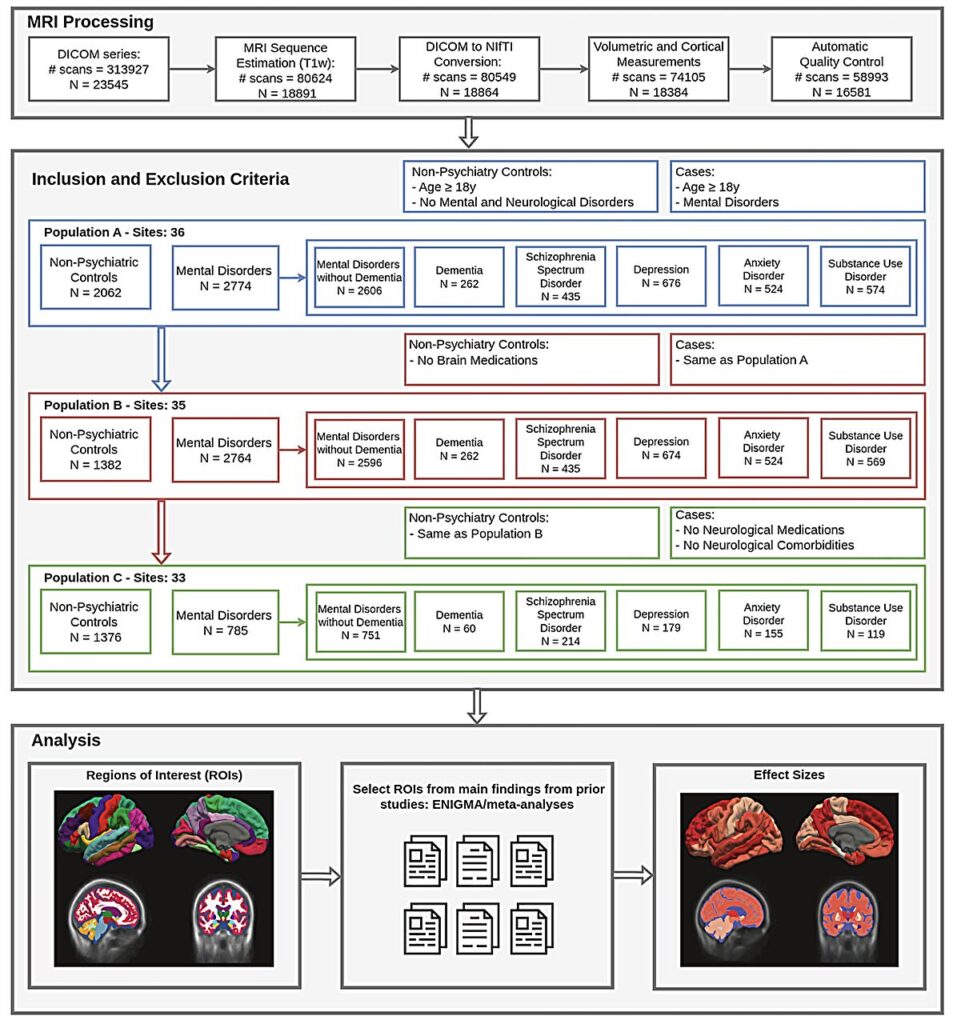
To test this, the team analyzed an massive dataset from the eastern part of Denmark. They utilized the country’s unique electronic health records, which link a patient’s medical history directly to their imaging data. The researchers initially pulled all clinical MRI scans from 2019, eventually narrowing their focus to a group of 4,800 patients who met specific criteria, including those diagnosed with a mental health disorder shortly before or after their scan. By comparing these to a control group with no known psychiatric or neurological conditions, the team could isolate specific structural differences.
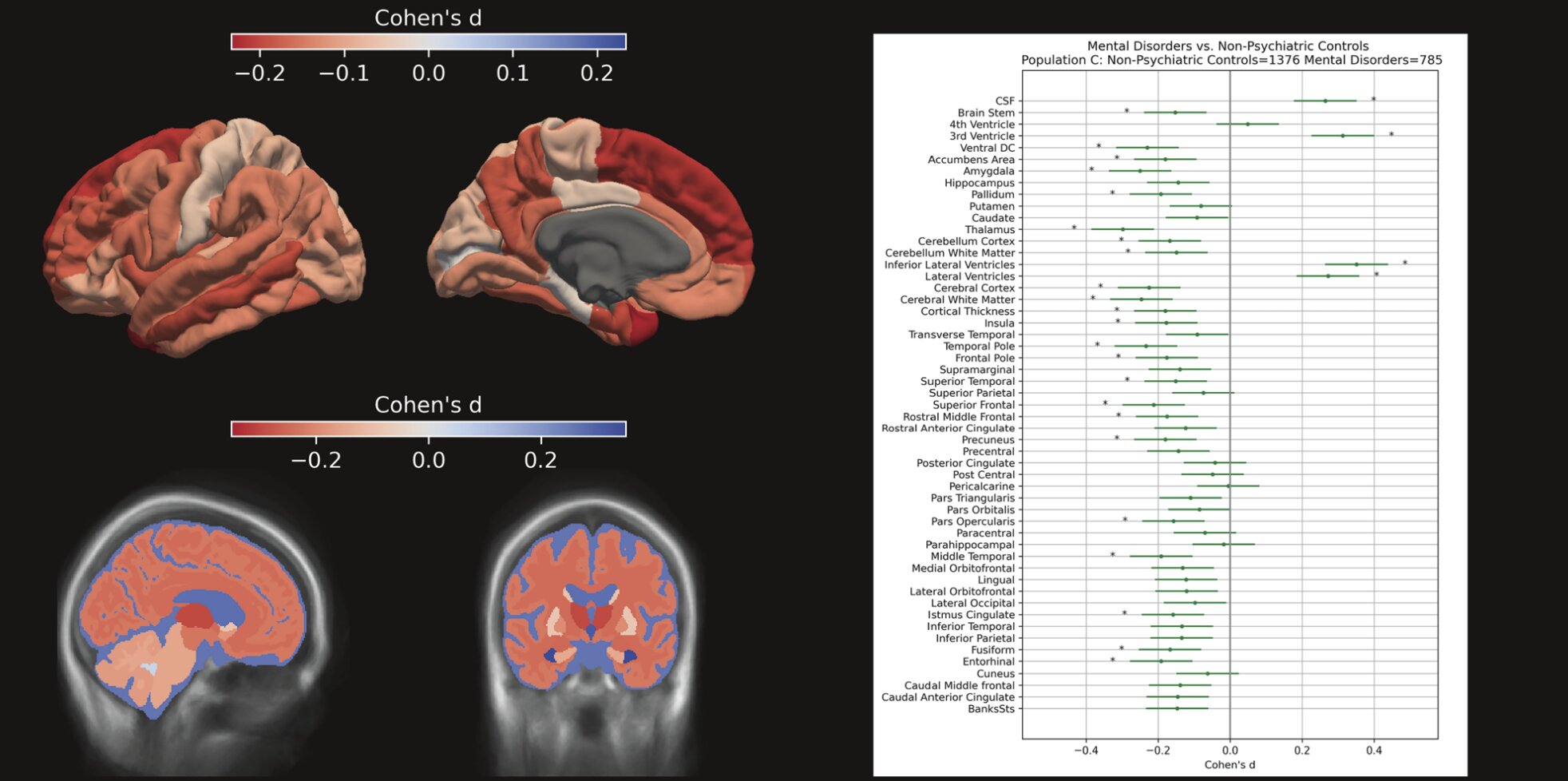
To overcome the technical hurdle of lower-resolution hospital scans, the researchers employed a specialized tool known as recon-all-clinical. This software was designed to process varied clinical images and provide accurate measurements of cortical thickness and the volumes of specific internal brain structures. The results were striking: the “real-world” data mirrored the findings of decades of high-end research. The study confirmed that individuals with severe mental health disorders frequently exhibit a smaller thalamus, a smaller amygdala, larger ventricles (the fluid-filled cavities in the center of the brain), and a thinner cerebral cortex.
From Messy Data to Precise Medicine
The significance of this validation cannot be overstated. It proves that the subtle changes in brain structure associated with mental health are detectable even in the “noisy” environment of a standard hospital scanner. Because these scans are linked to full medical histories, they offer a perspective that traditional research cohorts often lack. Researchers can now begin to investigate how specific variables—such as the duration of an illness, the age of onset, or the cumulative exposure to medications—actually shape the physical structure of the brain over time.
This approach allows scientists to move beyond broad categories and toward a more nuanced understanding of patient subgroups. For example, by analyzing how comorbidities or specific treatment paths influence brain structure, clinicians may eventually be able to use a routine MRI to help determine which medication or therapy is most likely to succeed for a specific individual. This is a foundational step toward precision psychiatry, where treatment is dictated by biological reality rather than trial and error.
The researchers emphasize that this clinical data may actually be more valuable than research-grade data in some respects because it represents the actual patient population that doctors see in their offices every day. While research studies often have strict inclusion criteria that filter out complex cases, hospital records include the full spectrum of human health, providing a more realistic picture of how mental health disorders manifest in the general population.
Mapping the Future of Psychiatric Care
Despite the success of the initial analysis, the research team views this study as only the beginning. The 2019 dataset represents just a fraction of the information available in Danish medical databases, which span many years. The next phase of the research will involve longitudinal analyses, where scientists track the same patients over several years. This would allow them to observe how the brain changes before a diagnosis is even made and how it evolves as a disorder progresses or improves with treatment.
Future studies will also aim to expand the scope of the conditions being analyzed. The initial study had to exclude certain conditions, such as bipolar disorder and attention deficit disorder (ADHD), because the sample sizes for those specific diagnoses in the 2019 data were too small for a robust analysis. By dipping into a larger multi-year database, the team hopes to find the structural patterns associated with a much broader range of mental health conditions.
The ultimate goal is to use these vast amounts of data to train AI-based computational tools. These systems could one day assist doctors by scanning a routine MRI and identifying early signals of a disorder before it fully develops or worsens. By bridging the gap between real-world imaging and clinical trajectories, the medical community can move toward a more biologically grounded approach to mental health.
Why This Matters
This research fundamentally changes the scale at which we can study the human brain. By proving that routine hospital scans are a viable source of scientific insight, it opens up a nearly infinite supply of data that was previously ignored. This move toward using “real-world” data ensures that scientific findings are applicable to actual patients, not just those who participate in controlled studies.
For the 1 billion people affected by mental health conditions, this means the possibility of faster, more accurate diagnoses and treatments that are tailored to their specific brain structure. It shifts psychiatry from a field based largely on observed behavior to one grounded in visible, measurable biological markers, potentially reducing the stigma of mental health and improving the quality of life for millions.
Study Details
Stefano Cerri et al, Cross-disorder comparison of brain structures among 4836 individuals with mental disorders and controls utilizing Danish population-based clinical MRI scans, Molecular Psychiatry (2026). DOI: 10.1038/s41380-026-03577-5.