The transition to a sustainable energy future has always faced a stubborn hurdle: the sun eventually goes down. While modern solar panels are remarkably efficient at converting photons into electricity, they lack an inherent mechanism to store that energy for use during the night or on overcast days. To bridge this gap, researchers have traditionally looked toward bulky external batteries or complex phase-change materials that often suffer from leakage, poor conductivity, or high flammability. Now, a team of scientists in China has looked to one of nature’s oldest building blocks to solve this modern problem. By reengineering the internal architecture of balsa wood, they have created a multifunctional material capable of capturing sunlight, storing it as heat, and later converting it back into electricity on demand.
Redesigning Nature From the Nano to the Micro Scale
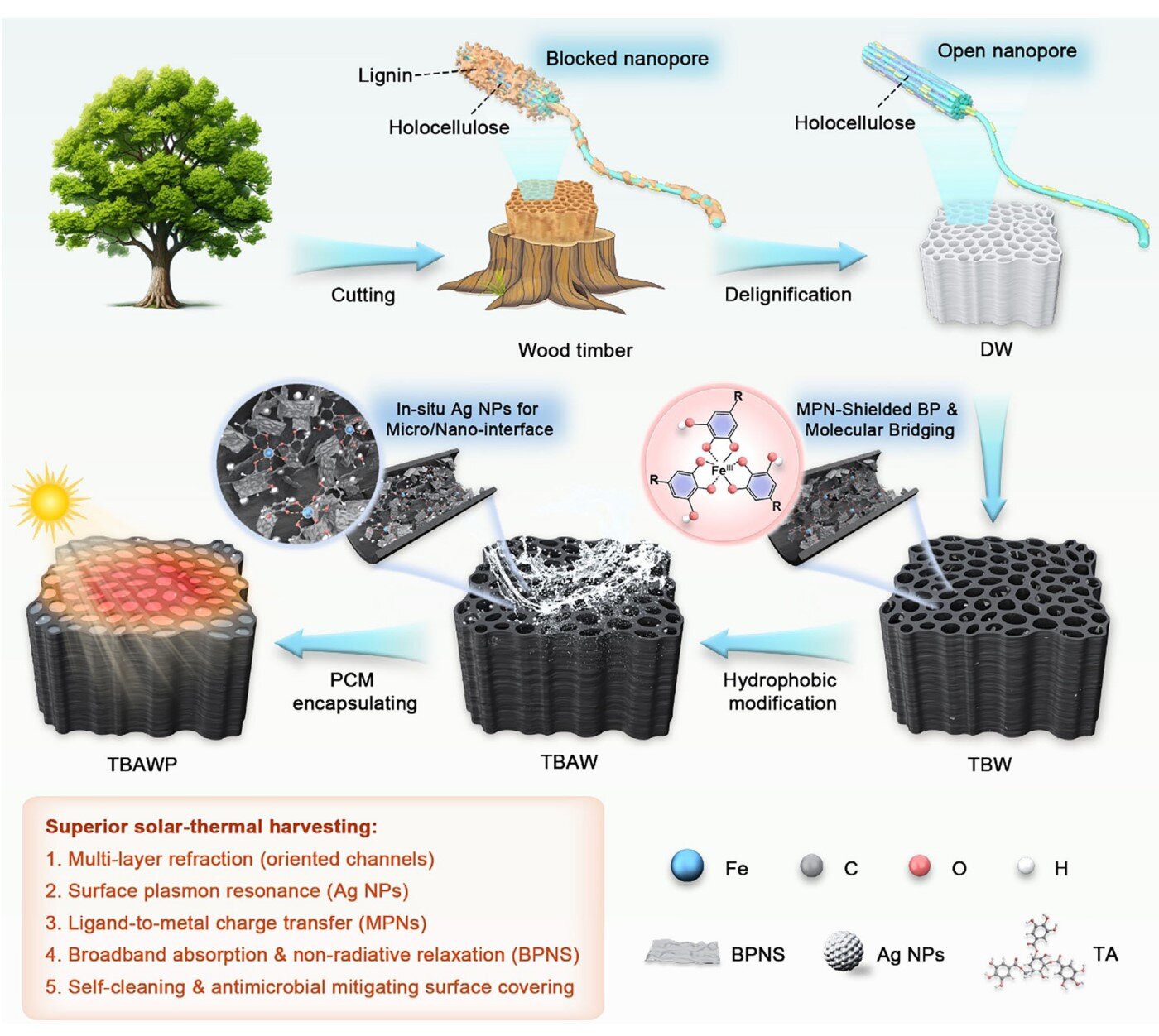
The researchers began their process by essentially stripping wood down to its skeletal form. In its natural state, balsa wood is held together by lignin, a organic polymer that acts as the “glue” for plant fibers. The team systematically removed this lignin, leaving behind a highly porous framework characterized by tiny, open longitudinal channels. This hollowed-out scaffold provided the perfect foundation for a multi-layered chemical overhaul designed to turn the wood into a high-performance energy sponge.
To enable the wood to catch as much sunlight as possible, the scientists coated these internal channels with ultrathin sheets of black phosphorene. This material is prized for its ability to absorb light across multiple wavelengths and convert it directly into heat. Because black phosphorene is notoriously unstable and tends to degrade rapidly when exposed to air, the team applied a secondary protective layer composed of tannic acid and iron ions. This shielding ensures the light-absorbing core remains functional over long periods of exposure.
Enhancing Efficiency With Nanotechnology and Organic Wax
The engineering did not stop at light absorption. To further boost the material’s ability to harvest solar energy, the researchers integrated silver nanoparticles into the structure. These particles act as microscopic enhancers, ensuring that the maximum amount of available sunlight is captured and funneled into the wood’s core. Finally, a water-repellent coating was applied to the entire structure, a critical addition that prevents rot and allows the wood to maintain its integrity in various weather conditions, including high humidity and rain.
Once the balsa wood scaffold was chemically fortified, it was filled with stearic acid, a bio-based phase change material (PCM). This organic wax is the “battery” of the system. When the sun shines on the modified wood, the black phosphorene and silver nanoparticles generate heat, causing the wax to melt and store that energy within its chemical bonds. When the ambient temperature drops or the energy is needed, the wax solidifies, releasing the stored thermal energy. Because the wood’s natural grain facilitates heat travel longitudinally rather than across the surface, the stored energy can be moved quickly and efficiently toward an external device for use.
Measuring the Output of Solar-Thermal Wood
To validate the effectiveness of this bio-composite, the research team subjected the material to rigorous testing within a solar simulator. The results revealed a photothermal efficiency of 91.27%, a figure indicating that nearly all the light striking the wood was successfully converted into usable heat. In terms of storage capacity, the reengineered balsa wood held 175 kilojoules of energy per kilogram, providing a dense medium for thermal retention.
The ultimate test of the material’s utility, however, was its ability to produce electricity. When the team connected the wood to a thermoelectric generator, the release of the stored heat successfully generated a voltage of up to 0.65 volts. While this may seem like a small figure in isolation, it proves the fundamental concept that a wood-based platform can serve as a bridge between solar harvesting and electrical generation, providing power even when the light source has been removed.
Durability Against Fire and Bacteria
Beyond its energy performance, the material had to overcome the inherent vulnerabilities of wood. Standard wood-based phase change materials are often criticized for being fire hazards or prone to biological decay. The researchers addressed these concerns through their hybrid coating, which significantly improved the safety profile of the balsa wood.
Testing showed that the modifications reduced the heat release rate (HRR) by 27.4% and the total heat release (THR) by 31.2% compared to untreated samples. Furthermore, the chemical treatment provided a natural defense against common environmental threats, showing strong resistance to bacteria such as E. coli and S. aureus, as well as various types of fungi. This makes the material not just an energy solution, but a durable outdoor structural component.
Why This Matters
This research represents a significant shift in how we think about building materials and energy infrastructure. By turning an abundant, renewable resource like wood into a sophisticated energy storage device, scientists are moving closer to a world where our homes and cities can harvest and store their own power without relying solely on traditional, resource-intensive batteries.
The scalability of this approach is particularly important. Because it uses a wood-based platform and bio-based waxes, it offers an environmentally friendly alternative to synthetic materials. It addresses the “intermittency problem” of solar energy—the gap between when energy is produced and when it is needed—by providing a way to keep the lights on long after the sun has set. This work provides a clear path forward for a new generation of smart, sustainable materials that do more than just provide shelter; they power our lives.
Study Details
Yang Meng et al, Interface‐Engineered Wood‐Based Composite Phase Change Materials Integrating Superhydrophobic, Flame‐Retardant, and Antimicrobial Properties for Sustainable Solar–Electric Energy Conversion, Advanced Energy Materials (2026). DOI: 10.1002/aenm.70872