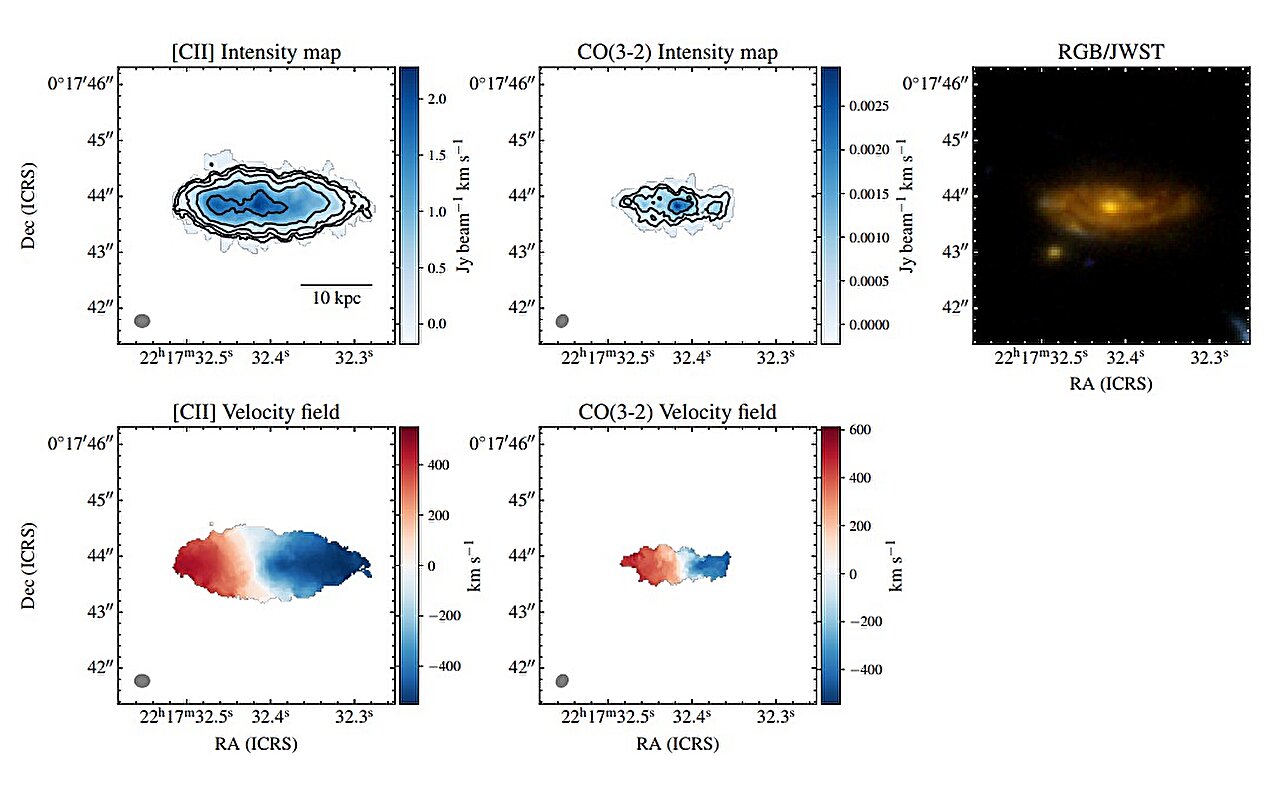
Deep in the early universe, a massive galaxy is spinning with such intensity that it is forcing astronomers to rethink the lifecycle of the most humongous structures in the cosmos. Located in a dense “city” of young galaxies known as the SSA22 proto-cluster, the galaxy ADF22.1 has emerged as a scientific anomaly. While most galaxies of its staggering size from this era are expected to be quiet, rounded collections of aging stars, ADF22.1 is a vibrant, dusty, star-forming disk that looks remarkably like the giants of the modern universe, despite existing billions of years in the past.
A team of European astronomers, led by Francesca Rizzo of the University of Groningen, recently turned two of the world’s most powerful observatories—the James Webb Space Telescope (JWST) and the Atacama Large Millimeter Array (ALMA)—toward this distant object. Their findings, published on the arXiv preprint server, reveal a galaxy that is not just surviving but thriving in a state of “starburst,” churning out new stars at a rate that challenges current models of galactic evolution. By peering back to a redshift of 3.09, the team has captured a snapshot of a “unique laboratory” where the rules of mass accumulation and dark matter interaction are being rewritten in real-time.
A Massive Disk in an Unlikely Era
The sheer scale of ADF22.1 is difficult to wrap the mind around. It boasts an effective radius of approximately 22,800 light years and a stellar mass previously estimated at 100 billion solar masses. In the early universe, galaxies this massive typically transform into “bulge-dominated” systems—dense, spherical clusters of stars that have largely finished their growth. However, ADF22.1 has maintained a distinct disk shape, characterized as a barred spiral galaxy. It is also heavily obscured by cosmic dust, hiding a bright and active galactic nucleus (AGN) fueled by a supermassive black hole at its core.
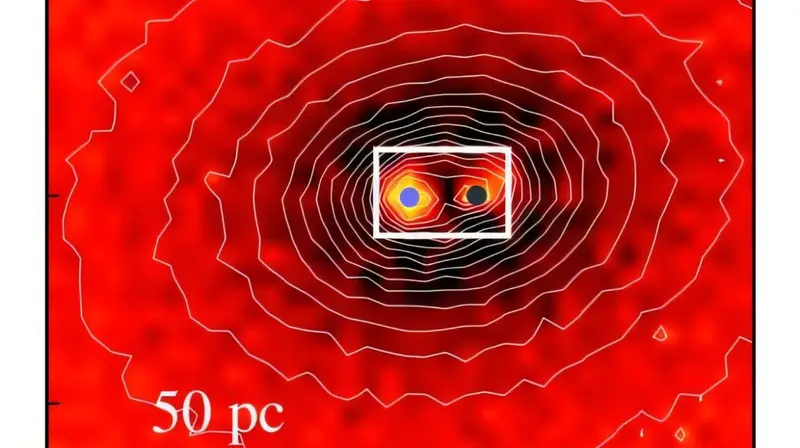
The researchers utilized the high-resolution capabilities of ALMA and JWST to peel back these layers of dust and map the internal movements of the galaxy. By measuring the rotation velocity and the “velocity dispersion”—the random movement of stars and gas—the team was able to perform a rotation-curve decomposition. This technique allows scientists to separate the gravitational influence of visible stars and gas from the invisible pull of dark matter, providing a rare look at the structural skeleton of a galaxy from the dawn of time.
Extreme Speed and Heavyweight Components
The results of these observations confirmed that ADF22.1 is a true cosmic speedster. The study verified that the galaxy reaches an exceptionally high outer rotation velocity of roughly 530 km/s. This velocity is maintained in a “flat” rotation curve that stretches from a radius of 16,000 light-years all the way out to 49,000 light-years. In the world of astrophysics, a flat rotation curve is a telltale sign of a massive dark matter halo providing the gravitational “glue” necessary to keep the galaxy from flying apart at such extreme speeds.
The detailed decomposition revealed that the galaxy is much heavier than previously thought. The astronomers calculated a total halo mass of 7.94 trillion solar masses. Within this massive dark matter envelope sits a stellar mass of 270 billion solar masses and a total baryonic mass—the “normal” matter consisting of gas and stars—of 520 billion solar masses. These figures indicate a stellar-to-halo mass ratio of 0.2, which is unusually high for this stage of the universe’s history. Essentially, ADF22.1 has been incredibly efficient at converting its available gas and dark matter environment into a massive, organized disk of stars.
Building a Giant Through Cold Gas
How did such a massive disk form so quickly without collapsing into a chaotic mess? The researchers suggest that the growth of ADF22.1 wasn’t interrupted by the usual “feedback” loops that typically halt galaxy growth. Often, the energy from a central black hole or exploding stars is enough to blow gas out of a galaxy, effectively starving it of the fuel needed to make new stars. In the case of ADF22.1, these processes were insufficient to expel enough gas to stop the disk’s expansion.
Instead, the team proposes a scenario where cold gas condensed directly out of the hot circumgalactic medium surrounding the galaxy. This could have happened spontaneously or through a “fountain-like” cycle where gas was pushed out by supernova or AGN activity and then fell back down into the disk. This cycle naturally builds a massive, extended disk with high angular momentum—meaning it spins with significant force. Structurally, the researchers found that ADF22.1 is nearly indistinguishable from the giant disk galaxies we see in our “local” neighborhood of the universe today, suggesting that the blueprint for giant galaxies was established much earlier than once believed.
The Final Transformation
Looking ahead, the fate of ADF22.1 appears to be one of two extremes. As it continues to evolve and its star-forming frenzy eventually slows down, it is destined to become an extreme “early-type” galaxy. One possibility is that it will remain a system with unusually high angular momentum, continuing its rapid spin. Alternatively, it could evolve into one of the most massive and extended elliptical galaxies in the local universe. Regardless of its final form, its current state as a starbursting giant provides a rare window into the transition between the chaotic early universe and the structured galaxies we observe today.
Why This Matters
Understanding ADF22.1 is crucial because it challenges the standard timeline of how the universe’s largest structures are built. If a galaxy can reach such a massive size and maintain a complex disk structure so early in cosmic history, it suggests that the “assembly instructions” for galaxies are more flexible than current models account for. By studying the relationship between the supermassive black hole at the center of ADF22.1 and its massive dark matter halo, astronomers can better understand the fundamental forces that dictate how mass accumulates in the cosmos. This research doesn’t just describe one distant galaxy; it helps explain the origins of the most massive systems in existence, providing a clearer picture of how our own corner of the universe came to be.
Study Details
Francesca Rizzo et al, The assembly and fate of a giant disc galaxy in a protocluster at z = 3, arXiv (2026). DOI: 10.48550/arxiv.2604.07440