Late at night, when the lights are off and the world grows still, a familiar glow fills bedrooms across the globe. A phone screen illuminates tired faces as minutes quietly stretch into hours. The intention was simple: check one message, watch one short video, read one update. Yet sleep keeps being postponed, not by obligation or emergency, but by an urge that feels strangely compelling. Many people experience this pattern with a mix of frustration and guilt, asking themselves why it feels so hard to stop scrolling, even when exhaustion is obvious and morning responsibilities loom.
This behavior is often framed as a lack of discipline or a modern bad habit, but that explanation is incomplete and unfair. The real reason you cannot stop scrolling your phone before bed lies deep within your brain’s biology, your evolutionary history, and the carefully engineered digital environments you interact with every day. This nightly struggle is not a personal failure. It is the predictable result of how human brains evolved to seek information, how sleep is regulated, and how modern technology exploits both with remarkable precision.
Understanding this phenomenon requires looking beyond willpower and into the complex interaction between neuroscience, circadian rhythms, emotional regulation, and the design of digital platforms. When these elements converge late at night, they create a perfect psychological trap, one that is especially powerful when you are tired and cognitively vulnerable.
The Brain’s Ancient Hunger for Information
Human brains evolved in environments where information was scarce, valuable, and often essential for survival. Knowing where food could be found, recognizing social cues, or detecting potential threats could mean the difference between life and death. As a result, the brain developed powerful mechanisms to reward information-seeking behavior.
At the center of this system is dopamine, a neurotransmitter often misunderstood as a simple “pleasure chemical.” In reality, dopamine is more accurately described as a signal for motivation and anticipation. It is released not just when we experience something rewarding, but when we expect something rewarding or novel. This system encourages exploration, curiosity, and learning, traits that were deeply adaptive in ancestral environments.
When you scroll through your phone, your brain interprets each swipe as a potential opportunity to encounter new and meaningful information. A message might bring social connection, a video might be entertaining, a headline might reveal something important. Even when the content is trivial, the brain cannot easily distinguish between information that matters and information that merely feels novel. Each scroll becomes a small gamble, and dopamine fuels the urge to keep going.
Variable Rewards and the Power of Uncertainty
One of the most powerful drivers of compulsive scrolling is the structure of rewards embedded in digital platforms. Social media feeds, video recommendations, and notification systems operate on what psychologists call variable reward schedules. This means that rewards appear unpredictably, rather than consistently.
Decades of behavioral science have shown that variable rewards are particularly effective at sustaining behavior. When a reward is uncertain, the brain remains highly engaged, constantly anticipating the next payoff. This mechanism was originally observed in studies of gambling, but it applies just as strongly to digital environments.
Each time you scroll before bed, you might encounter something boring, followed by something amusing, then something emotionally engaging. The unpredictability keeps your brain alert, even when your body is tired. Importantly, this anticipation activates dopamine pathways more strongly than predictable rewards would. As a result, the act of scrolling itself becomes reinforcing, independent of the actual content consumed.
Late at night, when external demands are low and the mind seeks stimulation or distraction, this system becomes especially dominant. The phone offers an endless stream of uncertain rewards, perfectly aligned with the brain’s deepest motivational circuits.
Fatigue and the Collapse of Cognitive Control
Self-control is not an unlimited resource. It relies heavily on the prefrontal cortex, the region of the brain responsible for planning, decision-making, and impulse regulation. Throughout the day, this region works continuously, helping you focus, resist distractions, and manage emotions.
As night approaches, the prefrontal cortex becomes less efficient. Mental fatigue reduces its ability to exert control over more primitive brain systems, including those involved in reward-seeking and emotional reactivity. This shift is not a flaw; it reflects a natural daily rhythm in brain function.
When you are tired, your ability to resist immediate rewards in favor of long-term goals weakens. The intention to sleep competes with the immediate stimulation offered by your phone, and the balance increasingly favors the latter. This is why scrolling often feels effortless at night, even when you know it will make you feel worse the next day.
In this state, decision-making becomes more impulsive. You may repeatedly tell yourself that the next scroll will be the last, yet the neural systems required to enforce that decision are temporarily compromised. What feels like procrastination is, in fact, a neurobiological vulnerability.
Blue Light and the Disruption of Circadian Rhythms
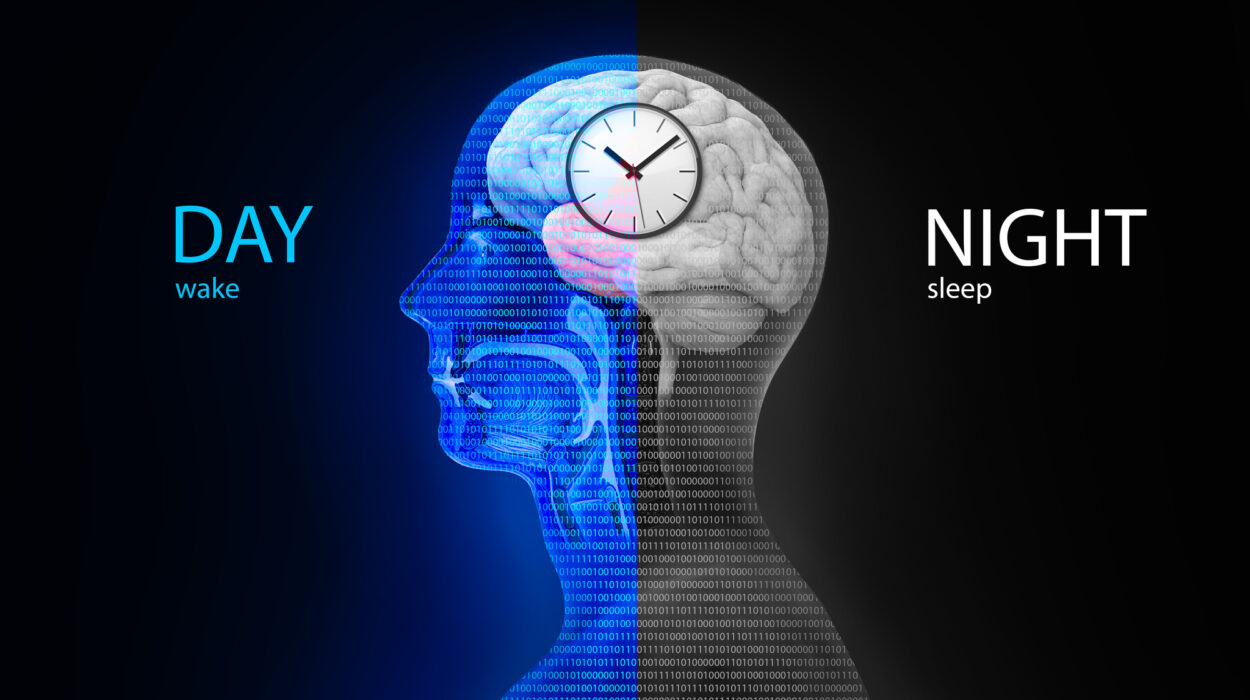
Beyond its psychological appeal, phone use before bed directly interferes with the biological processes that prepare the body for sleep. Central to this process is the circadian rhythm, an internal clock that regulates sleep, hormone release, body temperature, and metabolism over a roughly 24-hour cycle.
One of the most important signals for the circadian rhythm is light, particularly blue-wavelength light. During the day, exposure to blue light from the sun helps maintain alertness and synchronizes the internal clock. At night, the absence of blue light allows the brain to release melatonin, a hormone that promotes sleepiness.
Phone screens emit significant amounts of blue light. When you scroll in bed, this light enters the eyes and sends a signal to the brain that it is still daytime. As a result, melatonin release is suppressed, delaying the onset of sleepiness even further. This creates a feedback loop: the more you scroll, the more alert you become, and the harder it is to stop.
This effect is not merely psychological. Studies have shown that evening exposure to blue light can shift circadian rhythms, reduce sleep quality, and shorten total sleep duration. The brain is being biologically instructed to stay awake, even as physical exhaustion accumulates.
Emotional Regulation and the Need to Wind Down
Many people turn to their phones at night not only for entertainment, but for emotional regulation. The end of the day often brings unresolved thoughts, worries, or social tensions. In the quiet of bedtime, these mental states can become more noticeable and uncomfortable.
Scrolling offers a form of cognitive escape. It occupies attention, dampens self-reflection, and provides a sense of connection or distraction. From the brain’s perspective, this can feel soothing in the short term. Emotional discomfort decreases, replaced by engagement with external stimuli.
However, this relief comes at a cost. The brain does not fully process emotional experiences when they are continuously avoided. Instead, underlying stress may persist beneath the surface, contributing to restless sleep or nighttime awakenings. The phone becomes a tool for postponing emotional processing rather than resolving it.
This dynamic is particularly strong in adolescents and young adults, whose emotional regulation systems are still developing. For them, nighttime scrolling may serve as an important but imperfect coping mechanism for managing daily stressors.
Social Connection and the Fear of Missing Out
Humans are deeply social beings, and the brain is highly sensitive to social information. Acceptance, belonging, and status have always been crucial for survival. In modern digital environments, social cues are transmitted constantly through messages, likes, comments, and updates.
Before bed, social awareness does not simply switch off. Many people experience a subtle anxiety about missing important interactions or being left out of ongoing conversations. This phenomenon, often described as fear of missing out, has a measurable psychological and neurological basis.
Checking the phone reassures the brain that social bonds are intact and that no urgent social threats are present. Each new notification or update briefly satisfies this need. Yet because social interactions are continuous and unending, the reassurance is short-lived. The brain remains on alert, prompting repeated checking.
At night, when physical isolation is more pronounced, the desire for social connection may intensify. The phone offers a portal to social presence, making it difficult to disengage even when sleep is needed.
The Role of Habit Formation and Automatic Behavior
Over time, repeated behaviors become habits, encoded in neural circuits that operate with minimal conscious effort. Habit formation involves the basal ganglia, a set of brain structures that link cues, actions, and rewards into automatic sequences.
If you consistently use your phone in bed, the context itself becomes a cue. Lying down, dimming the lights, or placing your head on the pillow may automatically trigger the urge to scroll. This process occurs largely outside conscious awareness.
Once a habit is established, it no longer requires deliberate decision-making. The brain follows a familiar pattern, conserving cognitive energy. Breaking such a habit requires active intervention, which is particularly difficult when the brain is already fatigued.
This explains why intentions to change nighttime phone use often fail, even when motivation is high. The behavior is no longer fully voluntary; it has become embedded in neural routines optimized for efficiency rather than well-being.
Why Content Feels More Compelling at Night
Many people notice that content seems more absorbing late at night than during the day. This effect is not imagined. Cognitive and emotional states change as the day progresses, altering how information is processed.
At night, analytical thinking tends to decline while emotional sensitivity increases. The brain becomes more receptive to emotionally charged content, such as dramatic stories, humor, or conflict. This makes late-night scrolling feel more intense and engaging.
Additionally, reduced external stimulation amplifies the impact of digital input. In the quiet of the night, a phone screen becomes the primary source of sensory and cognitive engagement. The contrast between darkness and brightness, silence and sound, heightens attention.
These factors combine to make disengagement harder. Content does not merely fill time; it captures the mind in a state that feels immersive and difficult to abandon.
Sleep Pressure Versus Arousal Systems
Sleep is regulated by two interacting processes: sleep pressure, which builds with time spent awake, and circadian arousal, which fluctuates across the day. Ideally, these systems align in the evening, allowing sleepiness to emerge naturally.
Phone use before bed disrupts this alignment. While sleep pressure may be high, cognitive and emotional arousal are artificially elevated. The brain receives conflicting signals: the body is tired, but the mind is stimulated.
This mismatch creates a state of restless wakefulness. You may feel exhausted yet unable to sleep, prompting further scrolling to pass the time. Unfortunately, this only intensifies the problem by maintaining arousal and delaying rest.
Over time, this pattern can weaken the association between bed and sleep, making insomnia more likely. The brain learns to associate the bedroom with stimulation rather than relaxation.
The Long-Term Consequences of Nighttime Scrolling
Chronic sleep disruption has far-reaching effects on physical health, mental well-being, and cognitive performance. Insufficient or poor-quality sleep impairs memory consolidation, emotional regulation, immune function, and metabolic balance.
Nighttime scrolling contributes to sleep deprivation not only by delaying bedtime, but by fragmenting sleep and reducing its restorative quality. Even when total sleep time appears adequate, altered circadian timing and increased nighttime arousal can diminish the benefits of rest.
Over months and years, this pattern may increase vulnerability to anxiety, depression, attention difficulties, and metabolic disorders. Importantly, these outcomes are not the result of phone use alone, but of its interaction with sleep, stress, and lifestyle factors.
Understanding these risks does not mean demonizing technology. Rather, it highlights the importance of aligning digital habits with biological needs.
Reframing the Struggle With Compassion and Insight
The inability to stop scrolling before bed is often framed as a moral weakness or a failure of self-discipline. This narrative ignores the powerful neurobiological and psychological forces at play. When the brain is tired, emotionally sensitive, and exposed to highly stimulating digital environments, resistance becomes genuinely difficult.
Recognizing this reality allows for a more compassionate and effective response. Instead of blaming oneself, it becomes possible to see nighttime scrolling as a predictable outcome of modern life colliding with ancient neural systems.
Physics teaches us that systems behave according to underlying laws, and biology is no different. The brain follows principles shaped by evolution, chemistry, and experience. When conditions favor scrolling, scrolling occurs.
Understanding the Real Reason
The real reason you cannot stop scrolling your phone before bed is not a single cause, but a convergence of factors. An ancient brain designed to seek information encounters infinite novelty. Reward systems respond to uncertainty and social cues. Fatigue weakens self-control. Blue light disrupts circadian rhythms. Emotional needs seek distraction. Habits automate behavior.
Together, these elements create a powerful loop that is difficult to break through intention alone. This understanding shifts the focus from self-criticism to self-awareness. It opens the door to approaches that respect the brain’s limitations while supporting healthier sleep.
In the quiet glow of the screen, late at night, the struggle is not between you and your phone. It is between biological systems operating exactly as they were shaped to operate and an environment that relentlessly activates them. Recognizing this truth is the first step toward reclaiming the night, not through force, but through understanding.