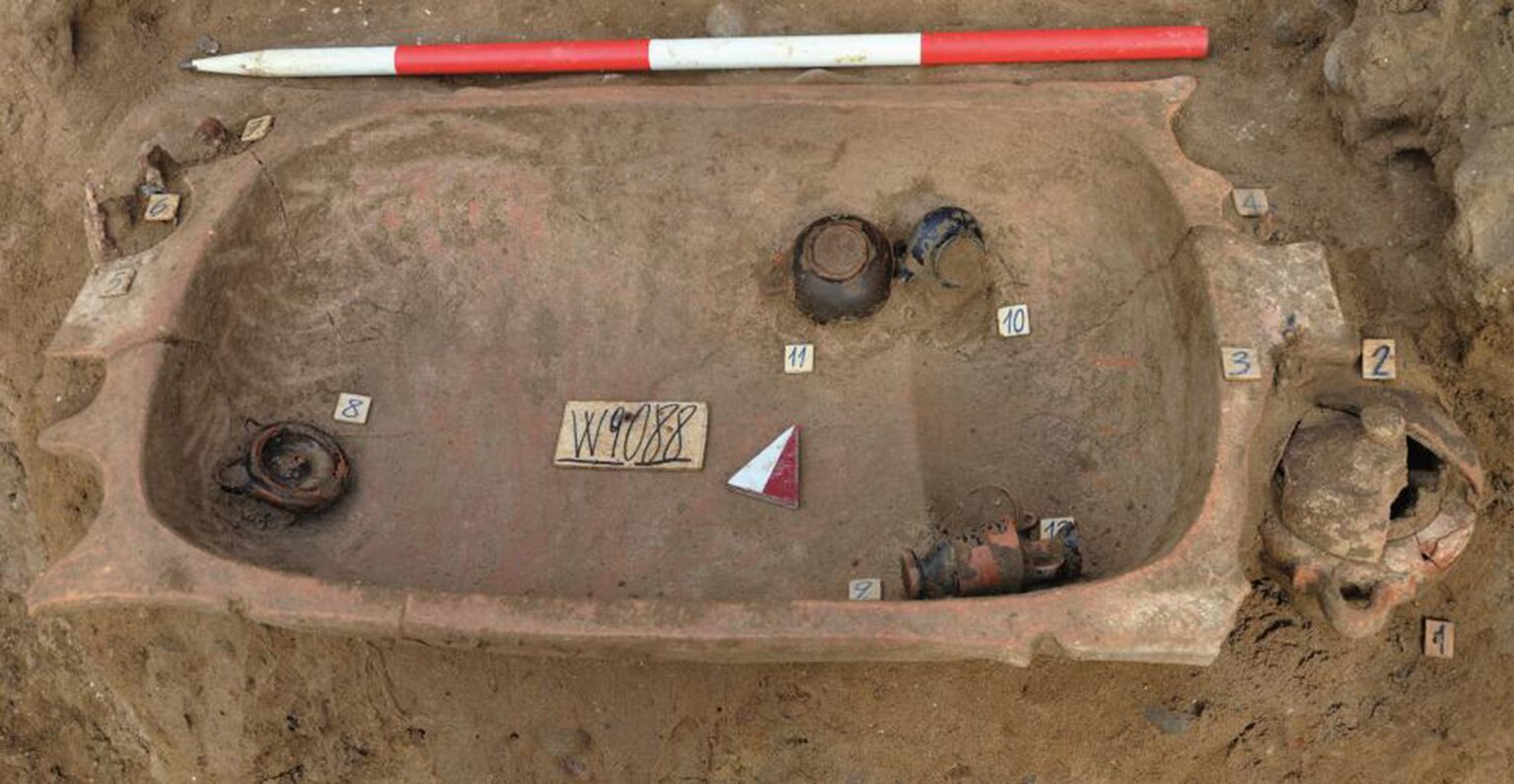
Children growing up in the ancient Greek colony of Himera, in present-day Sicily, began eating solid foods at around 3 months old but continued breastfeeding until roughly 3.8 years of age, according to an analysis of their bones. The findings suggest that families from different cultural backgrounds shared similar approaches to infant feeding, even as their community brought together Greeks, Phoenicians and local Sicilians.
The combination of early solid foods and prolonged breastfeeding is unusual. It also differs from recommendations made by ancient Greek physicians, who generally advised introducing solid foods later and ending breastfeeding sooner.
To investigate how families raised their children more than 2,500 years ago, researchers examined chemical traces preserved in the bones of children buried at Himera. Their findings offer rare evidence of everyday child-rearing practices in a multicultural ancient community.
What children’s bones reveal about breastfeeding
Himera was founded by Greek colonists between the seventh and fifth centuries B.C. and eventually developed into a large city with a population that included people of Greek, Phoenician and local Sicilian backgrounds.
Archaeologists have uncovered more than 13,000 burials at the site, providing researchers with an unusually large collection of human remains. Yet much remains unknown about how children experienced life in this culturally diverse settlement.
Laurie Reitsema, a biological anthropologist at the University of Georgia, and her colleagues turned to two chemical elements preserved in bones: carbon and nitrogen. Their measurements can help reconstruct the diets of people who lived centuries ago.
Nitrogen levels change during breastfeeding because infants consume their mothers’ milk, which gives them a different chemical signature from people eating other foods. As a result, breastfed babies can have nitrogen signatures resembling those of meat-eating animals.
“Breastfed babies look different than weaned babies, isotopically, because their diets consist of milk, which differs isotopically from other foods (babies are top carnivores!),” Reitsema said.
Carbon measurements, meanwhile, helped researchers investigate the plant-based foods children began eating as they moved beyond an exclusively milk-based diet.
The team analyzed bone samples from 58 children and 27 adult women. Together, the chemical evidence allowed them to estimate when children started receiving foods other than breast milk and when breastfeeding eventually stopped.
Early solids, but years of breastfeeding
The results revealed a distinctive feeding pattern. Children at Himera began the weaning process at approximately 3 months old, around two to three months earlier than ancient physicians such as Galen and Soranus recommended.
But introducing solid foods did not mean breastfeeding ended. Children continued nursing for an estimated 3.8 years, considerably longer than the periods recommended by either physician.
Soranus advised mothers to stop breastfeeding at around 1.5 years, while Galen recommended continuing until approximately age 3.
The findings suggest that Himera’s families combined early exposure to solid foods with an extended period of breastfeeding. Rather than treating weaning as a single event, the evidence points to a gradual transition in which breast milk remained part of children’s diets for years after other foods were introduced.
Reitsema, who is also a mother, described the human significance of the findings.
“It was exciting to see 2,500-year-old evidence of mothers’ responsiveness to infant needs.”
Could prolonged breastfeeding have helped children survive?
The researchers suggest that extended breastfeeding may help explain the apparently low infant mortality at Himera.
Breast milk provides nutrition and immune protection during early childhood. In communities without dependable access to safe drinking water, breastfeeding can also reduce infants’ exposure to contaminated water and the illnesses associated with it.
“Breastfeeding is well known to support infant survival,” Reitsema said, “especially in places without reliable access to clean, safe drinking water, which describes most of human history.”
However, the study cannot establish that prolonged breastfeeding caused the settlement’s apparently low infant mortality.
There is another important limitation: the researchers examined the remains of children who died young. Their feeding patterns may not represent those of children who survived into adulthood.
That raises a difficult question about how to interpret the results. Were the feeding practices observed at Himera typical of the community, or did they reflect circumstances affecting children who were already at greater risk?
“Would a baby with an optimal weaning trajectory be dying at age 2 or 3?” Reitsema asked. “It’s possible that the weaning behaviors we see in this study reflect a specifically unsuccessful strategy.”
The distinction matters because the bones provide evidence of the diets of children who died, not a complete record of how every family raised its children.
Similar practices across distant Greek communities
Himera’s cultural diversity makes its feeding practices particularly interesting. Despite the different backgrounds of its inhabitants, the community appears to have shared a relatively consistent approach to breastfeeding.
The researchers also found similarities with evidence from Apollonia Pontica, another Greek colony located on the Black Sea in what is now Bulgaria.
The resemblance suggests that Greek communities separated by considerable distances may have maintained similar infant-feeding traditions.
That pattern contrasts with findings from studies of Roman cities, where researchers have documented much greater variation in weaning practices.
The comparison raises questions about how cultural traditions influenced family life. People from different backgrounds living together might have adopted shared customs, maintained separate traditions or combined elements of both.
Child-rearing practices are especially difficult to reconstruct because they rarely appear in historical documents. Archaeological evidence of infant feeding therefore provides a way to investigate cultural interaction at the level of ordinary household life.
“Child care is deeply personal, and practices within households are often difficult to see in historical records or the archaeological record,” Reitsema said. But Himera, as a diverse melting pot, offers a rare glimpse into differences and similarities. “This can help us ask how people lived together: whether traditions blended, remained distinct or coexisted. It offers a glimpse into cultural interaction at an intimate, everyday level.”
The researchers now want to examine the remains of adults buried at Himera. Unlike the children who died young, these individuals survived childhood and may have experienced different feeding practices and early-life conditions.
“Adults are children who lived, and they may have had very different childhoods than those who died young,” Reitsema said.
The study was published in the European Journal of Archaeology.