Buried in a Roman-era rubbish dump for nearly 1,800 years, an unusual glass bottle discovered in York has been identified as a likely Egyptian kohl container—the first ever found in Roman Britain. The finding suggests that someone with strong ties to Egypt, possibly a soldier or resident who adopted Egyptian customs, may once have lived on the distant edge of the Roman Empire.
Sometimes, the most revealing archaeological discoveries spend decades hiding in plain sight.
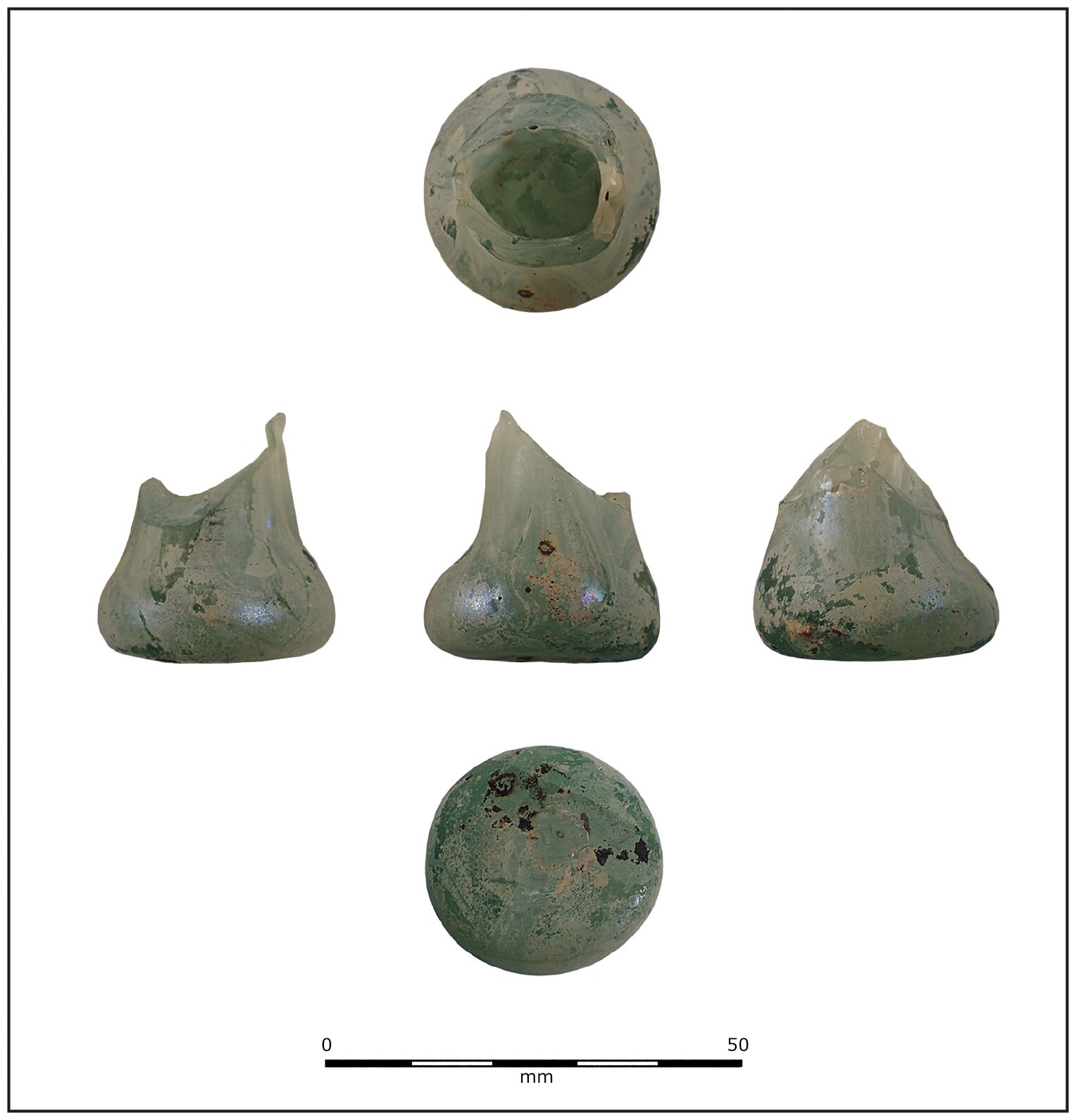
More than 40 years after a small glass flask was unearthed during excavations in York, England, researchers have concluded that the object may be something remarkably rare: an ancient Egyptian kohl bottle. If correct, the identification would make it the first and only known kohl bottle from Roman Britain, offering an unexpected glimpse into cultural connections stretching across the Roman world.
The discovery centers on a modest glass vessel excavated in 1983–84 at Tanner Row in York. At the time, the bottle attracted little attention. Its significance only emerged years later when archaeologist Dr. Hillary Cool revisited materials in her archive and noticed striking similarities between the York flask and Egyptian kohl containers.
An Unusual Bottle Stands Out
The bottle was recovered during excavations conducted by the York Archaeological Trust at a site that had served as a rubbish dump in the late 2nd century AD.
According to Dr. Cool, the area was located across the river from York’s legionary fortress and was developing into a substantial civilian settlement during that period. The site appears to have been used for disposing of waste from the nearby military community.
At first glance, the vessel looked different from typical Romano-British glassware. It featured a blue-green color, heavy silvery iridescence, and extensive weathering. Other glass fragments from the site displayed much more conventional appearances, making it unlikely that the bottle’s unusual characteristics resulted solely from burial conditions.
Its shape also raised questions. Most Roman bottles had thinner walls and internal cavities that closely followed their external form. The York example did not fit that pattern.
Dr. Cool also dismissed the possibility that the object was simply a poorly manufactured bottle, noting that she had never encountered such extreme workmanship issues in comparable Roman vessels.
These unusual traits pointed toward another explanation.
Why Researchers Believe It Was a Kohl Container
Ancient Egyptians commonly used kohl, a black cosmetic applied around the eyes. The substance was typically stored in small containers and applied using a stick.
During the 1st and 2nd centuries AD, Egyptian glassmakers produced bottles in two main styles. One mirrored the exterior shape internally, while another featured a cylindrical internal hollow. The York bottle belongs to the latter category.
That design was particularly useful for storing kohl because it allowed users to insert an applicator stick and retrieve the cosmetic more easily.
Comparable containers have been found at numerous sites throughout Egypt, including military installations and rubbish dumps. At one location, 36 kohl containers dating to the 2nd century AD were recovered.
What makes the York example so significant is its rarity outside Egypt and Sudan.
According to Dr. Cool, if these containers had been widely traded across the Roman Empire, archaeologists would expect to find many more examples. Instead, they remain overwhelmingly concentrated within Egypt and Nubia.
Tracing Cultural Connections Across the Roman Empire
Researchers explored several alternative explanations for the bottle’s presence in Britain.
Its small size made it an unlikely perfume container. The souvenir theory also appeared weak. If travelers frequently brought kohl products home from Egypt, similar containers would likely be much more common elsewhere in the Roman world.
After ruling out trade and other possibilities, Dr. Cool turned her attention to what the bottle might reveal about the person who owned it.
Kohl use was largely restricted to Egypt and Sudan, reflecting a regional cosmetic tradition. In much the same way that certain makeup tools found in Britain reflected local customs, kohl appears to have represented a distinctive cultural preference.
This observation led researchers to consider the bottle’s broader social significance.
Evidence of Egyptian Links in Roman Britain
The discovery does not stand entirely alone.
York and other parts of Roman Britain have produced evidence of connections to Egypt during this period. One example involves Claudius Hieronymianus, a commanding officer who commissioned a temple in York dedicated to Serapis, a Greco-Egyptian deity.
Elsewhere, archaeologists working in Leicester uncovered an ivory box decorated with the god Anubis, a figure especially popular among Roman soldiers who had served in Egypt. The same site also yielded military seals, including one connected to a unit previously based there.
Taken together, these finds suggest that people, beliefs, and cultural practices moved across vast distances within the Roman Empire.
Against that backdrop, the York bottle takes on added significance.
Dr. Cool proposes that it may have been a personal possession carried by someone who was either Egyptian or had spent considerable time in Egypt. Such an individual may have adopted local customs, including the use of kohl, before eventually arriving in Britain.
Rethinking Life on Rome’s Northern Frontier
The bottle offers more than evidence of long-distance travel. It also challenges modern assumptions about who lived in Roman Britain and how they expressed their identities.
Roman soldiers and civilians moved throughout the empire, bringing traditions, religious practices, and personal habits with them. The presence of an Egyptian-style kohl container in York suggests that cultural diversity extended even to the empire’s distant frontiers.
It may also prompt a reconsideration of how Roman soldiers appeared in everyday life.
As Dr. Cool noted, wearing eyeliner is not a behavior typically associated with the Roman military. Yet this small artifact hints that personal grooming habits and cultural identities may have been far more varied than commonly imagined.
Why This Matters
The York kohl bottle demonstrates how a single object can reshape understanding of the ancient world. Rather than portraying Roman Britain as isolated from distant regions, the find highlights the movement of people and traditions across thousands of miles.
If the bottle truly belonged to an Egyptian resident or a traveler deeply influenced by Egyptian culture, it provides rare evidence of personal identity surviving far from its place of origin. More broadly, it reminds us that the Roman Empire was not just a network of roads and armies—it was also a world connected by individuals carrying their customs, beliefs, and daily routines wherever they went.
Study Details
H.E.M. Cool, An Egyptian at York?, Britannia (2026). DOI: 10.1017/s0068113x26100737