Powerful winds racing across seven scorching giant exoplanets have revealed the clearest evidence yet that planets beyond our solar system possess magnetic fields. By tracking atmospheric motion on these distant worlds, astronomers uncovered an unexpected pattern that points to planet-wide magnetism strong enough to reshape our understanding of planetary environments and long-term habitability.
A strange mystery hidden in the atmospheres of distant worlds has led astronomers to a breakthrough that researchers have been pursuing for more than a decade. By measuring winds whipping across seven giant exoplanets, scientists discovered a surprising clue that may finally reveal one of the most elusive properties of planets beyond our solar system: their magnetic fields.
The findings, published in Nature Astronomy, provide what researchers describe as the first robust measurement of magnetism on exoplanets. The discovery opens a new avenue for studying how planetary environments evolve and whether some worlds can maintain the conditions necessary to support water and potentially life.
“This breakthrough opens a completely new window on exoplanet research,” said lead author Julia Seidel of the Laboratoire Lagrange at the Observatoire de la Côte d’Azur in France.
Searching for Winds, Finding Magnetism
The research team did not initially set out to measure magnetic fields. Instead, their goal was to investigate atmospheric winds on seven giant exoplanets.
These worlds resemble Jupiter in size but orbit extremely close to their host stars. Each planet is tidally locked, meaning one side constantly faces its star while the opposite side remains in perpetual darkness. The result is an extreme temperature contrast between the blistering day side and the frigid night side.
Such dramatic differences create some of the most intense weather conditions known. The astronomers measured wind speeds ranging from approximately 7,200 kilometers per hour to more than 25,000 kilometers per hour. For comparison, the fastest winds ever measured on Jupiter reach about 1,500 kilometers per hour.
To gather the data, the researchers used the ESPRESSO instrument on the European Southern Observatory’s Very Large Telescope (VLT) in Chile, along with a similar instrument on the Gemini North Telescope in Hawaiʻi.
Initially, the team wanted to determine whether atmospheric winds behaved similarly across all extremely hot giant planets. What they found instead was something unexpected.
Hotter Planets Had Slower Winds
As the researchers compared wind speeds with planetary temperatures, a puzzling trend emerged.
The hotter the planet, the slower its winds appeared to move.
That result ran counter to expectations. In principle, hotter planets should have more energy available to drive atmospheric circulation. Instead, the observations showed the opposite relationship.
“This is totally counter-intuitive because, all things being equal, hot planets have more energy to accelerate the winds,” said study co-author Vivien Parmentier, a professor at the Laboratoire Lagrange.
The finding suggested that another force was influencing atmospheric motion.
Magnetic Fields Provide the Missing Explanation
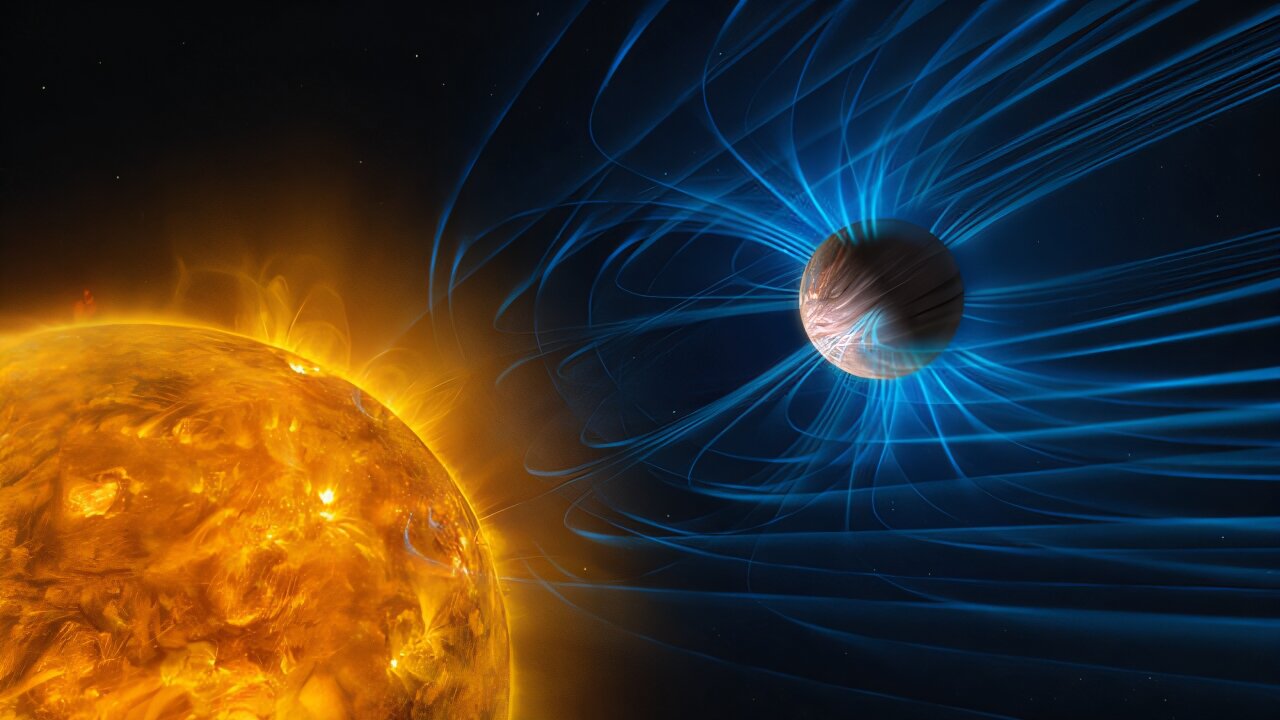
After analyzing the data, the researchers concluded that the most consistent explanation was the presence of planet-wide magnetic fields.
Magnetic fields can act as a brake on atmospheric movement by slowing charged particles circulating through a planet’s atmosphere. As temperatures rise, more particles become electrically charged, increasing the influence of magnetism on atmospheric dynamics.
This mechanism offered a natural explanation for why the hottest planets exhibited slower winds.
Using this relationship, the team was able to infer the strength of the magnetic fields surrounding the seven exoplanets. The results suggest that these magnetic fields are remarkably powerful.
According to the study, the measured fields are roughly four times stronger than Saturn’s magnetic field and about half as strong as Jupiter’s.
For exoplanet science, this represents a major milestone. Although scientists have long suspected that many exoplanets possess magnetic fields, directly measuring their strength had remained out of reach for roughly 15 years.
Alien Aurorae Could Light Up These Worlds
The implications extend beyond atmospheric winds.
On Earth, magnetic fields guide charged particles from the Sun toward the poles, producing the northern and southern lights. These colorful aurorae occur when those particles collide with gases in the atmosphere.
Researchers believe similar processes may occur on the studied exoplanets.
Because the newly detected magnetic fields appear so strong, any aurorae generated there could be even more dramatic than those seen on Earth.
Study co-author Bibiana Prinoth, now an astronomer at the European Southern Observatory in Germany, noted that magnetically driven light displays on these distant worlds could be spectacular, especially on planets where one hemisphere experiences endless daylight while the other remains in constant darkness.
Looking Ahead to the Next Generation of Telescopes
The team is already looking toward future observations that could expand this work beyond giant planets.
Researchers are particularly excited about the upcoming Extremely Large Telescope (ELT), which is expected to help scientists characterize a wider range of exoplanets, including smaller worlds more similar to Earth.
Future observations may even allow astronomers to identify atmospheric gases associated with auroral activity, providing another way to investigate magnetic environments across the galaxy.
The ability to study magnetic fields directly could become a crucial tool for understanding how planets evolve and how they interact with their stars.
Why This Matters
Magnetic fields play a major role in shaping planetary environments. On Earth, they influence the atmosphere and are considered an important factor in maintaining conditions suitable for life.
Until now, astronomers had no reliable way to measure magnetic field strengths on planets orbiting other stars. This study changes that by showing that atmospheric wind patterns can reveal the hidden magnetic forces at work on distant worlds.
By opening a new method for probing exoplanet magnetism, the discovery brings scientists closer to understanding which planets can preserve their atmospheres, retain water, and remain stable over long periods. As more powerful telescopes come online, magnetic fields may become one of the key pieces of the puzzle in identifying worlds that could someday prove hospitable to life.
Study Details
Magnetic field strengths of hot giant exoplanets consistent with Solar System values, Nature Astronomy (2026). DOI: 10.1038/s41550-026-02870-1