Stretching across more than 40,000 years of continuous human activity, El Mirón Cave in northern Spain has emerged as one of Europe’s most complete prehistoric records, revealing everything from Ice Age hunting cultures to early agriculture. Decades of excavation have uncovered rare human burials, intricate portable art, and ancient DNA that is reshaping how scientists understand the populations of Ice Age Iberia and beyond. At the heart of it all is a single site that kept “giving,” layer after layer, for more than three decades of research.
A cave perched high above a river valley in northern Spain does not usually become a centerpiece of global archaeological understanding. Yet El Mirón Cave has done exactly that, quietly transforming from an overlooked mountainside cavity into one of the most information-rich prehistoric sites in Western Europe. Inside its sunlit vestibule, buried beneath thick layers of sediment, lies a record of human life so continuous that it spans from the final Neanderthals to the Bronze Age.
For the researchers who dedicated their careers to it, the cave has never been just a dig site. It has been a long-running conversation with the past—one that continues to evolve with every new excavation season.
A Cave That Preserves 40,000 Years of Human Presence
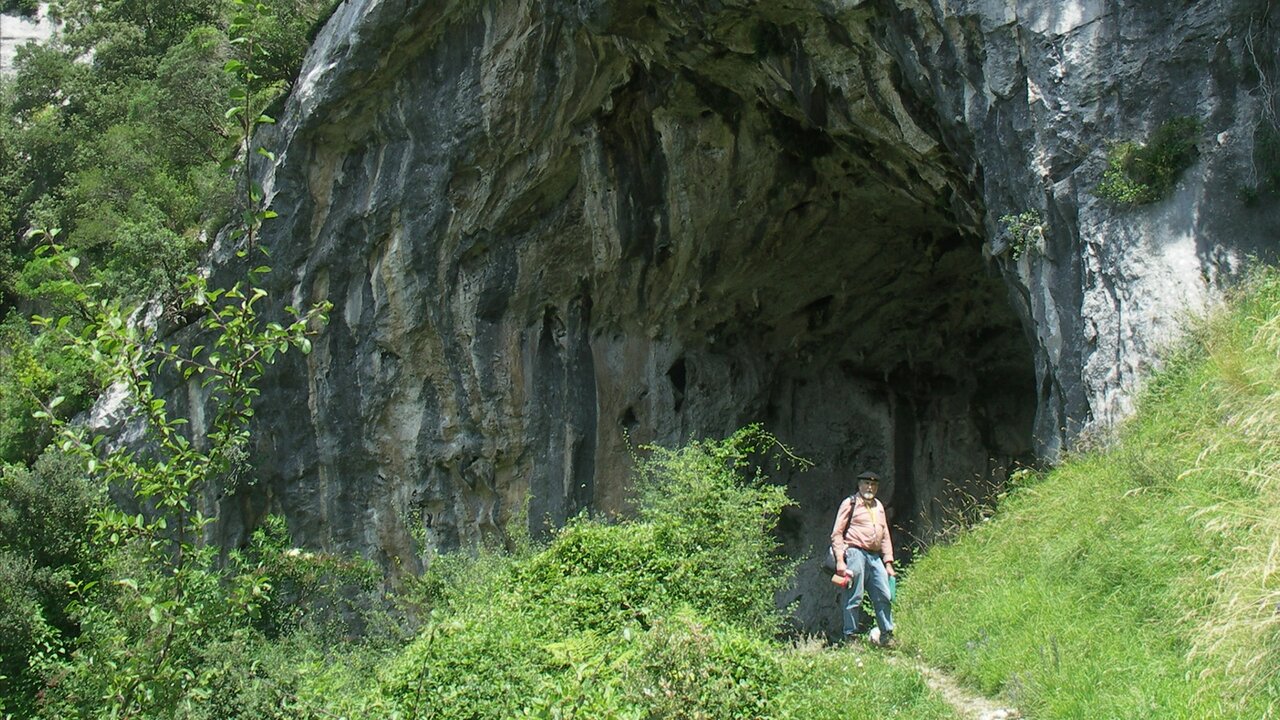
El Mirón Cave is located above the Asón River valley in Cantabria, Spain, near the edge of the Cantabrian Cordillera and overlooking the Bay of Biscay. First identified in 1903, the site is a deep limestone formation with a dense sedimentary fill made up of multiple archaeological layers.
But it was not until systematic excavation began in 1996 that its full significance emerged.
What makes El Mirón extraordinary is its uninterrupted sequence of occupation spanning more than 40,000 years, documenting one of the longest continuous human histories in Europe. The site preserves evidence from nine major archaeological periods, including the Middle Paleolithic, Early Upper Paleolithic, Gravettian, Solutrean, Magdalenian, Mesolithic, Neolithic, Chalcolithic, and Bronze Age.
Each layer adds a different chapter, revealing how human communities repeatedly returned to the same sheltered vestibule, adapting to shifting climates ranging from the harshest phases of the last Ice Age to warmer Holocene environments.
Three Decades of Excavation and Scientific Persistence
The modern scientific story of El Mirón began with Leslie Spier Distinguished Professor Lawrence Straus of the University of New Mexico and Manuel González Morales of the Universidad de Cantabria. Beginning their joint work in 1996, they launched what was initially a test excavation driven by curiosity about whether intact deposits still survived.
What followed was far more than expected.
Over three decades, the team accumulated an extraordinary dataset, including 102 radiocarbon dates generated using high-precision accelerator mass spectrometry. These dates helped build a refined timeline of occupation phases stretching across tens of millennia.
The excavation effort expanded into an international collaboration involving archaeologists, students, and specialists from multiple disciplines. Nearly 25 students from the University of New Mexico alone participated, with several doctoral dissertations emerging directly from the project.
From the beginning, excavation relied on meticulous fieldwork: careful stratigraphic removal, systematic sieving, and precise documentation of every artifact and environmental trace.
Daily Life Across Ice Age and Early Farming Worlds
The archaeological record preserved in El Mirón offers unusually detailed insight into how people lived, worked, and survived across shifting prehistoric worlds.
Researchers uncovered vast quantities of stone tools, bone fragments, hearths, and animal remains, revealing repeated cycles of occupation inside the cave’s wide vestibule. Evidence suggests both seasonal and longer-term habitation patterns, with communities returning repeatedly over thousands of years.
Hunting and subsistence strategies are especially well documented. Faunal remains show systematic hunting of red deer, ibex, horse, chamois, and roe deer, alongside fishing for species such as salmon and trout. These findings demonstrate a highly adaptable subsistence economy that shifted with environmental conditions.
Stone tool production reveals a complex pattern of resource movement. High-quality flint was often transported from distances of 50–60 kilometers, while local materials such as quartzite and mudstone were used for heavier tools. This pattern suggests a structured understanding of regional landscapes and raw material sources.
One striking artifact, a decorated red deer scapula engraved with fine striations, reflects the symbolic and artistic traditions of the Magdalenian period. Portable art objects, along with engraved cave surfaces, indicate that the site functioned not only as a shelter but also as a place of cultural expression.
The Red Lady of El Mirón
Among the most significant discoveries at the site is the burial of a woman who lived approximately 19,000 years ago during the Magdalenian period.
Her partial skeleton was uncovered in 2010 in a secluded part of the vestibule. The excavation revealed a tightly positioned burial area stained with red ochre, leading researchers to nickname her the “Red Lady of El Mirón.”
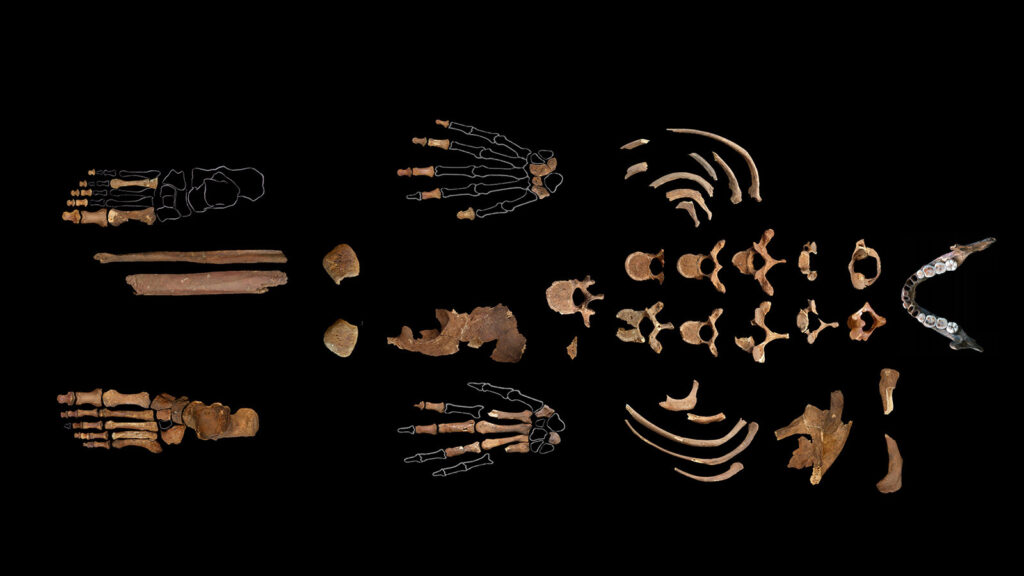
Her remains were found in association with a uniquely prepared burial context. An engraved rock block, positioned at an angle and illuminated by sunlight from the cave entrance, contained fine-line carvings that may represent symbolic imagery. Researchers suggest this block may have functioned as a grave marker, possibly created around the time of her burial.
The woman was placed in a tightly flexed fetal position. Ochre used in the burial was sourced from a location approximately 25 kilometers away, indicating deliberate effort to obtain and transport material for the ritual.
Analysis shows that she was a 35–40-year-old woman, of average stature, robust, and in relatively good health at the time of death. While her exact identity is unknown, the care involved in her burial suggests she held significant social importance.
Ancient DNA and a New Picture of Ice Age Europe
The Red Lady has also become a key figure in ancient genetic research. DNA extracted from her remains, analyzed by researchers including Svante Pääbo of the Max Planck Institute, links her to hunter-gatherer populations associated with the Goyet, Fournol, and Villabruna genetic clusters.
These groups played a central role in the recolonization of Europe as glaciers retreated near the end of the Ice Age.
Genetic analysis also revealed that she had dark skin, hair, and eyes, challenging earlier assumptions about the appearance of Ice Age Europeans. Her dietary profile, reconstructed through stable isotope analysis and dental calculus studies, shows a broad and flexible diet including land animals, fish such as salmonids, mollusks, seeds, plants, and fungi.
Even more unexpected was the discovery of preserved ancient oral bacteria in her dental calculus, some of which may have been inherited from Neanderthal-related microbial lineages that persisted long after Neanderthals disappeared.
A Living Laboratory for Modern Archaeology
Over time, El Mirón has become more than an excavation site—it has become a laboratory for evolving scientific methods.
Researchers now use advanced techniques such as ancient DNA sequencing, sedimentary DNA analysis, stable isotope analysis, and microscopic wear studies to reconstruct past environments and human behavior in unprecedented detail.
Sedimentary DNA recovered from cave soils has even revealed traces of human and carnivore presence from early occupation phases, expanding understanding of who used the cave and when.
These innovations have transformed the project from a traditional archaeological dig into a multidisciplinary investigation combining archaeology, genetics, chemistry, and environmental science.
Despite the technological advances, the foundation remains unchanged: slow, careful excavation. Every artifact still depends on patient removal from sediment layers, one trowel at a time.
Why This Matters
El Mirón Cave provides one of the clearest long-term records of how humans adapted to dramatic environmental change over tens of thousands of years. By preserving evidence from both Ice Age hunter-gatherers and early farming communities, the site bridges a critical gap in understanding how Europe transitioned from foraging to agriculture.
The combination of artifacts, human remains, environmental data, and ancient DNA allows researchers to reconstruct not just isolated moments, but continuous patterns of survival, migration, and cultural change.
Perhaps most importantly, the site demonstrates how modern science can extract deeply personal details from the distant past—diet, ancestry, appearance, and even microbial life—without losing sight of the human stories behind them.
As excavations are expected to resume in 2027, El Mirón continues to offer something rare in archaeology: a place that still has more to say, and a record that keeps expanding with every careful layer uncovered.
Study Details
Lawrence Guy Straus et al, A Window into 40,000 Years of the Prehistory of Iberia: The Long Excavation of El Mirón Cave, Cantabrian Spain, Journal of Anthropological Research (2026). DOI: 10.1086/739377