Fossil teeth from southern France are reshaping scientists’ understanding of Neanderthal evolution. Detailed scans of nine ancient teeth suggest that Neanderthal populations were far more diverse and regionally distinct than previously thought, highlighting the powerful role of climate-driven isolation and migration during the Middle Pleistocene.
What can a handful of ancient teeth reveal about human evolution? According to new research led by the Centro Nacional de Investigación sobre la Evolución Humana (CENIEH), quite a lot.
By taking a fresh look at fossil teeth discovered decades ago at the archaeological site of Payre in southeastern France, researchers have uncovered new evidence that Neanderthal evolution was not a straightforward journey. Instead, it appears to have been shaped by shifting climates, fragmented populations, and complex patterns of interaction across Europe roughly 250,000 years ago.
The findings, published in Archaeological and Anthropological Sciences, offer a rare glimpse into a poorly documented period of European prehistory and add to growing evidence that Neanderthals were far from a uniform population.
Looking Inside Ancient Teeth
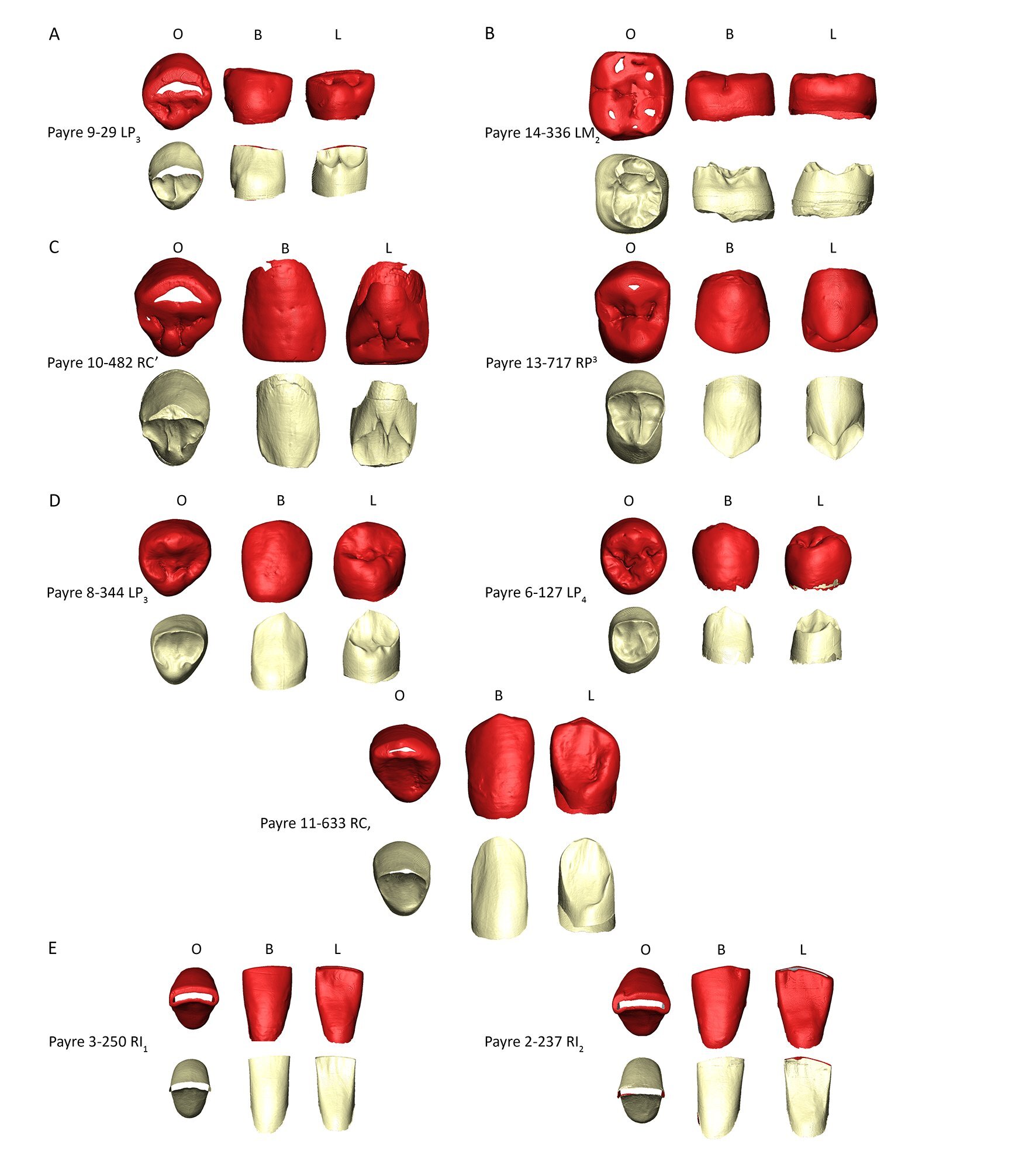
The study focused on nine fossil teeth recovered from different archaeological layers at Payre. Although these remains had been examined previously, researchers applied a new generation of analytical tools to extract far more information than was possible in earlier studies.
Using micro-computed tomography (micro-CT), geometric morphometrics, and analyses of dental tissue proportions, the team investigated both the external shape and the internal structure of the teeth in exceptional detail.
Lead author Laura Martín-Francés Martín de la Fuente explained that the combination of these methods allowed scientists to examine the fossils with an unprecedented level of precision, providing insights into features that are not visible from the outside.
The advanced imaging techniques enabled researchers to study the enamel-dentine junction (EDJ) and other internal structures that can preserve valuable evolutionary signals over hundreds of thousands of years.
Evidence of a Complex Evolutionary Story
For years, scientists have debated the nature of European human populations during Marine Isotope Stage 7 (MIS 7), a period dating from approximately 240,000 to 200,000 years ago.
One key question has been whether these populations already possessed the defining characteristics of so-called classic Neanderthals or whether they still retained traits inherited from earlier human groups.
The Payre fossils help clarify that picture.
Researchers found that the teeth shared multiple anatomical similarities with other Middle Pleistocene populations linked to the Neanderthal lineage. Comparable features were identified in fossils from Biache-Saint-Vaast, Montmaurin-La Niche, and Sima de los Huesos in Spain.
These connections strengthen the idea that the Payre individuals belonged to broader evolutionary networks associated with Neanderthal ancestry.
At the same time, the study uncovered something equally important: significant variation within the Payre sample itself.
Not One Population, but Many
The internal diversity observed among the Payre teeth suggests that Neanderthal evolution did not follow a simple, linear path.
Instead, the findings support a model in which populations were regionally structured and often separated from one another for extended periods. Isolation may have allowed distinctive traits to emerge in different groups, while intermittent contact between populations introduced opportunities for interaction and exchange.
According to the researchers, this pattern aligns with growing evidence that European Neanderthal populations were heavily influenced by Middle Pleistocene climatic oscillations.
As climate conditions changed, landscapes and migration routes also shifted. These environmental transformations could repeatedly divide populations or reconnect them, creating a dynamic evolutionary environment across the continent.
The result was a population history marked by both fragmentation and connectivity rather than a single, uniform evolutionary trajectory.
Old Fossils, New Discoveries
Beyond the specific findings about Neanderthals, the study highlights the scientific value of revisiting fossil collections that were discovered and analyzed years or even decades ago.
The Payre teeth demonstrate how advances in technology can unlock entirely new information from specimens that have already been studied.
Modern imaging methods now allow researchers to investigate internal anatomical structures in extraordinary detail without damaging the fossils themselves. Features that once remained hidden can now be measured, compared, and incorporated into broader evolutionary analyses.
The researchers argue that many historical collections still contain untapped scientific potential and may continue to yield important discoveries as analytical techniques improve.
A Broader Shift in Understanding Neanderthals
The new findings fit into a larger transformation in paleoanthropology that has unfolded over the past decade.
Advances in fossil analysis and ancient DNA research have increasingly challenged the traditional image of Neanderthals as a single, homogeneous population spread across Europe.
Instead, evidence points to a much more intricate picture involving interconnected groups with distinct regional characteristics. The Payre fossils add another piece to that puzzle by capturing a moment in time when Neanderthal populations were undergoing significant evolutionary diversification.
For scientists, such snapshots are particularly valuable because the period represented at Payre remains relatively understudied compared with other stages of Neanderthal history.
Why This Matters
Understanding how Neanderthals evolved is ultimately about understanding the broader story of human evolution.
The Payre fossils reveal that evolutionary change was shaped by a combination of environmental pressures, population movements, and long periods of regional separation. Rather than evolving as a single, unified group, Neanderthals appear to have existed as a network of populations responding to changing conditions across Europe.
By showing how much information can still be recovered from previously discovered fossils, the study also underscores the importance of reexamining museum collections with modern technology. As new tools continue to emerge, specimens that have sat in collections for decades may hold answers to some of the most enduring questions about humanity’s ancient past.
Study Details
Laura Martín-Francés et al, Reassessment and new evidence of the dental remains from Payre site (France), Archaeological and Anthropological Sciences (2026). DOI: 10.1007/s12520-026-02453-1