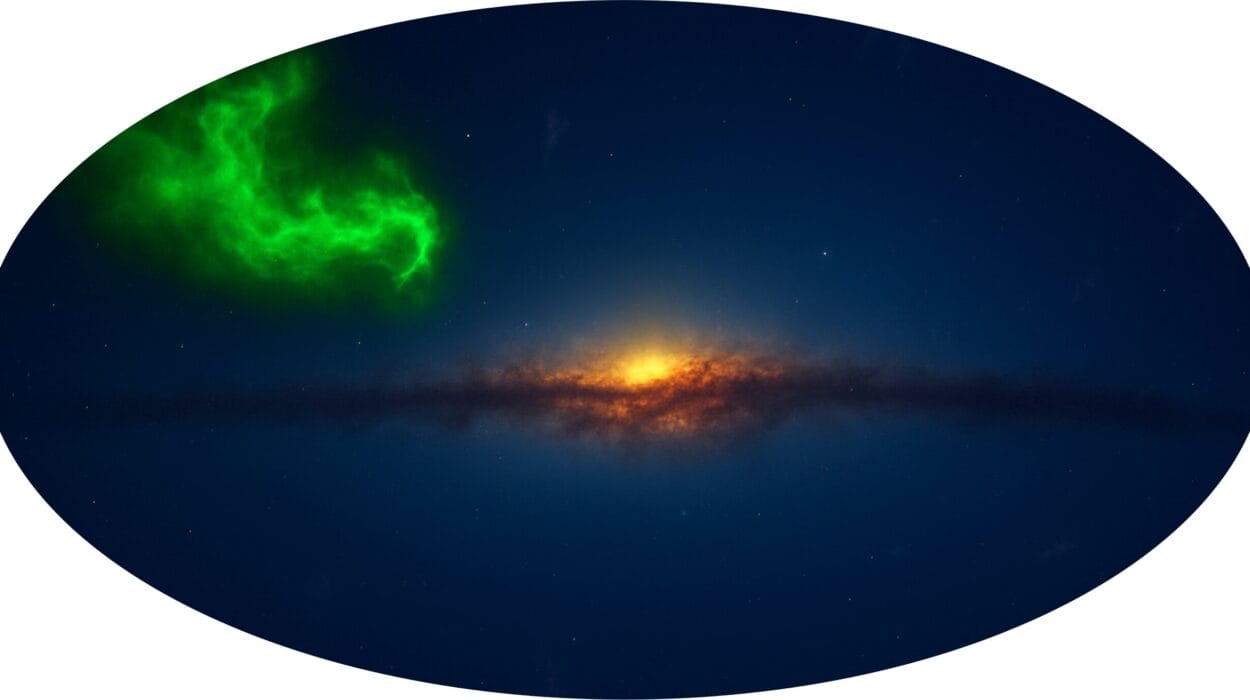
Observations from NASA’s James Webb Space Telescope have revealed one of the clearest pieces of evidence yet that some supermassive black holes may have been born enormous rather than growing gradually from collapsed stars. By directly measuring a black hole that existed just 700 million years after the Big Bang, researchers found it dominates its tiny host system and may have formed before a substantial galaxy even existed around it.
For decades, astronomers have debated one of the biggest questions in cosmic evolution: what comes first, a galaxy or the supermassive black hole at its center?
New observations from the James Webb Space Telescope are now challenging the traditional answer. Researchers studying a distant object known as Abell2744-QSO1 (QSO1) have found evidence that its central black hole was already extraordinarily massive when the universe was still in its infancy. The discovery suggests that at least some supermassive black holes may not have grown slowly from stellar remnants, but instead may have been born large from the start.
The findings could force scientists to rethink long-standing ideas about how the universe’s earliest and most powerful black holes formed.
A Tiny Object With an Enormous Black Hole
QSO1 belongs to a mysterious class of early-universe objects known as Little Red Dots. It existed only 700 million years after the Big Bang, yet its light has traveled for more than 13 billion years to reach Earth.
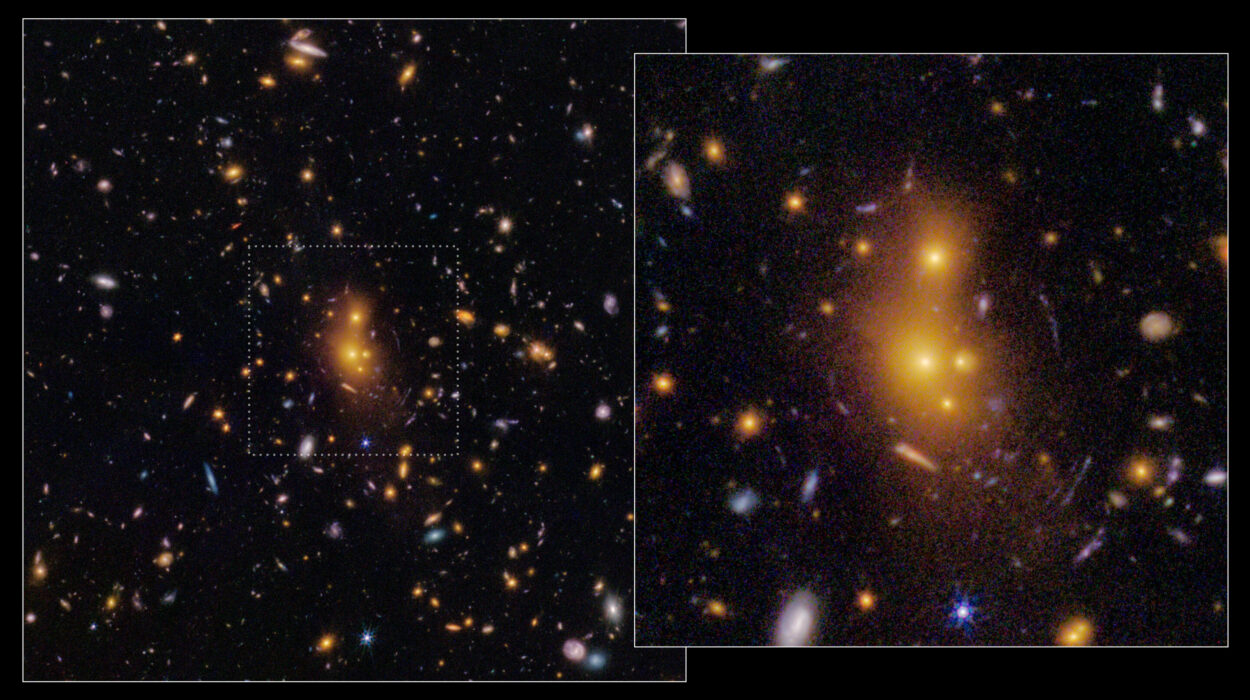
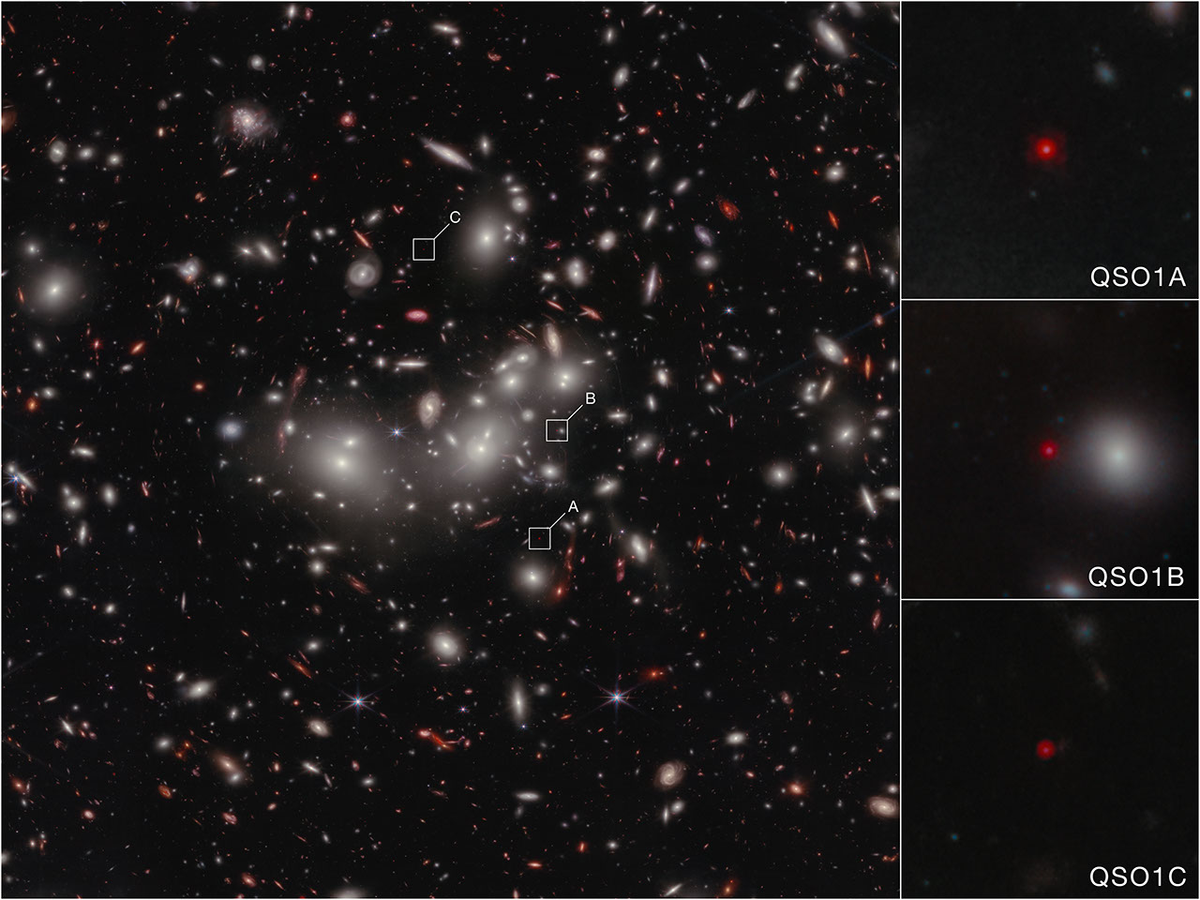
The object is relatively compact, measuring only about 1,300 light-years across. However, it is unusually accessible to astronomers because its light is magnified by the massive galaxy cluster Abell 2744, also known as Pandora’s Cluster. This gravitational lensing effect not only brightens QSO1 but causes it to appear in three separate locations in the sky.
Earlier studies had suggested that QSO1 might consist largely of hydrogen and helium gas orbiting a black hole estimated to be around 40 million times the mass of the Sun. Yet those estimates relied on indirect methods, leaving room for uncertainty.
Researchers wanted a more definitive answer.
Webb Maps the Motion of Gas Around the Black Hole
Using the Near Infrared Spectrograph (NIRSpec) aboard Webb, scientists analyzed the motion of gas surrounding QSO1’s central object.
The instrument’s integral field unit allowed researchers to simultaneously track gas movement and examine the distribution of chemical elements throughout the system.
When the team mapped the velocity of hydrogen gas at different distances from the center, they found a striking pattern. The gas followed Keplerian motion, orbiting the central region in much the same way planets orbit the Sun.
This result proved crucial.
If much of QSO1’s mass had been spread throughout a large population of stars, the gas would not have displayed such a clean orbital pattern. Instead, the observations showed that the overwhelming majority of the system’s mass is concentrated at its center.
First Direct Measurement of an Early-Universe Black Hole
Because Keplerian motion follows well-understood gravitational laws, the researchers were able to calculate the black hole’s mass directly.
Their measurements revealed a black hole with a mass of roughly 50 million Suns.
More remarkably, the black hole appears to account for at least two-thirds of QSO1’s total mass.
That proportion is dramatically different from what astronomers observe in nearby galaxies today. In the modern universe, supermassive black holes typically represent only a tiny fraction of the mass of their host galaxies. In QSO1, the black hole dominates the system.
The achievement also marks the first direct measurement of a black hole mass within the first billion years after the Big Bang, providing an important benchmark for studies of the early universe.
An Environment Almost Untouched by Stars
The telescope’s chemical maps offered another surprising clue.
Researchers found that the gas throughout QSO1 consists almost entirely of hydrogen and helium, the light elements produced in the early universe. Heavier elements such as oxygen, which are typically forged inside stars and dispersed through stellar activity, were largely absent.
The object’s metallicity is less than 0.5% that of the Sun, making it one of the most chemically pristine galactic environments ever measured.
This finding strengthens the idea that QSO1 has experienced very little stellar processing. If large populations of stars had already formed and evolved there, astronomers would expect to see far greater amounts of heavier elements mixed into the gas.
Instead, the observations suggest a system where a giant black hole exists despite the apparent absence of a mature, star-rich galaxy.
Evidence for Black Holes Born Big
The extraordinary mass of the black hole relative to its host system presents a challenge for traditional models of black hole growth.
Under the conventional picture, black holes begin as the remnants of massive stars and gradually grow through mergers and by consuming surrounding matter. Reaching tens of millions of solar masses in such a short cosmic timespan is difficult to explain.
The new observations point toward an alternative possibility: the black hole may have originated as a “heavy seed”, forming directly as a massive object rather than growing from a much smaller stellar ancestor.
Researchers say the findings are consistent with theoretical ideas involving primordial black holes or direct-collapse black holes, both of which predict black holes that are born already large.
While the exact origin of QSO1’s black hole remains uncertain, the evidence suggests it was likely massive from the very beginning.
Could Black Holes Have Built Galaxies?
One of the most intriguing implications of the discovery is that the black hole may have existed before a substantial galaxy formed around it.
Rather than galaxies creating supermassive black holes, some early black holes may have acted as the foundations upon which galaxies later developed.
The research team is now examining other Little Red Dots to determine whether QSO1 is unusual or part of a much larger population. If similar objects are found throughout the early universe, it could indicate that massive black holes commonly appeared before the galaxies that eventually hosted them.
Why This Matters
The discovery of QSO1 challenges one of astronomy’s most fundamental assumptions about cosmic evolution. By directly measuring a 50-million-solar-mass black hole in a chemically primitive system only 700 million years after the Big Bang, researchers have uncovered compelling evidence that some supermassive black holes may have formed before substantial galaxies existed.
If confirmed in other early-universe objects, the findings could reshape our understanding of how the first galaxies emerged and how the universe’s largest black holes came into being. Instead of growing slowly from stellar remnants, some of the cosmos’s most powerful objects may have been born giant from the very start.
Study Details
Ignas Juodžbalis et al, A direct black-hole mass measurement in a little red dot at high redshift, Nature (2026). DOI: 10.1038/s41586-026-10579-4
Roberto Maiolino et al, A black hole in a near pristine galaxy 700 Myr after the big bang, Monthly Notices of the Royal Astronomical Society (2026). DOI: 10.1093/mnras/staf2109