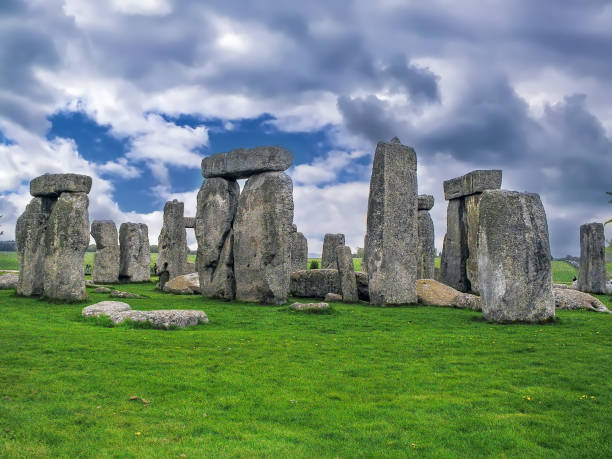
Stonehenge’s massive Altar Stone likely traveled about 700 kilometers from northeast Scotland to southern England through deliberate human effort, according to new research. By combining geological dating techniques with ice-sheet modeling, scientists found no viable glacial route capable of delivering the six-tonne megalith to Stonehenge, strengthening the case that prehistoric communities organized an extraordinary long-distance transport operation.
For centuries, one question has lingered over Stonehenge: how did its enormous stones reach one of the world’s most famous prehistoric monuments? New research is bringing scientists closer to an answer—and the story appears even more remarkable than previously thought.
Researchers from Curtin University have reconstructed a likely journey for Stonehenge’s central Altar Stone, a massive six-tonne sandstone megalith that is now believed to have originated in northeast Scotland, roughly 700 kilometers from Salisbury Plain. Their findings suggest the stone was not carried south by natural forces alone but was instead moved by people across challenging landscapes through a carefully coordinated effort.
Testing a Long-Standing Mystery
The study builds on earlier research that had already cast doubt on the idea that glaciers were solely responsible for transporting the Altar Stone to southern England.
To investigate further, the researchers combined mineral grain dating with advanced ice-sheet modeling. This approach allowed them to better determine where the stone originated and evaluate whether glaciers during the last Ice Age could have carried it all the way to Stonehenge.
The results pointed to a significant limitation in the glacial transport theory. While glaciers may have moved rocks from Scotland part of the way south, the models showed they could not provide a direct route connecting the source region to Stonehenge.
According to the researchers, this means people would still have been required to move the stone across hundreds of kilometers.
Glaciers Could Only Do Part of the Work
The modeling revealed that Ice Age glaciers may have transported rocks as far as Dogger Bank in the North Sea, but not into southern England.
That distinction is crucial. If glaciers stopped short of delivering the stone to the region where Stonehenge stands today, prehistoric communities would have had to complete the majority of the journey themselves.
Co-lead author Dr. Anthony Clarke, from Curtin University’s School of Earth and Planetary Sciences, said the evidence increasingly supports a deliberate human transport effort rather than a natural process.
The findings indicate there were no viable glacial pathways linking the stone’s Scottish source directly to Stonehenge. As a result, researchers conclude that human transport remains the most likely explanation.
A Journey Planned in Stages
The study also offers clues about how such a massive object may have been moved.
Rather than envisioning a single continuous trek, the researchers suggest the stone was probably transported in multiple stages. The route may have combined overland movement with transportation along rivers or coastal waterways whenever those options were available.
Such a strategy would have reduced some of the challenges posed by moving a multi-tonne stone across varied terrain. Even so, transporting a megalith of this size over such a vast distance would have required substantial organization and coordination.
Dr. Clarke noted that the evidence points to careful planning and a strong understanding of the landscape by the communities involved.
The proposed journey would have crossed difficult terrain and likely demanded cooperation among groups over a large geographic area. The research therefore highlights a level of logistical capability that may not have been fully appreciated before.
What the Findings Reveal About Neolithic Communities
Beyond solving a geological puzzle, the study sheds light on the people who built Stonehenge.
Moving a six-tonne stone over hundreds of kilometers would not have been a simple task. Researchers argue that accomplishing such a feat would have required planning, coordination, determination, and knowledge of possible travel routes.
The findings suggest that Neolithic communities may have been capable of organizing complex projects on a much larger scale than often assumed.
Rather than relying on natural forces to bring the stone closer to its destination, the evidence points toward intentional decision-making and collective effort. That interpretation paints a picture of communities that were highly resourceful and able to work together across considerable distances.
Combining Geology and Computer Modeling
One of the study’s key strengths is its integration of multiple scientific techniques.
By combining geological analysis with computer-based reconstructions of ancient ice sheets, researchers were able to test competing explanations for the stone’s presence at Stonehenge. This interdisciplinary approach helped address a long-standing question that has challenged archaeologists and geologists alike.
The research team included experts from Curtin University as well as collaborators from Sheffield Hallam University, the University of Sheffield, Wessex Archaeology, and the University of Bristol.
Why This Matters
Stonehenge remains one of humanity’s most iconic prehistoric monuments, and understanding how its stones arrived there is essential to understanding the people who built it.
This study strengthens the case that the Altar Stone’s remarkable 700-kilometer journey was the result of deliberate human action rather than simple natural transport. If correct, the findings reveal that prehistoric communities possessed a sophisticated ability to plan, coordinate, and execute large-scale projects across challenging landscapes.
Future research will focus on identifying the Altar Stone’s exact source in northeast Scotland and exploring the specific routes that may have connected distant communities. Each new piece of evidence brings scientists closer to understanding not only how Stonehenge was constructed, but also the capabilities of the people who made it possible.
Study Details
From Highlands to Henge: Refining the Provenance and Transport Pathways of Stonehenge’s Altar Stone, Journal of Quaternary Science (2026). DOI: 10.1002/jqs.70080