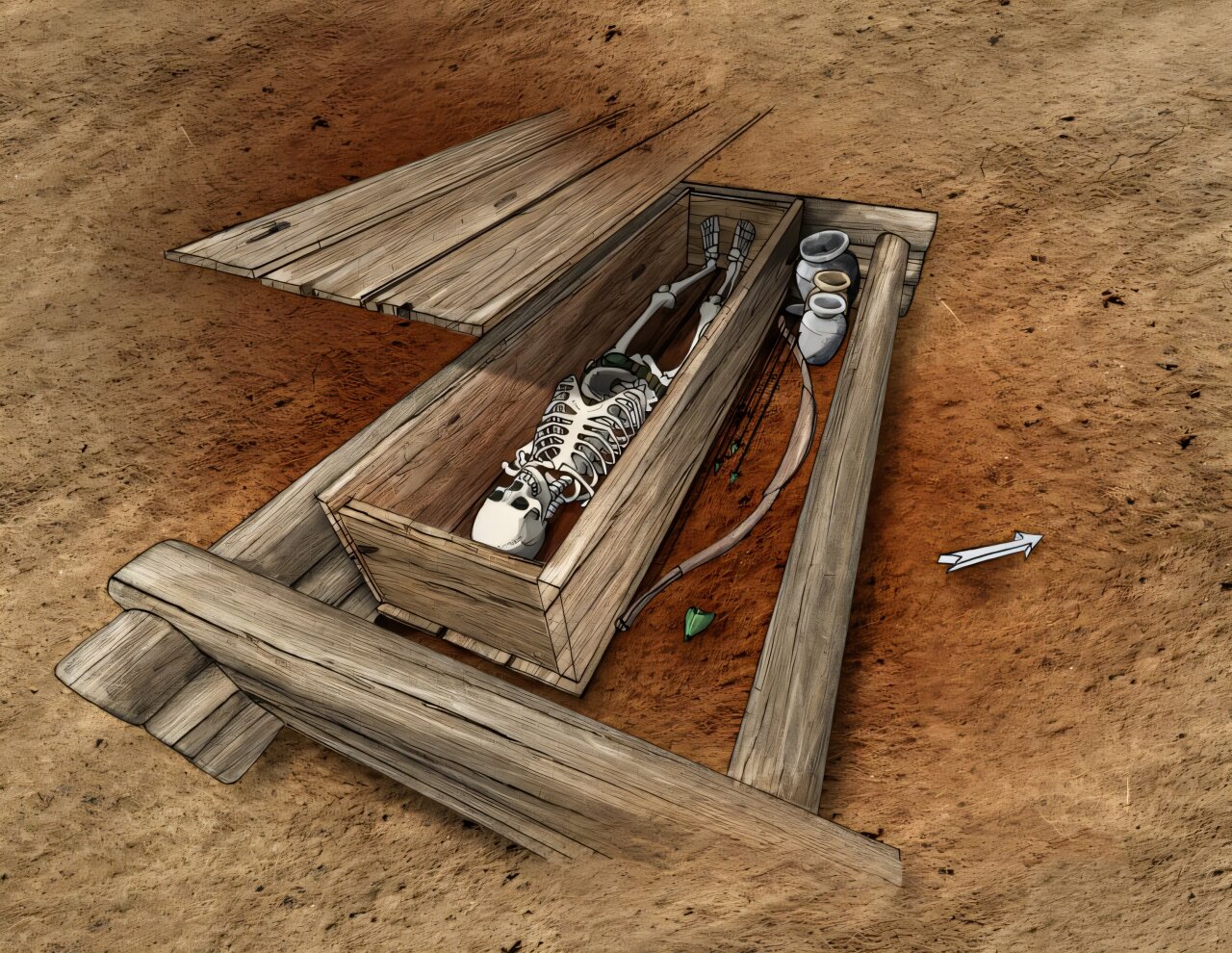
Burials at the ancient Tamir cemetery in Mongolia were shaped far more by wealth, political status, and social alliances than by biological family ties, according to a new study. By combining ancient DNA, machine learning, statistical modeling, and evolutionary-inspired analysis, researchers uncovered a complex social system where power—not blood—determined who rested beside whom.
For generations, archaeologists have often viewed ancient cemeteries as places where families remained together in death. But a remarkable investigation of a 2,000-year-old burial ground on the edge of the Mongolian steppe is challenging that assumption, revealing a society where political influence and social standing outweighed biological relationships.
The findings come from the Tamir cemetery, an important burial site linked to the Xiongnu Empire, and suggest that the organization of graves reflected a carefully maintained social hierarchy rather than simple family connections.
An Ancient Cemetery at the Frontier of the Xiongnu Empire
The Tamir cemetery overlooks the meeting point of two rivers on the edge of the vast steppe stretching toward the Gobi Desert. It served as a burial ground for members of the Xiongnu, the first great nomadic empire of the Central Asian steppes and long-standing rivals of China’s Han dynasty.
The cemetery was established around 100 BC, shortly after Han forces pushed the Xiongnu north of the Gobi Desert. It remained in use until approximately AD 100, when the empire declined and the cemetery was eventually abandoned.
Researchers were especially interested in Tamir because its eastern section is one of the few fully excavated Xiongnu cemeteries in Mongolia. Even more valuable, the site was excavated with exceptional detail, preserving information that allowed scientists to investigate not only who was buried there, but also how social relationships may have shaped burial practices.
Although historians know the Xiongnu divided political authority into “Left” and “Right” branches led by close relatives of the ruling family, exactly how those political structures influenced everyday life—and death—has remained uncertain.
Combining Ancient DNA With Machine Learning
Earlier ancient DNA research had already identified two major biological family groups, known as Lineages A and B, along with a third unrelated group called Lineage C.
To move beyond genetic relationships, researchers combined three complementary analytical approaches.
One used statistical modeling to examine whether grave goods could predict family relationships, wealth, and burial location. A second employed machine learning to identify patterns without first telling the computer which individuals were related. The third adapted methods commonly used in evolutionary biology to build “family trees,” but instead of tracing genes, it mapped similarities in burial customs.
Researchers emphasized that they were not treating funerary traditions as inherited like DNA. Instead, they borrowed the mathematical framework used to compare biological evolution and applied it to cultural practices such as body position and the objects buried alongside individuals.
The result was not a genetic family tree but a map showing cultural relationships across the cemetery.
Wealth, Not Blood, Shaped the Cemetery
The analyses pointed to a clear conclusion: social rank and wealth played a greater role than biological kinship in determining burial placement and funeral treatment.
Rather than functioning as a straightforward family cemetery, Tamir reflected a society where power, alliance, and symbolic affiliation influenced how people were honored after death.
Researchers even suggest that Lineages A and B may correspond to the Xiongnu’s historical Left and Right political branches.
One intriguing pattern involved Lineage A. Most generations included only a single family member buried at Tamir, implying that brothers and sisters were often buried elsewhere.
That pattern makes one remarkable exception especially revealing.
Two Brothers, Two Very Different Burials
Among the most striking discoveries were two brothers who shared the same biological family but experienced dramatically different funerals.
One brother was buried with his wife in one of the cemetery’s richest graves among members of Lineage A. His burial reflected exceptional status and prestige.
His brother, despite sharing the same ancestry, was buried roughly 200 meters (656 feet) away on the cemetery’s outskirts.
Their contrasting resting places demonstrate that shared blood alone did not determine burial treatment. Social standing could separate even close relatives in death.
Signs of a Changing Empire
Researchers also identified another unusual burial involving a wealthy man and a poor woman interred together.
Most couples at Tamir received similar burial treatment, making this pairing stand out from the broader pattern.
The timing may offer an important clue.
Their graves belong to the cemetery’s final phase, almost coinciding with the collapse of the Xiongnu around AD 85. During this period, grave goods became increasingly scarce before the cemetery was ultimately abandoned.
These changes suggest that broader political and economic shifts were beginning to reshape long-established burial customs as the empire weakened.
A New Tool for Studying Ancient Societies
The researchers describe their work as a proof of concept, demonstrating that analytical techniques inspired by evolutionary biology can help archaeologists uncover hidden social structures preserved within ancient cemeteries.
Instead of relying on genetics alone, the approach combines biological, cultural, and statistical evidence to reconstruct how ancient communities organized themselves.
The next step is to apply the same methods to other archaeological sites with similarly detailed burial records to determine whether comparable patterns emerge across different societies and historical periods.
Why This Matters
The Tamir cemetery reveals that ancient communities could define family in ways that extended beyond biological relationships. While DNA identified generations of relatives buried at the site, the broader organization of the cemetery reflected a society where wealth, political authority, social alliances, and symbolic identity carried tremendous weight.
By combining ancient DNA, machine learning, and innovative cultural analysis, researchers have shown that burial grounds can preserve not only family histories but also the social and political structures that shaped an empire. The study offers a powerful new framework for understanding how status and allegiance influenced life—and continued to matter long after death.