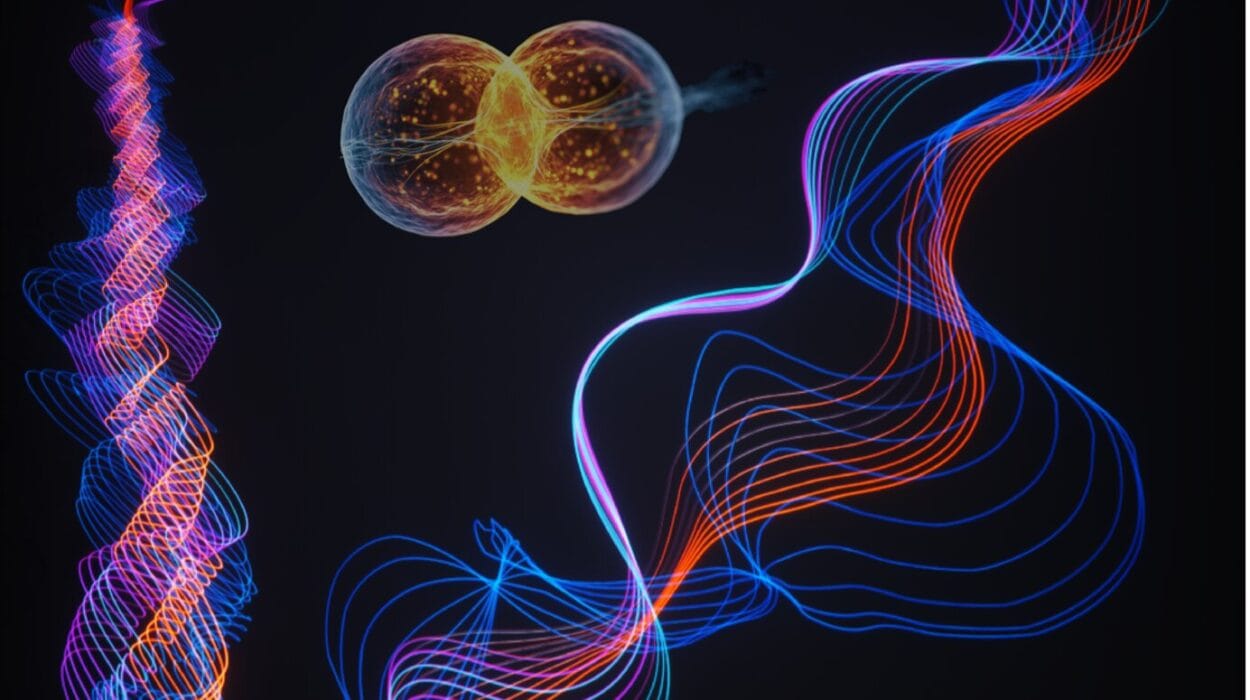
Trying to slice a single photon into two parts may trigger one of quantum physics’ strangest outcomes. New calculations suggest that rather than producing smaller pieces of light, the process would generate a quantum state containing an infinite number of photons, all emerging from disturbances in the electromagnetic field.
A photon is supposed to be indivisible. By definition, it is an elementary particle—something that cannot be broken into smaller components. But what if you tried anyway?
That question drove a new theoretical investigation published in Physical Review Letters, where researchers explored what would happen if a single photon were partially blocked while moving through space. Their answer challenges everyday intuition and reveals a surprisingly complex quantum reality: attempting to cut a photon in half does not create two smaller photons. Instead, it leads to a state containing infinitely many photons.
What Happens When a Photon Meets an Ultra-Fast Shutter?
The study, led by Johannes Skaar and colleagues, focused on one of the defining features of quantum particles. A photon behaves both as a localized particle and as a wave spread across space.
To investigate the consequences of interrupting that wave, the researchers imagined a photon passing through an optical shutter—a device that acts like an extremely fast mirror that can switch on and off.
If the shutter operates quickly enough, it can block only part of the photon’s extended wave. In effect, it would appear to “snip” the photon while it is in transit.
The key question was what happens to the photon’s quantum state after such an intervention.
Following the Quantum Mathematics
To answer that question, the team applied quantum equations describing the behavior of the photon’s underlying electromagnetic field.
Their analysis tracked how the photon’s quantum state would change when the shutter suddenly interrupted part of its wave. Rather than relying on a simplified picture of a particle being physically cut apart, the researchers examined the full quantum description of the electromagnetic field.
The outcome turned out to be far more complicated than expected.
Not One Photon and Empty Space
An intuitive prediction might be that the shutter would leave a photon on one side and nothing on the other. The calculations showed something entirely different.
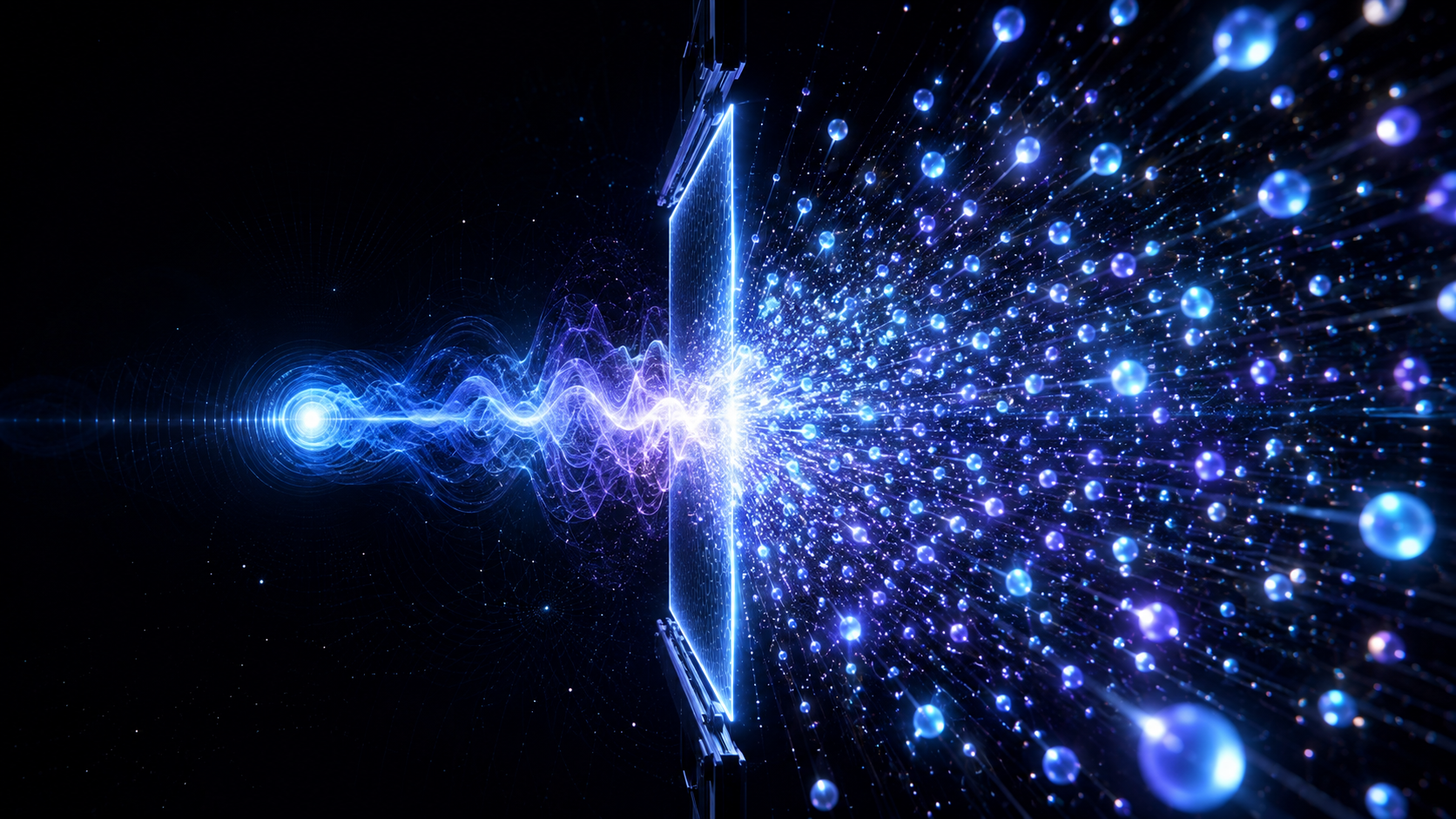
According to the study, the rapid action of the shutter produces a superposition containing infinitely many photons simultaneously.
In quantum mechanics, a superposition means multiple possible states exist at the same time until a measurement is made. Here, the resulting state is not simply a photon that has been partially removed. Instead, it becomes a far richer quantum configuration involving an unlimited number of photon states.
Empty Space Is Not Really Empty
The reason lies in a fundamental feature of quantum theory.
Even a vacuum is not completely empty. The electromagnetic field continues to experience fluctuations, meaning there is constant underlying quantum activity.
The researchers found that rapidly switching the optical shutter disturbs these fluctuations. That disturbance can spontaneously generate new photons.
As a result, what began as an attempt to cut a single photon transforms into a much more complex quantum state filled with newly created photons.
The calculations suggest that these additional photons are not added by any external source. Rather, they emerge from the quantum behavior of the electromagnetic field itself when it is suddenly disrupted.
Why the Result Looks Deceptively Ordinary
One of the most surprising aspects of the study is that the bizarre quantum state may not look unusual at first glance.
The researchers found that if an observer examined only the regions immediately on either side of the shutter, everything would appear normal.
The state would seem indistinguishable from a situation containing a single photon on one side and a vacuum on the other. The deeper complexity only becomes apparent when considering the full quantum description of the system.
In other words, a process that appears straightforward from a local perspective actually hides an extraordinarily intricate structure beneath the surface.
New Questions About Quantum Reality
Beyond its unusual conclusion, the work highlights how differently quantum particles behave compared with familiar objects in everyday life.
A classical object can often be divided into smaller pieces. The study suggests that the same intuition breaks down completely when applied to elementary quantum particles such as photons.
The findings also raise broader questions about how quantum systems are measured and how information is distributed and localized in space. Understanding those issues remains one of the central challenges in quantum physics.
The researchers plan to continue investigating these effects, including whether similar behavior occurs when multiple photons are involved. They also aim to explore whether comparable phenomena could arise for other elementary particles, including electrons.
Why This Matters
This study does not show that photons can literally be split into smaller photons. Instead, it demonstrates how attempts to force classical ideas onto quantum particles can reveal unexpected features of quantum fields.
By showing that interrupting a single photon’s wave can theoretically produce a state containing infinitely many photons, the research provides a striking example of how quantum reality differs from common intuition. It also opens new avenues for exploring the nature of measurement, vacuum fluctuations, and the fundamental structure of quantum systems.
Study Details
Isak Cecil Onsager Rukan et al, Truncated photon, Physical Review Letters (2026). DOI: 10.1103/94pm-hp34. On arXiv: arxiv.org/abs/2510.21636