Gas racing outward at nearly one-third the speed of light has been detected around a distant supermassive black hole, setting a new record for ultraviolet observations. The extraordinary outflow, found in a quasar known as J2318, is forcing astronomers to rethink how intense radiation can accelerate matter while preserving the atomic signatures they observe.
Something unusual was hiding in the light from a distant quasar. At first glance, J2318 appeared to be just another supermassive black hole-powered object among countless others scattered across the universe. But a closer look revealed an astonishing surprise: a wind moving toward Earth at 30% of the speed of light, making it the fastest quasar wind ever discovered at ultraviolet wavelengths.
The discovery, led by researchers at York University and published in The Astrophysical Journal, sheds new light on some of the most energetic processes occurring around supermassive black holes.
A Typical Black Hole With an Extraordinary Wind
At the center of J2318 sits a black hole with a mass of roughly 1.7 billion Suns. While enormous, that mass is not unusual for a quasar.
What sets J2318 apart is the speed of the gas flowing away from the region surrounding the black hole.
According to the researchers, the wind reaches velocities of 30% of the speed of light, a record for winds detected in ultraviolet light. Lead author Lucas Seaton compared the phenomenon to an impossibly powerful hurricane, saying its speed would be equivalent to a hypothetical “Category 79” hurricane—a comparison intended to illustrate just how extreme the outflow is compared with anything experienced on Earth.
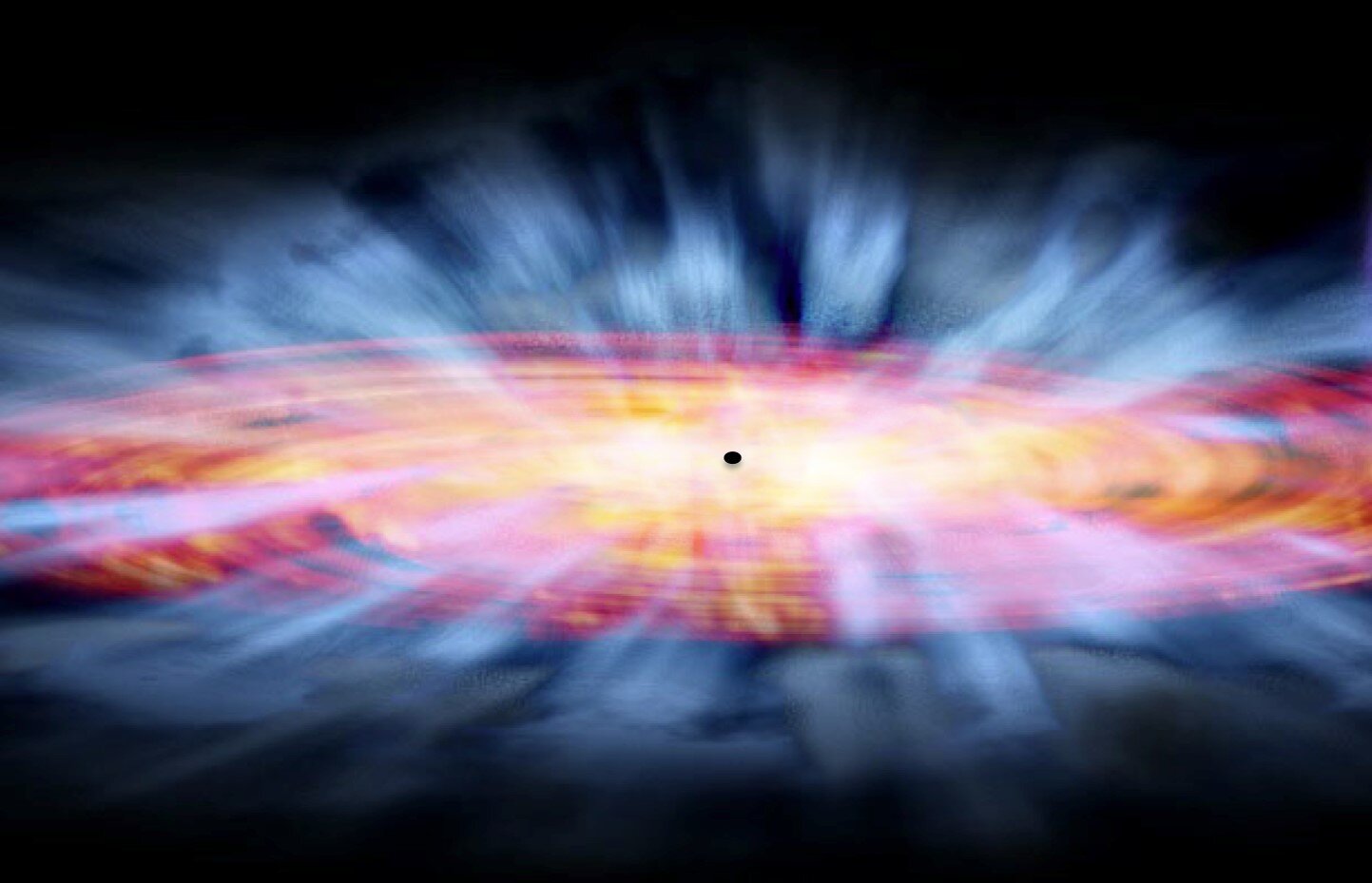
The quasar is located in the Great Square of the constellation Pegasus and is powered by a vast disk of hot gas spiraling into the central black hole.
How Quasars Launch Powerful Winds
For decades, astronomers have known that large galaxies host supermassive black holes at their centers. As material falls inward, it forms a hot, luminous disk known as a quasar.
These disks emit enormous amounts of light—enough to be visible across the observable universe. That radiation can also push gas away from the black hole.
Unlike winds on Earth, which are driven by pressure differences in the atmosphere, quasar winds are propelled at least partly by photons, the particles of light themselves.
When photons are absorbed or scattered by atoms in the gas, they transfer momentum. In a quasar, where the number of photons is immense, these tiny pushes can accumulate and accelerate gas to remarkable speeds.
The newly discovered outflow in J2318 demonstrates this process operating at an extreme level.
A Scientific Puzzle Emerges
The discovery does more than establish a speed record. It also highlights a major challenge for astronomers trying to understand how these winds work.
The same intense radiation that accelerates gas can also strip electrons from atoms. If too many electrons are removed, important atomic signatures disappear from observations.
Yet in J2318, researchers still detected ions of elements such as carbon and silicon while observing the extraordinarily fast wind.
That creates a puzzle: how can the radiation push gas to such extreme velocities while preserving the atomic states that astronomers can still observe?
The answer remains unclear, making J2318 an important target for future research.
The Discovery Began With Student-Led Observations
The record-breaking wind was uncovered using data from two components of the Sloan Digital Sky Survey (SDSS), a long-running international effort that has mapped the universe since 1998.
Graduate student Marianna Veltri first identified the quasar as potentially interesting in 2023 while still an undergraduate student at York University. After examining the object with software established by undergraduate researcher Zezhou Zhu, York professor Patrick Hall realized the quasar appeared to host an exceptionally fast outflow.
To verify the finding, the team quickly secured observations from the Frederick C. Gillett Gemini Telescope (Gemini North) in Hawai‘i. Those observations confirmed the wind’s record-breaking velocity.
The project also highlights the growing role of undergraduate researchers in modern astronomy. Hall noted that surveys such as SDSS allow students to examine large amounts of spectral data and identify unusual objects that might otherwise go unnoticed.
Twenty Years of Data Revealed the Hidden Wind
One of the study’s most intriguing findings is that J2318 did not stand out because of dramatic changes in brightness.
Veltri assembled measurements spanning 20 years from multiple surveys, beginning with the original SDSS observations. Those records showed that the quasar’s brightness varies in a manner indistinguishable from many other quasars.
The extraordinary wind became visible only through detailed analysis of the object’s spectrum—the breakdown of its light into different wavelengths.
Further work by co-author Liliana Flores examined absorption features within the spectrum and found that the amount of absorbed light changes over time. That variability suggests conditions within the wind itself are evolving.
Clues to How Galaxies Evolve
Researchers believe these extreme outflows may play an important role far beyond the immediate surroundings of a black hole.
According to study co-author Paola Rodríguez Hidalgo, such winds carry tremendous amounts of energy and may help connect the activity near a galaxy’s central black hole with processes occurring throughout the rest of the galaxy.
This connection, often referred to as feedback, has long been incorporated into simulations of galaxy formation. However, observational evidence remains incomplete, and discoveries like J2318 provide valuable opportunities to test and refine theoretical models.
The team is now continuing its search for similarly powerful quasar winds across both nearby and distant regions of the universe.
Why This Matters
The discovery of J2318’s record-breaking ultraviolet wind provides a rare glimpse into one of the universe’s most extreme environments. By revealing gas moving at 30% of the speed of light, the finding challenges astronomers to explain how radiation can accelerate matter so efficiently while preserving the atomic signatures visible in observations.
Beyond setting a new speed record, the quasar offers an important laboratory for studying how supermassive black holes influence their host galaxies. Understanding these powerful outflows could help researchers better explain the long-term evolution of galaxies and improve the simulations used to model the universe itself.
Study Details
Lucas M. Seaton et al, A New Member of the Fast and Furious Family: A Relativistic and Time-variable UV Outflow in a Luminous Quasar, The Astrophysical Journal (2026). DOI: 10.3847/1538-4357/ae5f94