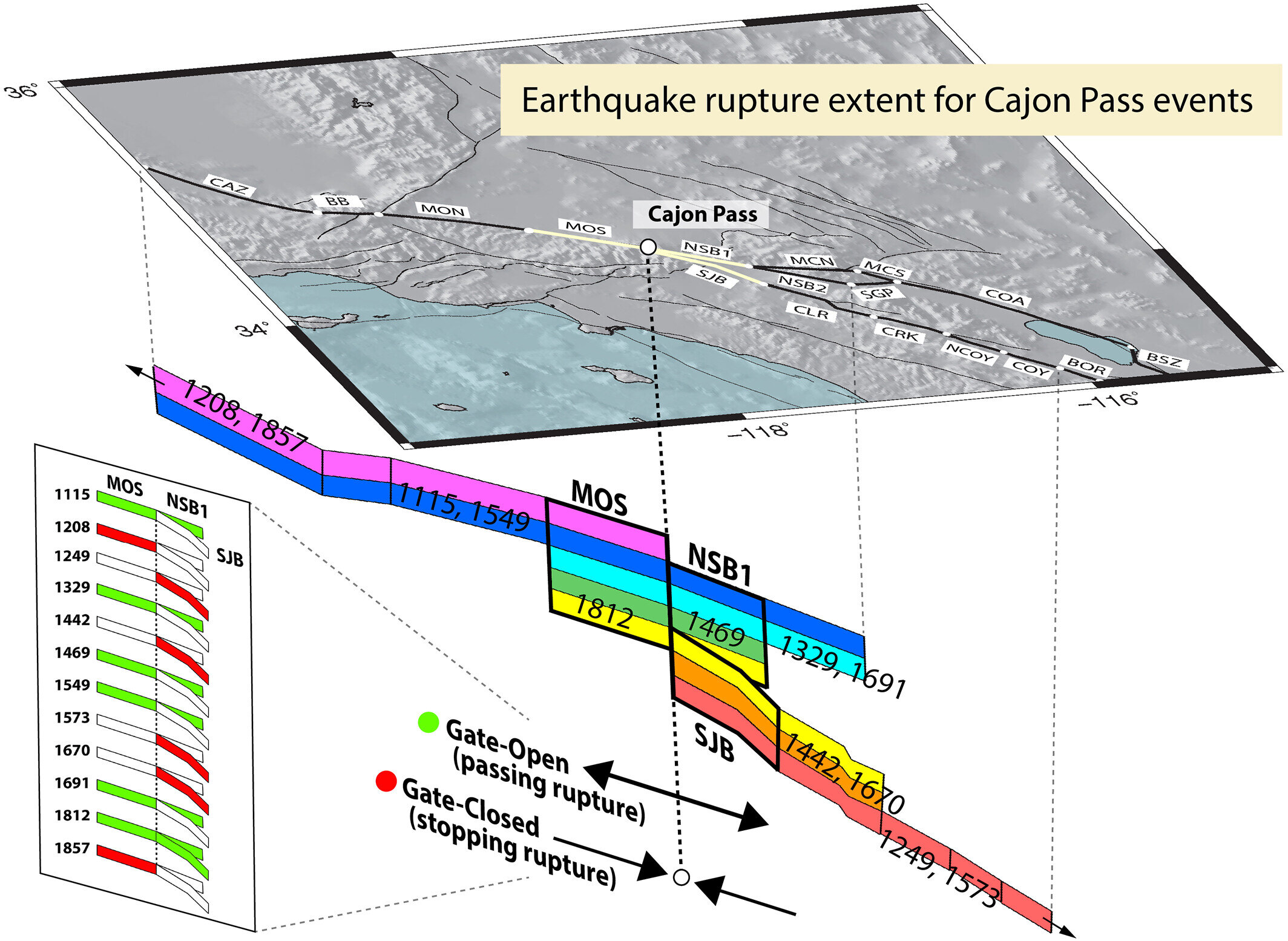
Tectonic stress along Southern California’s most important fault systems has reached—and in some places exceeded—the highest levels seen in the past millennium, according to a new study. Researchers found that a critical junction known as Cajon Pass may act as an “earthquake gate,” influencing whether future ruptures stay confined to one fault or spread across two major fault systems at once.
For decades, scientists have watched Southern California’s fault networks with growing concern. Now, a new analysis suggests that the region may be carrying more accumulated tectonic stress than at any point in the last 1,000 years, highlighting the importance of understanding how future earthquakes could unfold.
The study focuses on the complex interaction between the San Andreas Fault and the San Jacinto Fault, two of the most significant fault systems in Southern California. Where these faults approach one another northeast of Los Angeles lies Cajon Pass, a critical geological junction that researchers believe could play a decisive role in determining the scale of future earthquakes.
Published in the Journal of Geophysical Research: Solid Earth, the research was led by Dr. Liliane Burkhard of the University of Bern and involved scientists from several U.S. institutions, including the University of Hawaiʻi at Mānoa, the U.S. Geological Survey Earthquake Science Center, and the Scripps Institution of Oceanography.
Reconstructing a Millennium of Earthquake Activity
To understand how stress has accumulated over time, the research team built a sophisticated four-dimensional earthquake cycle model that simulates fault behavior in three spatial dimensions while tracking changes through time.
The model was fed with a reconstructed 1,000-year earthquake history derived from geological and historical evidence, including radiocarbon dating, tree-ring records, and documented surface ruptures.
According to the researchers, the simulation tracks how each earthquake redistributes stress across neighboring fault segments, how stress accumulates during periods of relative quiet, and how deeper parts of Earth’s crust gradually relax after major seismic events.
By replaying centuries of earthquake activity, the team was able to estimate the present-day stress state of the fault network.
Their conclusion was striking: stress levels across the region are currently at their highest point in the entire millennium-long simulation.
The Discovery of an “Earthquake Gate”
One of the study’s most important findings is the introduction of the “earthquake gate” concept.
Researchers describe Cajon Pass as a dynamic junction that can determine whether a large earthquake remains restricted to a single fault system or propagates across both the San Andreas and San Jacinto faults in a single event.
Historical earthquakes demonstrate both possibilities.
The 1857 Fort Tejon earthquake, which reached magnitude 7.9, stopped at Cajon Pass and did not continue onto the San Jacinto Fault. In contrast, the 1812 Wrightwood earthquake crossed through the junction and ruptured both fault systems in a single event.
The new research suggests that Cajon Pass does not consistently behave one way or the other. Instead, its behavior changes depending on the stress conditions present at a given time.
Researchers found that the likelihood of a rupture crossing the junction depends not only on how much stress has accumulated on individual faults but also on how closely the stress levels on both fault systems match one another.
When stress rises on both faults in a similar way, conditions become more favorable for a rupture that spreads across both systems. When stress levels diverge, ruptures are more likely to stop at the junction.
Stress Levels Are Approaching Critical Conditions
The modeling results indicate that current conditions resemble those associated with past joint ruptures.
On the San Jacinto–Bernardino section, modeled stress has reached 3.6 MPa, surpassing the highest value recorded anywhere in the 1,000-year simulation.
Meanwhile, the neighboring Mojave South section of the San Andreas Fault has reached 2.8 MPa.
Researchers emphasize that both fault segments are not only highly stressed but are also carrying relatively similar stress levels. Historically, this combination has been linked to scenarios in which ruptures crossed the Cajon Pass and involved both fault systems simultaneously.
According to Burkhard, the concern is not merely that stress levels are reaching historic highs. Equally important is the fact that the relationship between stress levels on the two fault systems is moving into a range associated with larger, multi-fault ruptures.
What a Joint Rupture Could Mean
The consequences of a rupture involving both major fault systems would be substantially greater than those of an earthquake confined to a single fault.
The affected area includes some of the most densely populated and infrastructure-dependent regions in the United States, including the greater Los Angeles area, San Bernardino, Riverside, and the Coachella Valley.
Critical transportation and utility networks also pass directly through Cajon Pass, including major highways, rail corridors, and energy infrastructure.
Because of this, understanding how stress evolves within the fault system is a major priority for geoscientists and hazard planners.
Not a Prediction, but a Warning About Possibilities
Despite the alarming findings, the researchers stress that the study does not predict when an earthquake will occur.
Instead, the work provides a physics-based assessment of the current condition of the fault system and helps identify the types of rupture scenarios that may be possible under present-day stress levels.
The modeling framework also has applications beyond California, offering a way to investigate other complex fault junctions around the world.
Burkhard notes that while the timing of future earthquakes remains uncertain, understanding the current stress state is essential for evaluating hazards and preparing for a range of potential outcomes.
Why This Matters
Southern California has experienced a prolonged period without a major earthquake affecting the wider Los Angeles region since the 1857 Fort Tejon earthquake. During that time, tectonic stress has continued to build beneath the surface.
This study suggests that stress levels have now reached their highest point in at least 1,000 years, while the interaction between the San Andreas and San Jacinto fault systems is approaching conditions historically associated with larger, interconnected ruptures.
Although the research does not forecast an imminent earthquake, it provides critical insight into how the region’s fault network is evolving. That knowledge can help guide hazard assessment, infrastructure planning, and emergency preparedness, giving communities and decision-makers a clearer understanding of the risks they may need to confront in the future.
Study Details
Liliane M. L. Burkhard et al, Cajon Pass and the Southern San Andreas Fault System: Earthquake Cycle Stress Accumulation and Present‐Day Loading, Journal of Geophysical Research: Solid Earth (2026). DOI: 10.1029/2025jb033213
Interactive Online Tool “LA-GRID” Liliane Burkhard developed the online tool “LA-GRID” (Los Angeles Geospatial Risk and Infrastructure Dashboard). This web-based, interactive tool visualizes seismicity and fault data for the Los Angeles region, with live updates on earthquakes and wildfires. The tool: https://liliane-sys.github.io/LA-GRID/