Dozens of headless human skeletons discovered in a 7,000-year-old settlement in Slovakia initially appeared to tell a story of violence and social collapse. But new research suggests the remains may instead reflect complex burial practices that played an important role in the social lives of early farming communities.
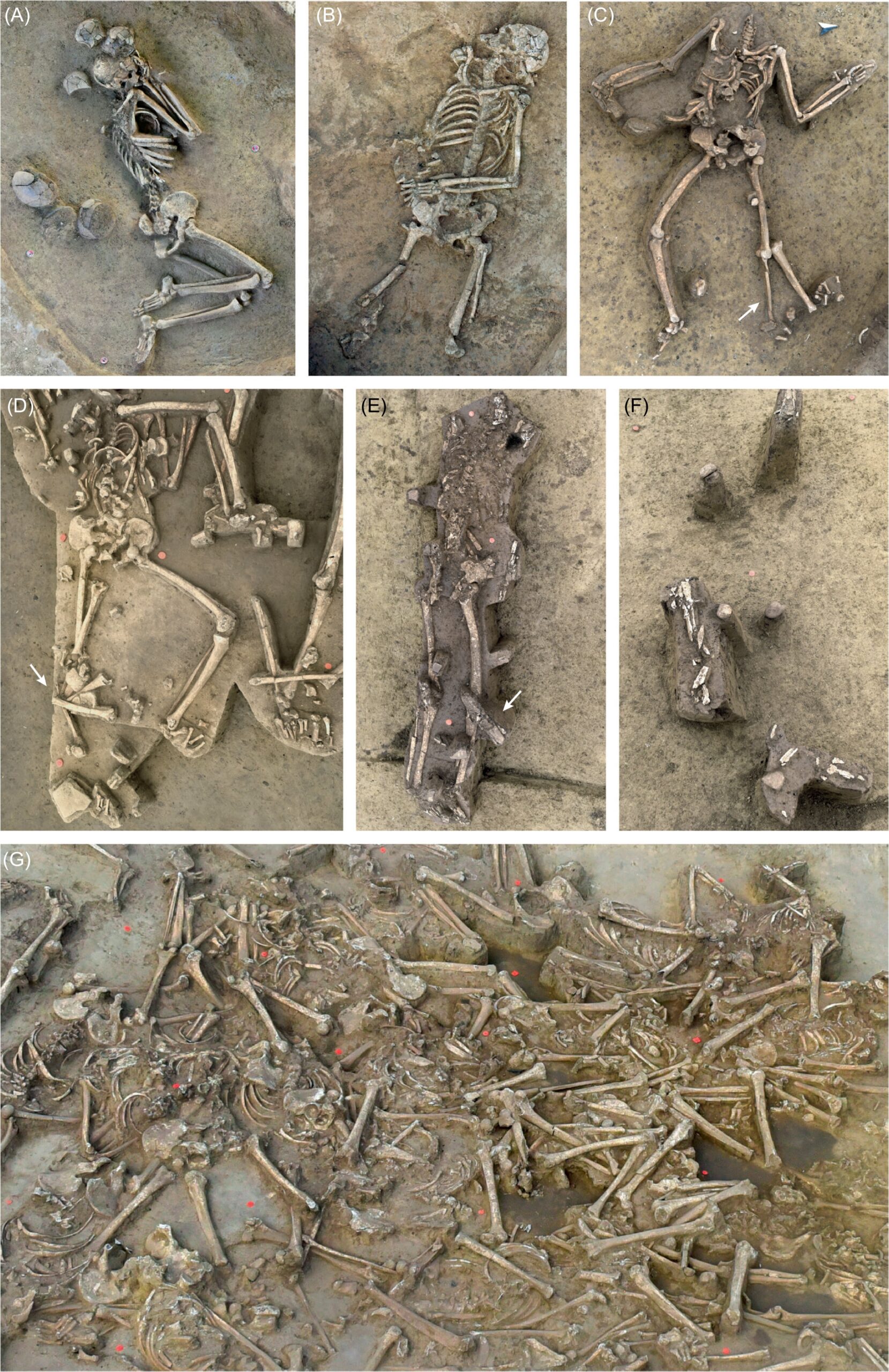
A startling scene has been emerging from the soil near the modern Slovak town of Vráble. Archaeologists have uncovered dozens of human skeletons lying on and beside one another, many in unusual positions and almost all missing their skulls. At first glance, the discovery seems to point toward a grim chapter of prehistory—a massacre, conflict, or societal breakdown.
Yet the evidence collected so far is leading researchers toward a very different conclusion.
According to a new study published in Proceedings of the Prehistoric Society, the strange burials may have been part of meaningful and recurring social practices rather than signs of widespread violence. The findings challenge long-standing assumptions about how archaeologists interpret unusual human remains from the late Neolithic period.
One of Central Europe’s Most Important Neolithic Sites
The discoveries come from the large Neolithic settlement of Vráble, one of the most significant archaeological sites associated with the Linear Pottery culture (LBK) in Central Europe.
Researchers from Kiel University and the Slovakian Academy of Sciences in Nitra have been studying the settlement since 2012. The site contains the outlines of more than 300 houses spread across three neighborhoods. At its peak, as many as 80 buildings may have been occupied at the same time.
The settlement existed for several centuries, roughly between 5250 and 4950 BCE, offering researchers a rare opportunity to investigate the lives and customs of some of Europe’s earliest farming communities.
One section of the settlement was enclosed by a ditch that likely served as a boundary. Human remains had been found there during earlier excavations, but the scale of the discoveries became much clearer after fieldwork resumed in 2022.
Near an entrance to the settlement, archaeologists uncovered the remains of at least 78 individuals, deposited in a variety of positions with no obvious organizational pattern.
The Mystery of the Missing Skulls
Among the most striking aspects of the discovery is the near-total absence of skulls.
Of the 78 individuals, 77 lacked a head. Only a single skeleton—a child—was found with its skull still preserved.
Researchers believe that little time passed between the deaths of these individuals and their burial. This observation is important because it suggests the bodies were intentionally manipulated soon after death rather than being disturbed centuries later.
The evidence points toward deliberate actions involving the bodies.
Dr. Katharina Fuchs, a biological anthropologist at Kiel University and co-author of the study, explained that the remains clearly show intentional manipulation. Early analyses indicate that the skulls were not removed through violent decapitation. Instead, the evidence suggests a more careful and skilled removal process.
This distinction is crucial. If the heads had been severed violently, it might support theories involving warfare, execution, or massacre. Instead, researchers are seeing indications of a controlled practice whose purpose remains uncertain.
A Different Interpretation of Ancient Burials
The missing skulls raise an obvious question: where did the heads go?
One possibility is that the skulls were stored separately. Although direct evidence for this practice has not yet been found at Vráble, similar behaviors have been documented in other prehistoric contexts.
Body manipulation after death was not unknown among Neolithic societies. Comparable practices have been recorded both within the Linear Pottery culture and in other prehistoric communities. However, the exact methods and meanings varied widely from place to place.
Likewise, the placement of bodies or body parts within settlement ditches is not unique to Vráble. Archaeologists have identified similar patterns at other sites dating to the later phases of the LBK.
For decades, such discoveries have often been interpreted as evidence of social crisis. Mass graves, unusual burials, and manipulated bodies have frequently been linked to conflict, violence, or periods of instability.
The researchers involved in the new study argue that this explanation may be too simplistic.
Instead, they suggest these deposits could represent socially significant rituals carried out repeatedly over time. Such practices may have helped structure relationships within communities and across wider regional networks.
Dr. Nils-Müller-Scheeßel, a co-author of the study, noted that the deposition of bodies and body parts may have formed part of more complex and meaningful traditions than previously assumed.
Looking Beyond Violence
One reason the researchers are cautious about interpreting the remains as evidence of conflict is the relative lack of signs pointing directly to violence or crisis.
Lead author Prof. Dr. Martin Furholt emphasized that the available evidence currently supports a view in which these unusual burials were embedded within broader social practices rather than representing a catastrophic event.
The challenge, he explained, lies in understanding cultural behaviors that existed within systems of meaning very different from those of modern societies.
Practices that appear disturbing or incomprehensible today may have held specific social, ceremonial, or symbolic significance for Neolithic communities. Without written records, archaeologists must reconstruct these meanings from physical evidence alone.
That task becomes even more difficult when dealing with burial customs that do not fit modern expectations.
More Answers May Be Hidden in the Bones
Although the new study offers an important reinterpretation of the site, many questions remain unanswered.
Researchers are continuing to sort and analyze the recovered bones. Ongoing investigations aim to determine the age and biological sex of the individuals and to examine marks on the neck vertebrae in greater detail.
Additional studies are exploring whether any evidence of violence can be detected and how the bodies decomposed after burial.
Future DNA analyses and isotope studies are expected to provide insights into the individuals’ origins, diets, and family relationships. Researchers also hope to learn more about the construction and purpose of the ditch system where the remains were found.
Each new piece of evidence could help clarify why so many people were buried together and why nearly all of them were missing their skulls.
Why This Matters
The discoveries at Vráble are important not simply because they are unusual, but because they offer a rare window into how early farming societies understood death, the human body, and community relationships.
Rather than reinforcing assumptions about violence and collapse, the findings encourage archaeologists to consider that seemingly disturbing discoveries may reflect complex cultural traditions. As researchers continue to investigate the site, Vráble may help answer some of the most fundamental questions about Neolithic life: how people treated their dead, how social bonds were expressed through ritual, and how communities organized themselves thousands of years before written history.
The mystery of the headless skeletons is far from solved. But the evidence gathered so far suggests that what first appeared to be a story of tragedy may instead reveal a deeper and more complicated chapter of human social history.
Study Details
Martin Furholt et al, Neolithic Bodies in Vráble—7000 year-old Headless Human Skeletons in an Enclosed LBK Settlement in South–West Slovakia, Proceedings of the Prehistoric Society (2026). DOI: 10.1017/ppr.2026.10082