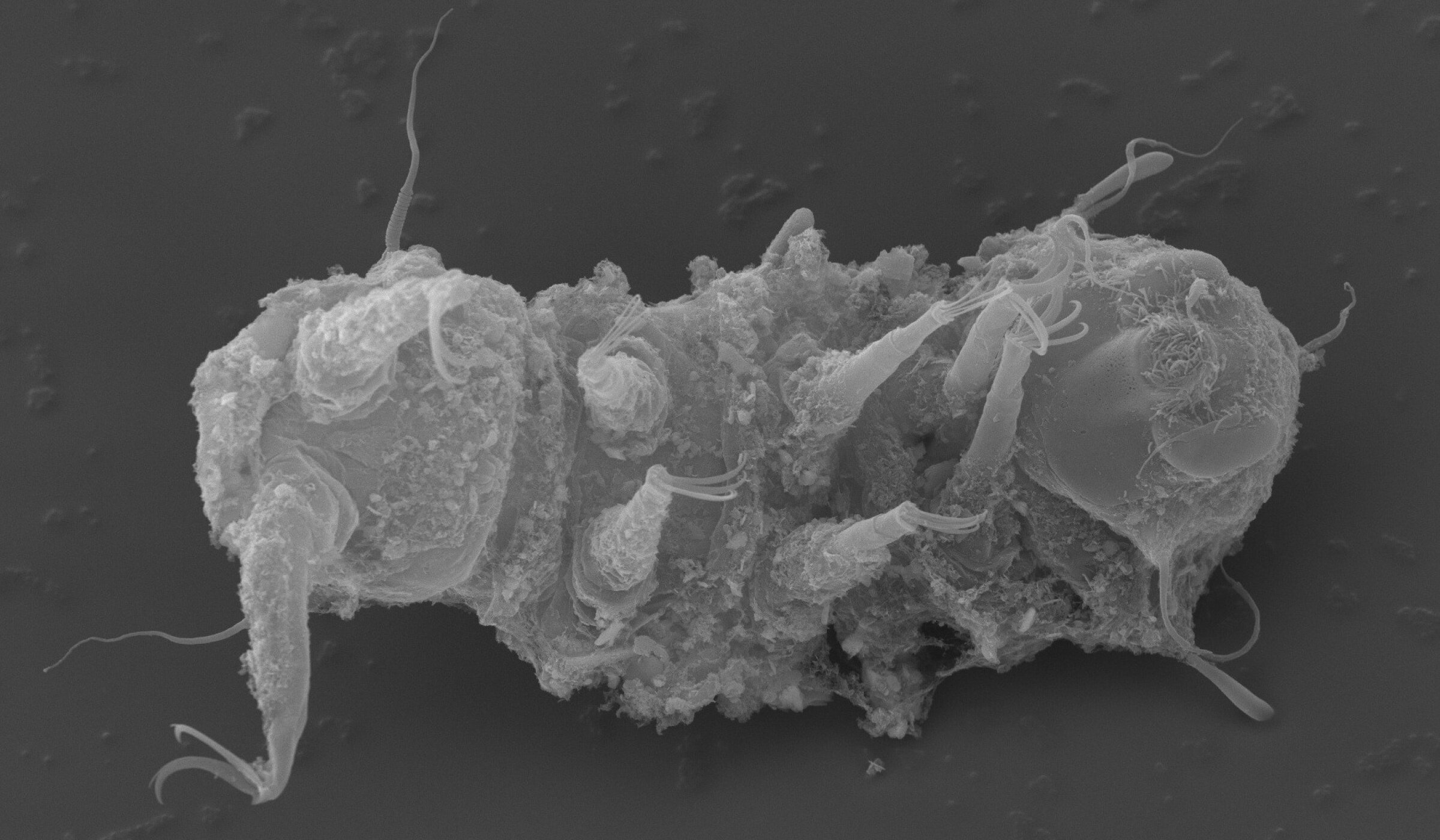
Scientists have identified two previously unknown species of microscopic marine tardigrades living in sediment atop the Senghor Seamount in the eastern Atlantic. The discovery adds to evidence that underwater mountains can harbor unusually diverse communities of life, even among animals barely visible to the naked eye.
The two new species were found in sediment collected from Senghor Seamount, an underwater mountain off the Cape Verde Islands. Researchers identified 20 tardigrade taxa—distinct biological groups—in samples from the seamount, compared with just two at a deep-sea reference site roughly 100 kilometers (62 miles) farther north.
The findings suggest that seamounts may support far richer communities of these tiny animals than the surrounding deep-sea floor.
A mountain rising from the deep
Senghor Seamount stands out from the surrounding ocean floor. Its summit lies about 100 to 130 meters (330 to 430 feet) below the surface, while the seabed around it drops to depths of several thousand meters.
The difference extends to the sediment. At the summit, the seafloor is covered mainly by coarse, calcium-rich material made from fragments of marine organisms, including corals, sea urchins, bryozoans, clams and snails. Farther out on the deep-sea floor, the sediment is mostly fine, mudlike material.
These contrasting environments may help explain why the seamount supports a much larger variety of tardigrades than the nearby deep-sea site, although the study does not establish which environmental factors account for the difference.
The research team, led by Dr. Alexander Kieneke and Dr. Roman R. Trokhymchuk of Senckenberg am Meer in Wilhelmshaven, examined material collected during a 2009 expedition aboard the research vessel Meteor.
Of the 219 tardigrades examined, 212 came from the seamount’s summit plateau and just seven from the deep-sea reference site. The researchers documented 20 different taxa at the seamount, compared with two at the reference site.
The contrast supports the idea that seamounts can act as biodiversity-rich habitats for marine tardigrades. However, the limited number of specimens recovered from the deep-sea site makes it difficult to draw firm conclusions about the full difference in biodiversity between the two environments.
Two species with unusual physical traits
The newly described animals belong to the armored tardigrades, a group characterized by distinctive body structures. Their physical features also help scientists distinguish species that might otherwise be difficult to identify.
One of the new species, Megastygarctides hekatae, has genital spines—short, hollow projections with small hooks connected to the internal reproductive organs. Such structures are extremely rare among tardigrades.
The species was also collected at a depth of about 100 meters (330 feet), making it the deepest known record of a tardigrade belonging to the genus Megastygarctides.
The second species, Parastygarctus potercha, has a developmental feature known as pedomorphism, in which adults retain certain physical characteristics associated with an earlier stage of development. In this species, those traits include a particularly small body and fewer claws.
These differences are important for identifying and classifying tardigrades, particularly in marine environments where many species remain poorly documented.
Marine tardigrades remain poorly studied
Tardigrades, often called water bears, are tiny animals typically measuring only a few tenths of a millimeter. Their compact bodies and slow, awkward movements resemble those of miniature bears. They inhabit mosses on land as well as freshwater and marine environments.
In marine habitats, they form part of the meiofauna, a community of very small organisms living in seafloor sediments, generally measuring up to one millimeter.
Although tardigrades are widely known for their ability to withstand extreme conditions, much of their diversity in marine environments remains undocumented. The researchers note that as many as 35 tardigrade species have been recorded on the Faroe Bank, another Atlantic plateau, while large areas of the deep sea remain unexplored.
That gap means species counts from well-studied locations may not reflect the true diversity of marine tardigrades across the ocean.
The new study also provides updated identification keys for the genera Megastygarctides and Parastygarctus, helping researchers distinguish species using their physical characteristics. With the two additions, Megastygarctides now includes seven known species, while Parastygarctus includes eight.
The discovery expands the known diversity of marine tardigrades and strengthens the case for investigating seamounts as habitats for small, often overlooked marine life.
The study was published in the journal ZooKeys.