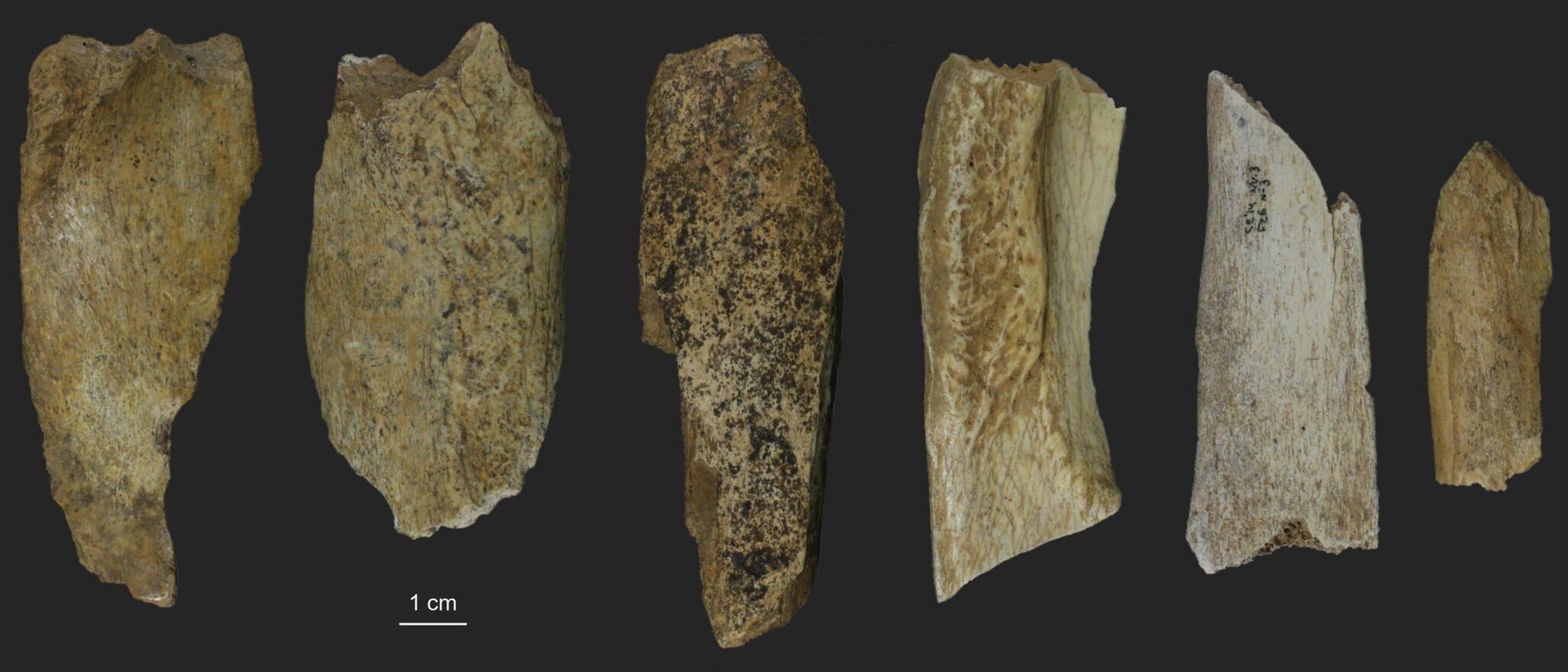
New research utilizing collagen-based mass spectrometry at the Cova Eirós site has revealed that Paleolithic hunter-gatherers employed far more diverse survival strategies than previously believed. By identifying over 8,000 highly fragmented bone remains, scientists have corrected historical biases that overestimated the presence of cave bears and underestimated the role of large ungulates in the diets of both Neanderthals and early modern humans.
For decades, the damp, limestone walls of Cova Eirós in northwestern Spain have served as a silent witness to the transition between two eras of human history: the Middle Paleolithic, dominated by Neanderthals, and the Upper Paleolithic, which saw the rise of Anatomically Modern Humans (AMH). However, the story told by the cave’s floor was incomplete. Archaeologists frequently encountered thousands of bone fragments so shattered and worn that they were impossible to identify by eye. These “indeterminate” remains represented a massive gap in our understanding of prehistoric life, leaving scientists to wonder if their theories on ancient diets were based on the whole truth or just the most recognizable pieces of the puzzle.
A new study published in the International Journal of Osteoarchaeology has finally bridged this gap. Led by Hugo Bal García and a multidisciplinary team from the CENIEH and the Universidad de Santiago de Compostela, researchers have turned to molecular biology to identify what the human eye could not. By analyzing the very proteins preserved within the bone, the team has effectively performed a “census” of the animals that shared the landscape with our ancestors, revealing a subsistence strategy that was significantly more complex and varied than traditional archaeological methods had suggested.
The Power of Molecular Fingerprinting
The breakthrough at Cova Eirós was made possible through a cutting-edge technique known as ZooMS, or Zooarchaeology by Mass Spectrometry. This approach shifts the focus from the shape of a bone to its chemical composition. Because bone collagen contains specific sequences of amino acids that vary between animal groups, scientists can extract collagen peptide mass fingerprints from even the smallest fragments. By comparing these molecular signals against established reference databases, the researchers were able to assign a taxonomic identity to remains that had previously been classified as “indeterminate.”
The research team applied this collagen-based approach to 114 bone fragments that had stumped traditional morphological analysis. While 114 might seem like a small number compared to the total assemblage, these specific fragments were crucial because they represented the portion of the record most likely to be ignored. When these molecular identifications were integrated into the broader study of more than 8,000 faunal remains from the site, the resulting data changed the entire landscape of the archaeological interpretation. It allowed for a large-scale taxonomic identification that finally included the broken, the battered, and the unidentifiable.
Correcting the Cave Bear Bias
One of the most significant shifts in the site’s narrative involves the cave bear (Ursus spelaeus). Historically, faunal interpretations at Cova Eirós suggested that these massive, extinct predators were a dominant presence. This was largely due to an abundance of deciduous teeth—baby teeth—found throughout the cave layers. Because teeth are incredibly durable and easy to identify, they often take center stage in traditional morphological studies. This created a statistical “overestimation” of the bears’ role in the cave’s history.
The ZooMS data, however, provided a much-needed reality check. When the fragmented bone mass was analyzed, it became clear that the relative representation of cave bears was lower than previously suggested. The high volume of teeth had created a bias, making it appear as though the cave was a constant den for bears, when in reality, other animals were leaving behind far more skeletal material—it was just too fragmented to be seen. By correcting this bias, the researchers have painted a more accurate picture of how the cave was shared between hibernating carnivores and visiting human groups.
A Broadened Spectrum of Survival
With the “bear bias” corrected, a new protagonist emerged in the story of Cova Eirós: the large ungulate. The molecular analysis revealed a much greater presence of large hoofed mammals than had been identified through conventional methods. Previously, red deer (Cervus elaphus) were thought to be the primary, almost exclusive, resource for the hunter-gatherers at the site. While red deer remained important, the new data shows that the spectrum of exploited resources was actually much broader.
The inclusion of bone fragments bearing clear anthropogenic modifications—marks left by human tools—was a key factor in this discovery. As it turns out, the very behavior of these ancient humans was what had made the bones so hard to identify in the first place. Neanderthals and Anatomically Modern Humans were not just hunting these animals; they were processing them with extreme intensity. They broke bones to reach the nutrient-rich marrow and stripped every possible resource from the carcass. This intensive processing of herbivores generated a massive amount of “indeterminate” debris, which naturally skewed the archaeological record toward animals that weren’t processed as heavily, such as the bears.
Why This Matters
The findings at Cova Eirós represent a major step forward in how we reconstruct the lives of Paleolithic people. By proving that subsistence strategies were more diversified and complex, the study challenges the idea that ancient humans were narrow specialists. Instead, it suggests a high level of adaptability and a thorough, systematic approach to utilizing the natural world.
More importantly, this research highlights a critical flaw in traditional archaeology: the “identifiability bias.” If scientists only study the bones they can recognize, they are only studying a fraction of ancient behavior. The success of the ZooMS technique at this site provides a blueprint for future excavations, ensuring that the smallest, most fragmented pieces of history are no longer thrown away or ignored. For the first time, we are seeing the full menu of the Paleolithic diet, proving that even in the most fragmented remains, there is a wealth of information about the resilience and ingenuity of the human lineage.
Study Details
Hugo Bal‐García et al, Expanding the Faunal Interpretation of the Cova Eirós (NW Iberia) Middle Paleolithic–Early Upper Paleolithic Record With ZooMS, International Journal of Osteoarchaeology (2026). DOI: 10.1002/oa.70107