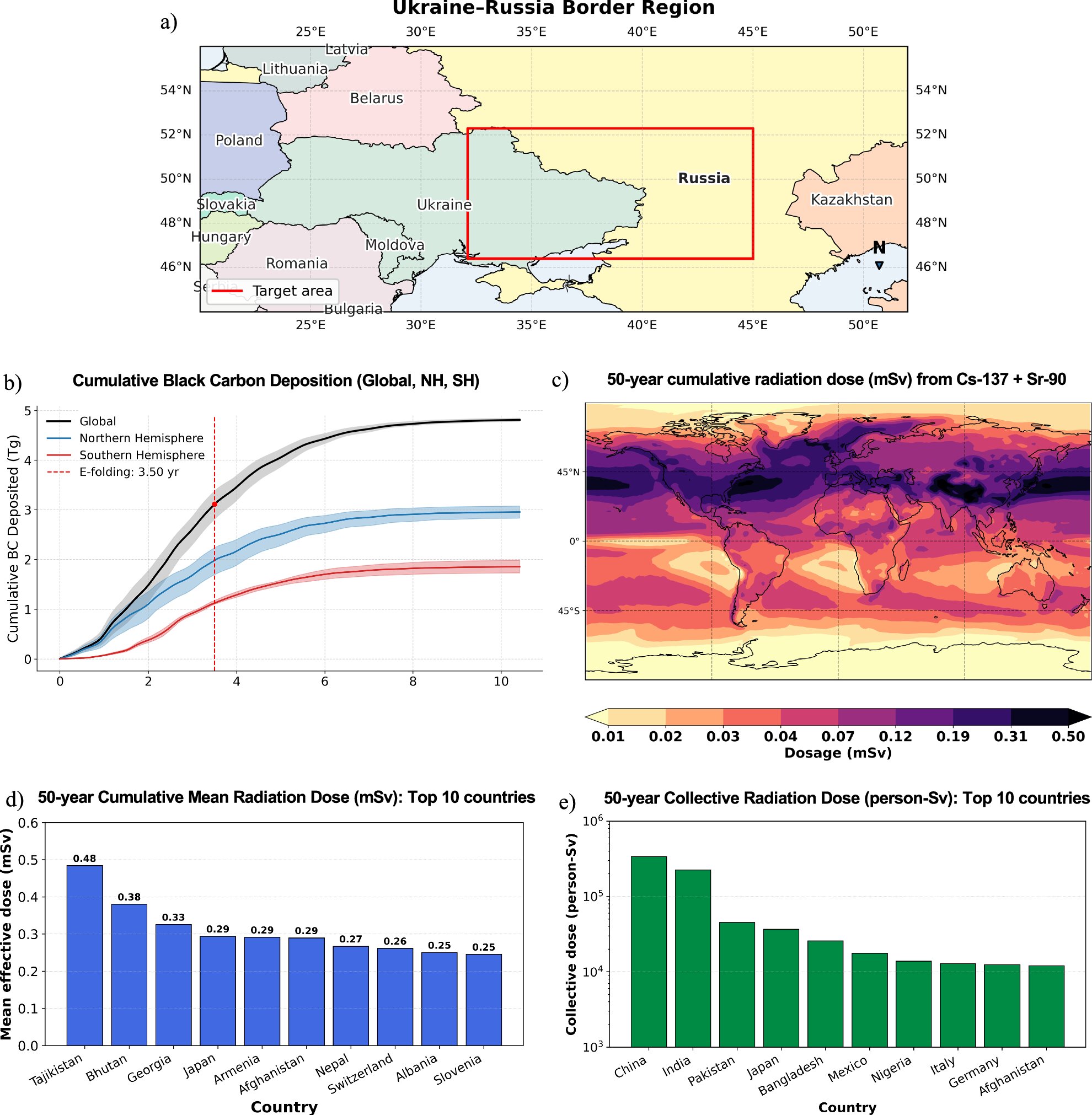
New research reveals that even a limited nuclear exchange at the Ukraine–Russia border would ignite a six-year global environmental catastrophe, plummeting temperatures in the United States and Russia by as much as 5°C. The study warns that radioactive particles would hitch a ride on atmospheric soot, spreading fallout across both hemispheres and transforming a localized war into a worldwide humanitarian disaster.
The threat of nuclear conflict is often discussed in the context of immediate destruction at the ground level, but the most enduring scars of such an event would likely be written in the sky. For decades, scientists have theorized about the atmospheric consequences of atomic detonations, yet new simulations are painting an increasingly precise—and sobering—picture of how the planet would react. According to a study published in npj Clean Air, a conflict confined to a single geographic border would not stay regional for long. Instead, the smoke and debris from the blasts would effectively hijack the Earth’s climate systems, triggering a chain reaction that reaches far beyond the initial blast zone.
Atmospheric Soot and the Cooling of the Northern Hemisphere
The researchers from the University of Exeter utilized the UK Earth System Model to track the movement of black carbon or soot emitted after a hypothetical detonation. When nuclear weapons strike urban or industrial targets, the resulting fires release massive quantities of soot into the upper atmosphere. Unlike common smoke that eventually rains out, this material would rise high enough to bypass the weather layer, spreading rapidly across the globe. Once established, this shroud of soot acts as a solar shield, reflecting sunlight back into space before it can reach the surface.
In the immediate aftermath of such a conflict, the consequences for the Northern Hemisphere would be drastic. The simulation indicates that within the first year, average temperatures across the hemisphere would drop by approximately 1°C. However, this average masks much more severe regional impacts. In Russia, temperatures are projected to fall by roughly 5°C, while the United States would see a decrease of 4°C. These sharp declines would be accompanied by a significant reduction in surface sunlight and a substantial drop in precipitation, particularly across mid-latitude agricultural zones that are critical to the global food supply.
A Six-Year Climate Disruption
One of the most significant findings of the Exeter study is the persistence of these environmental shifts. The climate would not simply “reset” once the smoke cleared. Instead, the model suggests these disruptions would last for approximately six years. The mechanism behind this longevity lies in the stratosphere, the layer of the atmosphere above where our weather occurs. As the black carbon particles absorb solar radiation, they cause the stratosphere to warm significantly. This localized heating creates a massive imbalance that alters the planet’s primary circulation patterns.
These changes would specifically impact the jet streams, which dictate weather patterns across North America and Europe, and the Intertropical Convergence Zone, a belt of low pressure near the equator that is responsible for much of the world’s tropical rainfall. By shifting these invisible atmospheric “gears,” the soot ensures that the cooling, drying, and darkening effects of the conflict remain locked in place for over half a decade. This prolonged period of instability would likely outlast the geopolitical tensions that sparked the conflict in the first place, leaving the global environment in a state of semi-permanent shock.
Global Dispersion of Radioactive Material
The environmental threat is not limited to temperature and light. The study also examined how radioactive material behaves when it interacts with the soot produced by nuclear fires. The simulation found that long-lived radionuclides—radioactive atoms that take years to decay—would attach themselves to the black carbon particles. Because these particles are light enough to stay aloft for extended periods, they serve as a transport mechanism for radiation, carrying it far from the site of the original explosion.
The data suggests a surprising and grim level of global connectivity: roughly 40% of the radioactive material would eventually settle in the Southern Hemisphere. This means that nations thousands of miles away from the Ukraine–Russia border, which have no involvement in the conflict, would still face the consequences of radioactive fallout. The study concludes that the fallout would be deposited globally, effectively erasing the boundaries between the “war zone” and the rest of the world. This transition from a regional catastrophe to a global environmental crisis highlights the inescapable nature of modern nuclear consequences.
Insights from Planetary Science
The methodology used to uncover these Earth-bound risks actually has its roots in the study of other worlds. Researchers noted that the models used to simulate nuclear soot are the same adaptations used to understand extreme weather on other planets. For instance, observations of planet-wide dust storms on Mars and the incredibly fast, kilometer-per-second winds found in the atmospheres of hot gas giants have provided the foundational data needed to model Earth’s atmosphere under extreme stress. By studying how atmospheres behave in the most hostile environments in the solar system, scientists can more accurately predict how our own planet would respond to the “non-normal” conditions created by a nuclear exchange.
Why This Matters
This research underscores that the concept of a “contained” nuclear war is a scientific impossibility. The study confirms that the atmospheric and radiological links between nations are far too integrated for the effects of a conflict to remain borders-bound. Specifically, the data highlights the urgent need for international cooperation and the extension of arms control agreements. With the New Strategic Arms Reduction Treaty having ended on February 5, 2026, the findings provide a data-driven argument for the immediate renewal of such pacts.
Beyond the immediate cooling and radiation, the disruption of agricultural regions in the U.S. and Russia—two of the world’s largest food producers—suggests that the ultimate toll of a regional conflict would be measured in global food security and humanitarian stability. By proving that the fallout would reach both hemispheres and persist for years, the study serves as a stark reminder that in the nuclear age, every nation resides downwind of a potential conflict.
Study Details
Ananth Ranjithkumar et al, Nuclear Conflict in Eastern Europe: Climate disruption and Radiological fallout, npj Clean Air (2026). DOI: 10.1038/s44407-026-00064-7