There is a certain comfort in imagining our solar system as vast. The distance from Earth to the Sun feels immense. The orbit of Neptune stretches billions of kilometers into the darkness. The distant Oort Cloud—an icy halo of comets—extends even farther, marking the outermost whisper of the Sun’s gravitational reach.
And yet, in the grand architecture of the universe, even this enormous domain is astonishingly small.
Far beyond our planetary neighborhood lie nebulae—colossal clouds of gas and dust, shaped by gravity, radiation, and time. These structures are not merely larger than our solar system; they are so vast that our entire planetary system would vanish inside them like a grain of sand in a desert storm.
Nebulae are the cradles and graveyards of stars. Within them, new suns ignite. Within them, the remnants of dead stars disperse into space, seeding future generations. They are luminous, chaotic, and breathtakingly immense.
Here are five giant nebulae so vast that they could easily swallow our entire solar system—and still have room to spare.
1. The Orion Nebula
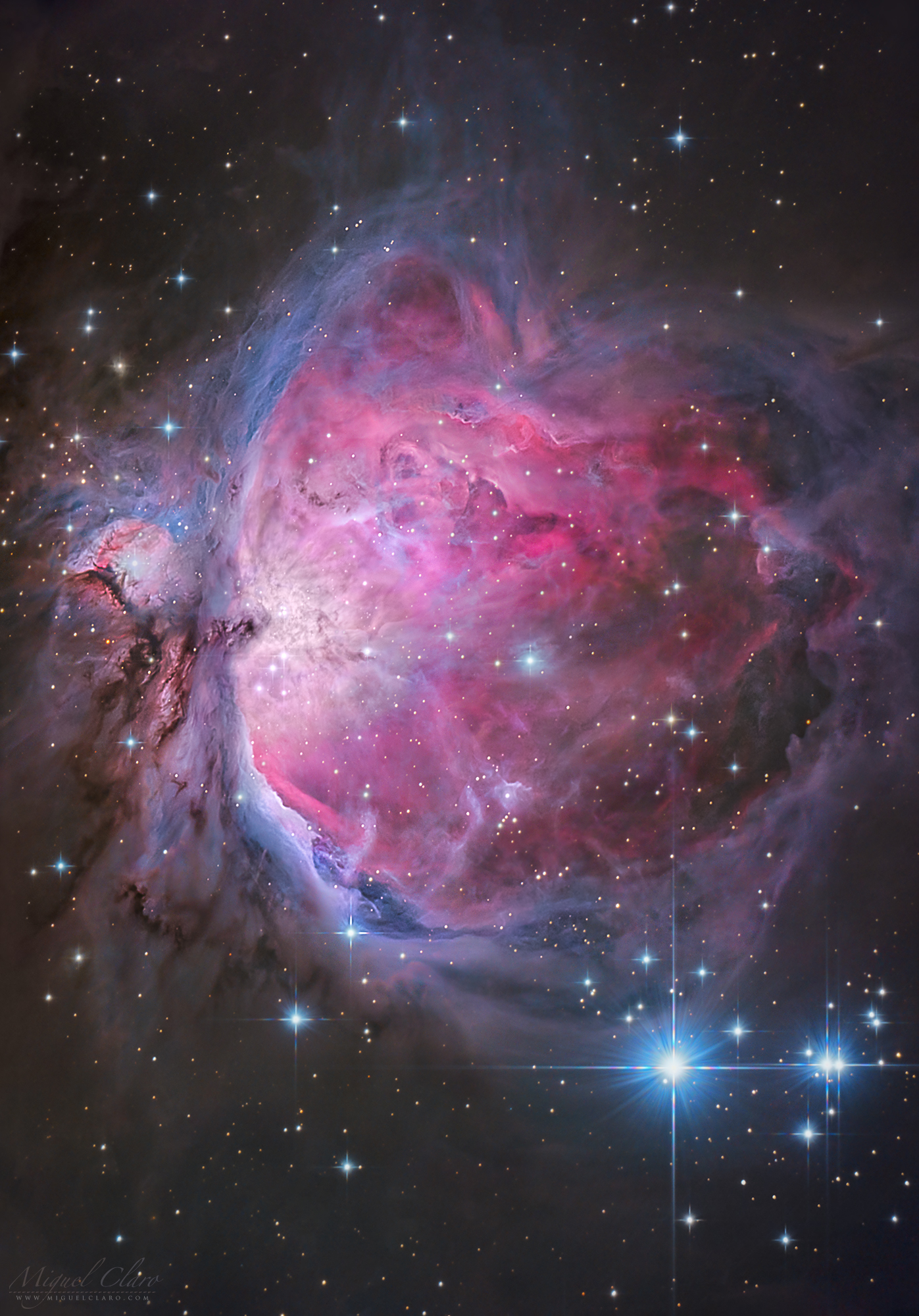
Among the most studied and visually stunning nebulae in the night sky is the Orion Nebula. Located about 1,344 light-years away in the constellation Orion, this nebula is one of the closest massive star-forming regions to Earth.
Its apparent size in the sky is only a small window into its true scale. The Orion Nebula spans roughly 24 light-years across. To grasp this magnitude, consider that the distance from the Sun to Pluto is less than a single light-day. Even the farthest edges of the Oort Cloud extend only a few light-years at most.
Placed inside the Orion Nebula, our solar system would be utterly insignificant.
Scientifically, the Orion Nebula is a stellar nursery. It contains dense molecular clouds collapsing under gravity to form new stars. At its core lies the Trapezium Cluster, a group of massive young stars emitting intense ultraviolet radiation. This radiation ionizes the surrounding hydrogen gas, causing it to glow brilliantly.
Within this nebula, astronomers observe protoplanetary disks—rotating disks of gas and dust around young stars where planets may be forming. In many ways, the Orion Nebula offers a glimpse into our own origins, as our solar system likely formed in a similar environment billions of years ago.
Emotionally, it is humbling. The place where stars are born is not a quiet, gentle nursery. It is turbulent, radiant, and immense beyond comprehension.
2. The Carina Nebula
Far larger and more energetic than Orion is the Carina Nebula, located approximately 7,500 light-years away.
The Carina Nebula stretches over 300 light-years across—more than ten times the diameter of the Orion Nebula. Within this vast expanse, entire clusters of stars form, evolve, and sometimes explode.
At its heart resides one of the most massive and luminous stars known: Eta Carinae. This unstable stellar system has undergone dramatic outbursts, ejecting enormous amounts of material into space. These eruptions sculpt the surrounding nebula, creating intricate structures of glowing gas and dark dust.
The Carina Nebula is a place of extremes. Stellar winds—streams of charged particles emitted by massive stars—collide and carve cavities within the cloud. Radiation pressure compresses gas in some regions while dispersing it in others.
If our solar system were placed within the Carina Nebula, it would drift unnoticed within a cosmic landscape spanning hundreds of light-years. The scale is so immense that even entire star clusters appear as minor features within it.
This nebula is not just large—it is violently creative, continuously reshaping itself through the life cycles of its stars.
3. The Tarantula Nebula
In the neighboring Large Magellanic Cloud lies one of the most massive and active star-forming regions in the local universe: the Tarantula Nebula.
This nebula spans over 1,000 light-years across.
Its name comes from its sprawling, filament-like structure, which resembles the legs of a spider. But its appearance is far less important than its scale and intensity. The Tarantula Nebula is forming stars at a rate far greater than most regions in our galaxy.
At its center lies the R136 star cluster, containing some of the most massive stars ever discovered. These stars emit enormous amounts of radiation and stellar winds, shaping the nebula and triggering further star formation.
If the Tarantula Nebula were as close to Earth as the Orion Nebula, it would cast shadows at night.
Our entire solar system, including the distant Oort Cloud, would be a microscopic speck within this colossal region. Even dozens of solar systems combined would barely register.
The Tarantula Nebula reveals a universe that is not quiet or static, but bursting with energy, constantly forging new stars in a cosmic blaze.
4. The Eagle Nebula
The Eagle Nebula, located about 7,000 light-years away, is famous for one of the most iconic images in astronomy: the “Pillars of Creation.”
These towering columns of gas and dust rise several light-years in height, shaped by intense radiation from nearby young stars. Within these pillars, dense knots of material collapse to form new stars.
The Eagle Nebula itself spans roughly 70 light-years across—vast enough to engulf our solar system countless times over.
What makes this nebula particularly fascinating is the interplay between destruction and creation. Ultraviolet radiation from massive stars erodes the pillars, slowly dispersing them into space. At the same time, this same radiation compresses gas in certain regions, triggering the birth of new stars.
It is a paradox of cosmic evolution: the forces that destroy also create.
Within this environment, our solar system would not simply exist—it would be immersed in a dynamic process of transformation, surrounded by structures larger than the distances between stars in our neighborhood.
The Eagle Nebula is a reminder that creation in the universe is rarely gentle. It is sculpted by powerful, competing forces.
5. The Helix Nebula
Unlike the previous examples, which are stellar nurseries, the Helix Nebula represents a later stage in a star’s life.
Located about 650 light-years away, the Helix Nebula is a planetary nebula—a shell of gas ejected by a dying star similar to our Sun.
It spans about 2.5 light-years across, making it smaller than the other nebulae on this list, yet still vastly larger than our solar system. Even this “modest” nebula could easily encompass the entire orbit of Pluto and far beyond.
At its center lies a white dwarf—the remnant core of the original star. As the star exhausted its nuclear fuel, it shed its outer layers, creating expanding rings of glowing gas.
The Helix Nebula is often called the “Eye of God” because of its appearance. But scientifically, it is a glimpse into the future of our own solar system. In about five billion years, the Sun will evolve into a red giant and eventually shed its outer layers, forming a planetary nebula.
The planets may be engulfed or stripped away, leaving behind a glowing shell similar to the Helix.
This nebula is not just vast—it is personal. It shows us how even stars like our own end their lives, returning material to the cosmos.
The Scale That Defies Imagination
To say that these nebulae are large enough to swallow our solar system is technically true—but it barely captures the reality.
The solar system, even including the distant Oort Cloud, spans perhaps a few light-years at most. Many nebulae extend tens, hundreds, or even thousands of light-years across. They are not just larger—they are incomparably larger.
Within these structures, stars are born, live, and die. Entire stellar populations exist within single nebulae. Gas and dust flow like cosmic weather systems. Radiation sculpts matter into intricate forms.
The scale challenges human intuition. Distances measured in kilometers or even astronomical units become meaningless. Only light-years begin to approach the dimensions involved.
And yet, these immense structures are part of a larger whole—the galaxy, which itself is only one of billions in the universe.
Our Place Within the Cosmic Ocean
There is something profoundly humbling about nebulae.
They remind us that our solar system, vast as it seems, is a tiny island in an immeasurable ocean. The Sun is just one star among hundreds of billions in the Milky Way. And the environments where stars are born or die are far larger and more complex than anything we experience directly.
Yet there is also a sense of connection.
The atoms in your body were once part of ancient stars. Those stars likely formed in nebulae like the ones described here. When they died, they scattered elements into space, enriching the interstellar medium. From that material, new stars—and eventually planets and life—emerged.
We are, in a very real sense, products of nebulae.
To look at these vast clouds is to look at both our origins and our future. They are the places where matter is recycled, where new possibilities emerge, where the universe continues its endless transformation.
The cosmos is not empty. It is filled with structures so immense that they dwarf our imagination.
And somewhere within that vastness, on a small planet orbiting an ordinary star, we have begun to understand just how extraordinary it all is.