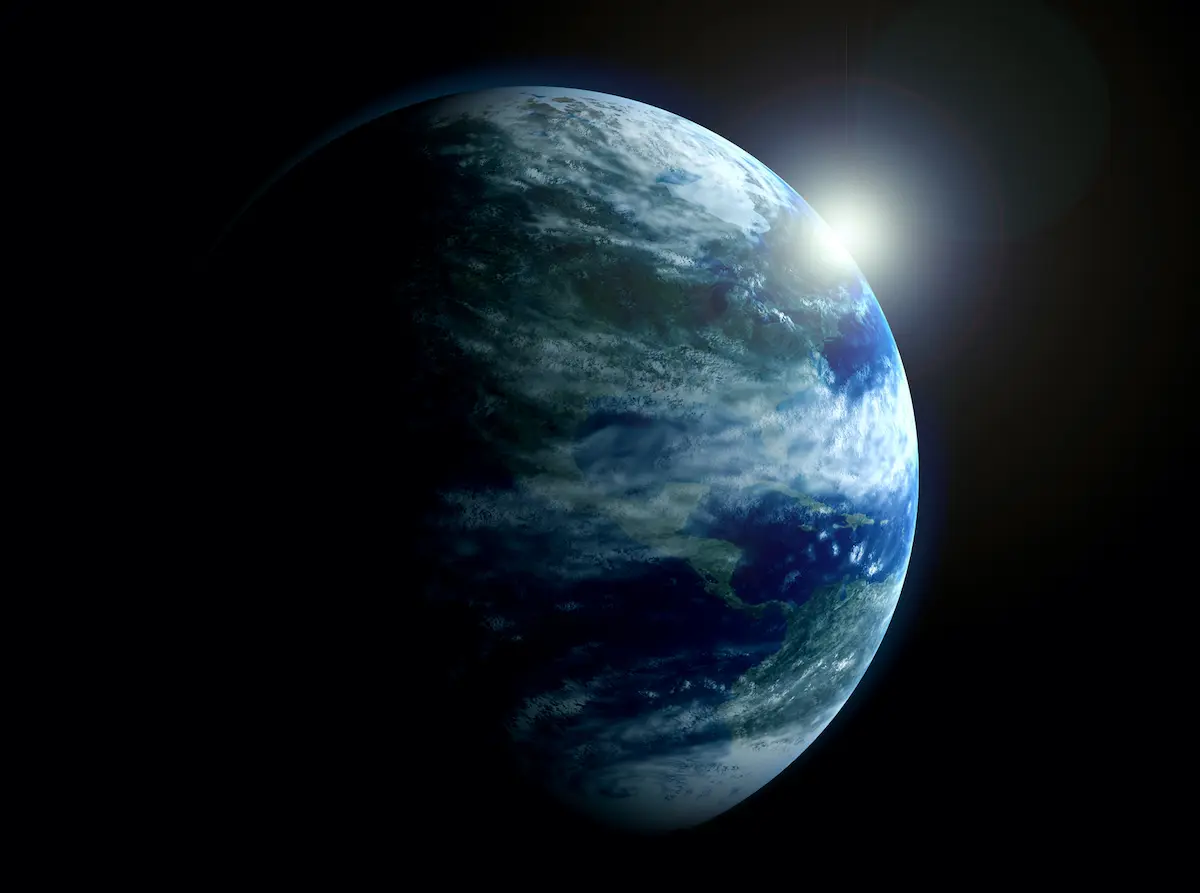
“What if Earth stopped rotating for only five seconds?” At first, the question feels almost playful, like a thought experiment you might hear late at night when curiosity wanders beyond everyday worries. Five seconds is nothing, after all. We blink longer than that. We lose track of time for far more than five seconds while scrolling on a phone or staring out of a window. How much harm could possibly come from such a brief pause?
Yet hidden inside this innocent-sounding question is a profound confrontation with how deeply Earth’s rotation is woven into every moment of our existence. The planet’s spin is not a background detail. It is not a quiet setting that can be paused like a video. Earth’s rotation is an active, dynamic motion that shapes oceans, air, gravity’s effects, the length of our days, and even the structure of the planet itself. To stop it, even briefly, would not be like tapping the brakes on a car. It would be like slamming into an invisible wall at cosmic speed.
To imagine Earth stopping for five seconds is to imagine the sudden interruption of a motion that has been continuous for more than four billion years. It is to imagine a world that rebels violently against the idea of stillness, because nothing on Earth is prepared for it.
Earth Is Always Moving, Even When We Feel Still
We do not feel Earth spinning, and that fact is one of the great tricks of everyday life. At the equator, the surface of Earth moves eastward at about 1,670 kilometers per hour due to rotation. Even at higher latitudes, the speed remains enormous. We are all passengers on a planet that is constantly racing through space, yet the motion feels perfectly calm.
This calmness exists because Earth’s rotation is steady. There is no sudden acceleration or deceleration. Our bodies, the atmosphere, the oceans, and everything else move together. From our perspective, it feels like rest. Physics, however, knows better. Motion does not disappear simply because it feels normal.
If Earth were to stop rotating instantly, even for only five seconds, that smooth, shared motion would be violently broken. The planet itself would pause, but everything on and above its surface would desperately try to keep going.
The Moment the Rotation Stops
Imagine a single, impossible instant. There is no warning. No slowing down. Earth’s rotation halts completely, as if frozen by a cosmic hand.
The solid ground beneath your feet stops moving eastward. But your body does not. You are still traveling at hundreds or thousands of kilometers per hour, depending on your latitude. The air around you is doing the same. The oceans are doing the same. Momentum, one of the most unforgiving laws of physics, refuses to negotiate.
In that moment, Earth becomes a surface rushing westward into everything that was previously moving with it.
What Happens to People and Objects on the Surface
For humans, the experience would be unimaginably violent. People would not gently stumble or lose balance. They would be hurled eastward at extraordinary speed. Buildings, trees, vehicles, and entire cities would be subjected to forces far beyond anything they were designed to withstand.
At the equator, a person would suddenly be moving at over 1,600 kilometers per hour relative to the now-stationary ground. No structure made by humans could survive that. The idea of standing, holding on, or even being partially protected becomes meaningless. The forces involved would be instantly fatal for nearly all life on the surface.
Even far from the equator, where rotational speed is lower, the sudden stop would still be catastrophic. Hundreds of kilometers per hour of sideways motion would turn landscapes into fields of destruction. The violence would not be localized. It would be global.
For five seconds, Earth would be a world where inertia reigns supreme and survival is almost nonexistent.
The Atmosphere Does Not Stop With the Planet
One of the most terrifying consequences would come from the air itself. Earth’s atmosphere rotates along with the planet. When the ground stops, the atmosphere does not politely wait.
The result would be global winds traveling at hundreds to over a thousand kilometers per hour. These would not be ordinary hurricanes or storms. They would be planet-spanning shockwaves of moving air, scraping across continents, tearing apart forests, flattening cities, and scouring the land down to bare rock in many places.
The sky would become a weapon. The air we depend on to breathe would turn into a destructive force beyond any known natural disaster. Even the strongest structures would be pulverized by winds moving faster than most aircraft.
For those five seconds, Earth’s surface would experience an atmospheric catastrophe unmatched in planetary history.
The Oceans Become Walls of Water
The oceans, like the air, are moving with Earth’s rotation. When the planet stops, the water does not. Entire oceans would surge eastward, piling up against continents with unimaginable force.
These would not be tsunamis in the traditional sense. Tsunamis are waves caused by disturbances like earthquakes. What would happen here is far more extreme. Whole ocean basins would attempt to continue moving, slamming into landmasses at immense speed.
Coastal regions would be obliterated almost instantly. Water would surge inland for hundreds or even thousands of kilometers, depending on geography. Entire continents could be reshaped in seconds. Mountains might slow the flow, but nothing could truly stop it.
The violence of moving water on this scale would grind landscapes down, erasing ecosystems and geological features that took millions of years to form.
Earth’s Crust Feels the Shock
Earth is not a rigid sphere. Its crust floats atop a semi-molten mantle, constantly shifting and adjusting. The sudden halt in rotation would send shockwaves through the planet itself.
The redistribution of mass from moving oceans and atmosphere, combined with the abrupt change in rotational forces, would place enormous stress on the crust. Earthquakes would erupt across the globe, not as isolated events but as a near-simultaneous planetary convulsion.
Volcanoes could be triggered as pressure systems within the mantle destabilize. Fault lines would rupture in unpredictable ways. The surface of Earth would crack and tremble as it tries to adapt to a state it was never meant to experience.
Gravity Feels Different, Briefly and Subtly
One of the quieter but fascinating effects of Earth’s rotation is its influence on gravity. Because the planet spins, there is a slight outward centrifugal effect, strongest at the equator. This effect makes gravity there slightly weaker than at the poles.
If Earth stopped rotating, that centrifugal effect would disappear instantly. Gravity would become marginally stronger at the equator. In normal circumstances, this change would be subtle and barely noticeable. But in this scenario, it would add to the chaos, increasing the downward force on everything at the same time that horizontal forces are already tearing the world apart.
Though this gravitational change would not be the main source of destruction, it would contribute to the overwhelming stress placed on structures and bodies.
Five Seconds That Feel Like an Eternity
Time itself would feel distorted in such a moment. Five seconds is brief in a clock’s measurement, but in physical experience, it would be an eternity of destruction.
The momentum-driven chaos would unfold almost instantly. Buildings would collapse within fractions of a second. Winds and water would begin their devastation immediately. There would be no gradual escalation, no chance to react. The first second alone would be enough to end nearly all surface life.
By the time the five seconds are over, Earth would be unrecognizable.
The Rotation Starts Again
Now imagine the impossible happens again. After five seconds of stillness, Earth resumes its rotation, instantly returning to its previous speed and direction.
This restart would not undo the damage. Instead, it would introduce a second wave of catastrophe. The ground would suddenly move eastward again beneath whatever remains. Air and water that were displaced during the stop would now be violently redirected.
The restart would generate new shockwaves, new winds, and new surges of water. Structures already weakened or destroyed would be further scattered. The planet would be struck twice by the consequences of interrupted motion.
Earth would not return to normal. It would enter a prolonged period of chaos.
The Aftermath: A Broken Planet
After the rotation resumes, Earth would be a wounded world. The atmosphere would be in turmoil, with extreme weather patterns dominating for years. The oceans would take immense time to settle into stable circulation again.
Ecosystems would be devastated. Most life on the surface would be gone. Survivors, if any, would exist in isolated pockets, likely underground or in exceptionally sheltered environments. The biosphere as we know it would collapse.
Geographically, the planet would be altered. Coastlines would shift. Sediments would be redistributed. Entire regions might be stripped to bedrock while others are buried under layers of debris.
Earth would still be a planet, but it would no longer be the gentle home humanity knows.
Why Five Seconds Is Enough
It is tempting to think that catastrophe requires time. That disasters build slowly. But physics teaches us that energy and momentum do not care about human intuition.
Earth’s rotation carries enormous kinetic energy. Stopping it, even briefly, requires removing that energy from the planet. Restarting it requires adding it back. These are not gentle processes. They involve forces so large that they dwarf anything humans have ever experienced.
Five seconds is not “only” five seconds when dealing with planetary-scale motion. It is more than enough to unleash devastation beyond comprehension.
Why This Can’t Really Happen
The good news is that there is no known physical mechanism that could suddenly stop Earth’s rotation for five seconds and then restart it. Such an event would require forces far beyond anything present in our solar system.
Earth’s rotation can change, but it does so gradually. Tidal interactions with the Moon slowly slow Earth’s spin over millions of years. Earthquakes can slightly alter rotation by redistributing mass. But an instant stop belongs purely to the realm of imagination.
This thought experiment is valuable not because it predicts a real danger, but because it reveals how finely balanced our world is.
What This Thought Experiment Teaches Us
Imagining Earth stopping for five seconds strips away the illusion that our planet is static and safe by default. It reminds us that stability is the result of continuous motion, not its absence.
Earth’s rotation gives us day and night. It shapes weather and ocean currents. It influences gravity and the behavior of the atmosphere. It is a silent, constant partner in every moment of life.
We depend on that motion so completely that its absence, even briefly, becomes lethal.
A New Appreciation for Ordinary Motion
After contemplating this scenario, it becomes impossible to see an ordinary sunrise the same way. The turning of Earth, once taken for granted, becomes something almost miraculous. Every morning, the planet spins exactly as it should. The air moves gently instead of violently. The oceans stay mostly where they belong.
The fact that Earth has maintained this steady rotation for billions of years is one of the great quiet triumphs of nature. It is a reminder that our existence depends not only on dramatic cosmic events, but on the reliable continuation of motions we never feel.
Stillness Is Not Always Peaceful
In human experience, stillness often means calm. Silence can be comforting. Rest can be healing. But on a planetary scale, stillness can be deadly.
Earth is alive with motion. It spins, orbits, circulates, and vibrates. Life evolved not despite this motion, but because of it. To stop the planet, even briefly, is to pull the rug out from under the systems that sustain life.
This thought experiment teaches a humbling lesson: stability does not mean immobility. It means balance within motion.
The Fragile Miracle of Earth
What if Earth stopped rotating for only five seconds? The answer is not just a story of destruction. It is a story of dependence. It shows how every breath we take, every step we make, every calm day and quiet night is supported by vast, invisible physical processes.
Earth’s rotation is not dramatic. It does not announce itself. It simply continues, moment after moment, holding the world together.
In realizing how catastrophic its absence would be, we gain a deeper appreciation for how extraordinary it is that the planet keeps turning at all.