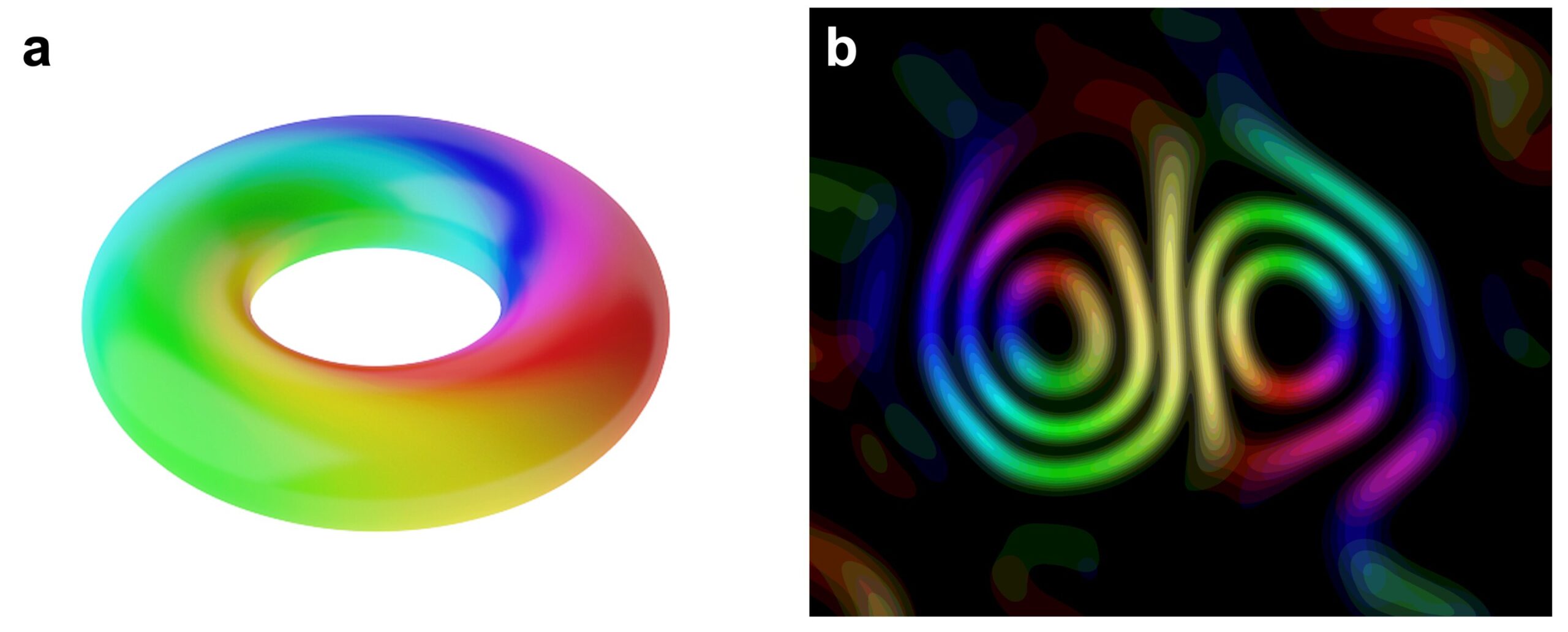
For half a century, hopfions existed mostly in the quiet realm of theory—mathematical shapes so intricate they seemed almost unreal. First proposed in 1975, these three-dimensional topological solitons were envisioned as twisting structures capable of forming rings, links, and knots within a continuous field. Their defining feature, known as the Hopf charge, captures a kind of deep topological complexity—an internal order that cannot simply be smoothed away.
Physicists believed such structures could arise in many places, from magnetic materials to plasmas, even in the conditions thought to resemble the early universe. Yet belief is not the same as proof. The sheer complexity of hopfions made them extraordinarily difficult to create, observe, and control. For decades, they hovered at the edge of scientific possibility—beautiful, compelling, and frustratingly elusive.
Now, a collaboration led by scientists at the Hefei Institutes of Physical Science of the Chinese Academy of Sciences, working alongside researchers from Anhui University, ShanghaiTech University, and University of New Hampshire, has transformed that long-standing vision into something tangible. Their findings, published in Nature Materials, mark the first time hopfions have been generated electrically and controlled inside a solid-state magnetic system.
It is not just a demonstration. It is a turning point.
Where Theory Meets Matter
To understand why this moment matters, it helps to appreciate what made hopfions so difficult to realize. Unlike simpler structures that exist in two dimensions or follow predictable patterns, hopfions are fully three-dimensional topological configurations. Their internal geometry twists through space in ways that are difficult not only to produce, but also to verify experimentally.
Researchers needed a physical environment capable of hosting such complexity—and one that could be manipulated with precision. Their answer was a chiral magnet, a material whose internal magnetic structure naturally supports twisting arrangements. Within this system, the team found a promising laboratory for bringing theory into reality.
They chose the chiral magnet FeGe as their experimental stage. But the material alone was not enough. To actually generate hopfions, the researchers had to carefully orchestrate a set of physical influences. They applied spin-transfer torque, a phenomenon in which the angular momentum of electrons can push and reorient magnetic structures. At the same time, they introduced thermal excitation, providing the system with the energy needed to reorganize itself into new configurations.
Together, these forces coaxed the magnetic field into forming something never before achieved under electrical control: genuine, stable hopfions.
A Structure That Holds Its Form
Creating hopfions was only the beginning. The next challenge was even more demanding—proving that the structures truly existed as predicted, and that they behaved in a controlled and stable way.
The researchers discovered something remarkable. Once formed, the hopfions did not require an external magnetic field to remain intact. They were stable on their own, maintaining their structure even after the external influence was removed. This stability represented a significant advance beyond earlier work, which had largely been limited to static or less controllable observations.
But stability alone does not reveal shape. Hopfions are inherently three-dimensional, and confirming their topology requires more than indirect measurement. The team needed to see how the magnetic structure actually twists through space.
To achieve this, they combined angle-dependent quantitative electron holography with micromagnetic simulations. The experimental imaging method allowed them to probe magnetic configurations from multiple angles, while the simulations provided a detailed theoretical framework for interpreting what those measurements meant.
Together, these tools revealed the internal geometry of the structures. The researchers could map the rotational magnetic phase and confirm the presence of the predicted 3D topological configuration. For the first time, hopfions were not merely inferred—they were visualized and characterized in full three-dimensional detail.
When Electricity Becomes a Steering Wheel
Even with stable, observable hopfions, one essential question remained. Could they be moved? Could they respond to electrical signals in a controlled way?
To find out, the team performed in-situ electrical measurements, observing how hopfions behaved under applied electric currents. What they saw was both clear and unexpected.
The hopfions could indeed be driven by electric currents. But their motion did not follow the familiar patterns seen in many other magnetic textures. Instead of deflecting sideways through the well-known Hall effect, these structures moved without such deviation. Their behavior reflected an unconventional dynamic response—one directly tied to their deeply three-dimensional topology.
This absence of Hall deflection was not a minor detail. It revealed that the transport properties of hopfions are fundamentally shaped by their topology. Their motion is governed not merely by external forces, but by the intricate geometry encoded within them.
In other words, their structure does not just define what they are. It determines how they move.
Seeing a New Experimental Landscape
With electrical generation, stability without external fields, direct three-dimensional visualization, and controllable motion, the researchers have established something far larger than a single experimental achievement.
They have created a scalable and controllable experimental platform for studying hopfions.
This platform allows scientists to investigate hopfion dynamics systematically—to explore how they form, how they evolve, and how their unique topology influences their behavior. It also opens the door to studying their universal physical properties, moving beyond isolated demonstrations toward a deeper understanding of these structures across different systems.
For decades, hopfions lingered as theoretical curiosities—complex shapes that could be described mathematically but rarely touched experimentally. Now, they have a laboratory home.
Why This Breakthrough Matters
This research represents more than the successful creation of an unusual magnetic structure. It marks the transition of hopfions from abstract theory to controllable physical reality.
For the first time, scientists can generate hopfions electrically, observe their full three-dimensional structure, and drive them with electric currents—all within a solid-state system that can be studied and manipulated in detail. The ability to do all three simultaneously transforms hopfions from rare experimental phenomena into accessible subjects of systematic investigation.
Equally important is the demonstration of stability without an external magnetic field. This shows that hopfions are not fragile artifacts that exist only under carefully maintained conditions. They can persist, maintaining their topology even when external influences are removed. That robustness is essential for any meaningful exploration of their physical behavior.
The discovery also reveals something profound about the relationship between geometry and motion. The unconventional transport properties of hopfions—especially their movement without Hall deflection—show that topology is not merely a mathematical description. It is a governing principle that shapes how physical systems respond to forces.
Finally, by establishing a scalable platform for experimentation, the research creates a foundation for future work. Scientists can now explore the dynamics, interactions, and universal features of these three-dimensional topological structures in ways that were previously impossible.
What was once a theoretical possibility has become an experimental reality—visible, controllable, and ready to be explored. In turning hopfions from mathematical speculation into tangible structures, this work does more than confirm a prediction from 1975. It opens an entirely new landscape of physical phenomena, where topology is not just an idea, but something that can be created, observed, and steered with electricity itself.
Study Details
Long Li et al, Electrically writing a magnetic heliknoton in a chiral magnet, Nature Materials (2026). DOI: 10.1038/s41563-025-02450-0