For years, the mound of Tapeh Tyalineh sat quietly on the landscape, its secrets pressed into the soil. Wind passed over it. Farmers plowed across it. Time did what time always does—it layered the present over the past. And then, unexpectedly, the earth answered back.
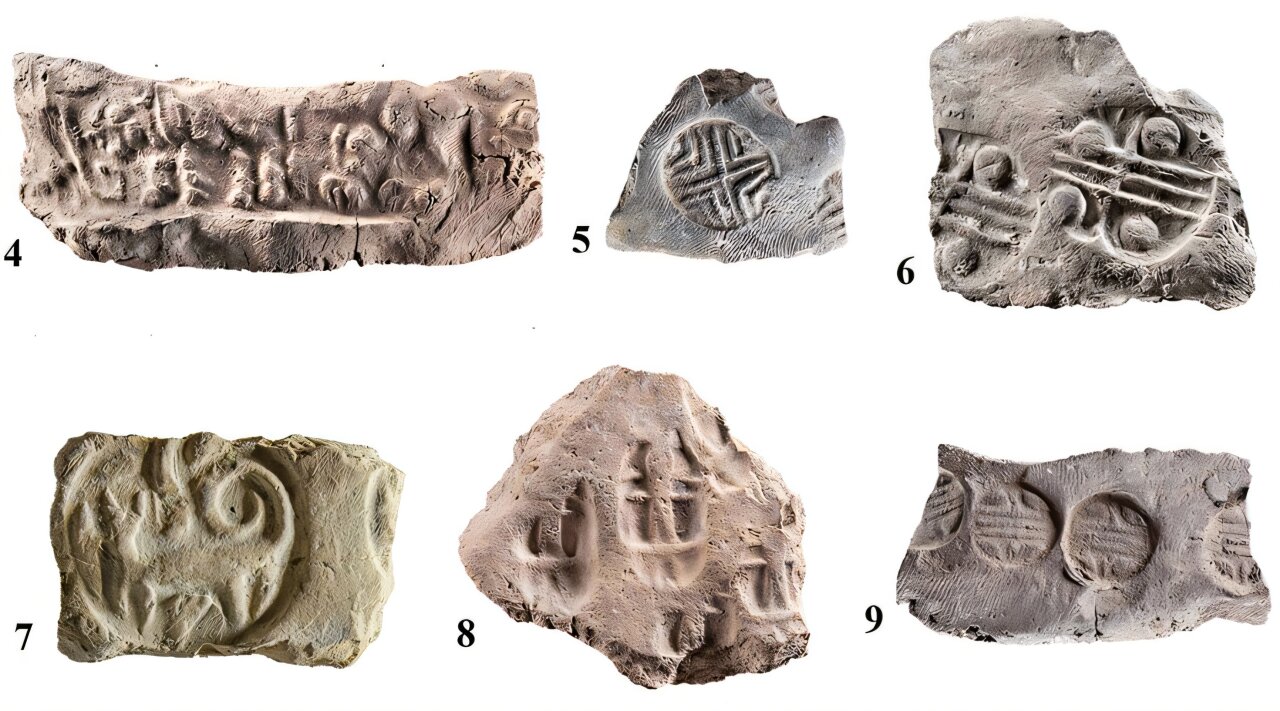
In the journal Antiquity, Dr. Shokouh Khosravi revealed preliminary findings that feel almost unbelievable in scale: the largest known corpus of prehistoric seal impressions in the ancient world. More than 7,000 seal impressions, alongside over 200 clay figurines, clay tokens, and two cylinder seals, all dating back roughly 5,000 years.
What began as fragments of clay has now opened a window into an entire administrative world—one that suggests Tapeh Tyalineh was not a quiet village, but a living, breathing center of organized commercial exchange.
A Landscape of Early Power
Long before towering palaces or inscribed stone monuments, some of the earliest states took shape in quieter ways—through systems. Administrative institutions emerged to manage goods, people, and obligations. In the Fars highlands of Iran and the lowlands of Susiana, such bureaucratic systems were active as early as the late fifth and early fourth millennia.
Yet something about Tapeh Tyalineh makes it stand apart.
Seals and sealings have been found in south-western Iran, but they are rare across the Central Iranian Plateau, north-western Iran, and the Central Zagros before the Bronze Age. That scarcity makes what surfaced at Tapeh Tyalineh extraordinary.
On the Kouzaran plain, just north of Mahidasht and only 25 kilometers west of Chogha Zanbil, unauthorized soil removal revealed 67 sealings dated to around 3200–2800 BC. It was a startling glimpse into a buried administrative world. But it also came with heartbreak.
Between one and two meters of the mound’s upper layers, spanning approximately 2,000 square meters, were destroyed by local villagers. Annual plowing by farmers has caused further damage. The site’s story, once neatly layered in earth, now carries scars.
And yet, even in its damaged state, it has yielded a discovery of astonishing magnitude.
A Century of Seals
Dr. Khosravi believes the massive corpus of seals did not accumulate overnight. Though absolute dating analyses are still pending, the findings likely span several decades—perhaps up to 100 years.
Imagine that. A century of careful sealing and resealing. A century of doors closed and opened. A century of goods recorded, counted, dispatched.
These were not decorative marks. They were tools of administration.
The seals were used to secure door pegs of storage facilities, as well as sacks, jars, and receipts. They carried authority. To press a seal into clay was to assert responsibility, control, and accountability.
Although detailed analyses remain underway, the seals likely played a role in the transport, storage, and exchange of oil, wine, and beer. These were not random goods. They were staples of economic and social life.
But what makes this discovery even more compelling is the diversity hidden within those impressions.
Faces in Clay
Each seal impression is like a signature without a name. A pattern, a design, a symbol pressed into soft clay and hardened by time.
One of the central questions is whether certain seals were used exclusively for specific tasks—doors, sacks, jars—or whether they were multipurpose. For now, only preliminary observations are possible.
What has already emerged is intriguing.
Some seal owners appear to have been responsible solely for sealing storage facilities. These individuals likely oversaw the entry and exit of goods. Their seal impressions guarded thresholds—both literal and economic.
Others seem to have sealed both containers and storage doors. Their authority extended further, spanning multiple stages of the exchange process.
Even more revealing is the difference between seal impressions applied to vessels and those used on sacks. The designs differ. That difference suggests goods were arriving from multiple origins, carried by various merchants or communities.
The clay tells a story of movement.
If each distinct seal represents an individual—and if we exclude around 20 distinct seal types used specifically for storage facilities—the inhabitants of Tapeh Tyalineh were in contact with over 150 other merchants or individuals. These contacts were not confined to nearby villages. They likely extended to communities both near and far.
The diversity of seals reflects extensive connections. This was not an isolated settlement. It was a node in a web.
An Organized World Before Writing
The varied and extensive corpus of seal impressions, along with other administrative artifacts, reveals something profound. Tapeh Tyalineh was part of an organized commercial exchange network stretching across Iran and Mesopotamia.
Before formal states with grand monuments, before fully developed written records, there were systems. Systems of trust. Systems of accountability. Systems embodied in clay.
The seals speak of coordination on a scale that required structure. Goods were transported, stored, and exchanged with oversight. Responsibilities were defined. Roles were assigned.
The administrative effort required to manage more than 7,000 seal impressions over decades suggests a community deeply engaged in economic organization. Tapeh Tyalineh was likely an important center—one that needed a large administrative system to function.
Those small impressions, each barely the size of a thumbprint, carry the weight of governance.
The Work Is Just Beginning
Despite the scale of the discovery, much remains unknown.
Dr. Khosravi’s team is now studying botanical and zoological remains, stone tools, pottery, and small finds. Every fragment matters. Every shard may refine the picture.
Laboratory studies have already begun to determine the sourcing of some samples, with plans to examine more in the coming year. Understanding where materials originated will shed further light on the scope of the site’s connections.
Extensive archaeo-geophysical surveys are also planned. These surveys may reveal what lies beneath the remaining layers—structures, storage facilities, perhaps even more administrative artifacts.
If progress continues as planned, excavations and fieldwork could resume from 2027 onward.
The story of Tapeh Tyalineh is far from complete. In many ways, it has just begun.
Why This Discovery Matters
At first glance, seal impressions might seem like small, technical artifacts. But this discovery reshapes how we understand early organization and economic life.
The presence of over 7,000 seal impressions concentrated at a single site suggests an administrative intensity rarely seen in this region and period. It indicates that complex economic networks were not confined to well-known centers but extended into places previously considered peripheral.
The diversity of seal types reveals extensive connections—evidence of interaction with more than 150 individuals or merchants. This is not a picture of isolation. It is a portrait of movement, exchange, and coordination.
Tapeh Tyalineh shows that administrative sophistication was already taking root 5,000 years ago, in ways that required structured oversight and sustained activity over decades.
Even more powerfully, the discovery reminds us how fragile the archaeological record can be. Damage from soil removal and plowing has already erased portions of the site’s history. What remains is precious.
These hardened pieces of clay are more than administrative debris. They are the fingerprints of an ancient economy. They capture moments when someone pressed a seal into soft clay to secure a door, a sack, a jar—trusting that the mark would stand for authority and accountability.
Through them, we glimpse a world in motion, a network humming with exchange, and a community deeply embedded in a larger system of trade and organization.
Tapeh Tyalineh, once silent, now speaks with thousands of impressions. And each one tells us that even five millennia ago, human societies were building the complex, interconnected worlds that still shape us today.
Study Details
Shokouh Khosravi, The late prehistoric administrative artefacts from Tapeh Tyalineh, Kermanshah, western Iran, Antiquity (2026). DOI: 10.15184/aqy.2025.10259