For thousands of years, the rolling hills and fertile plains of the Paris Basin have held a secret buried deep within the earth. Near the small town of Bury, about 50 kilometers north of the French capital, an ancient tomb stood as a silent witness to a world in transition. This was the era of the Neolithic, a time when humans had traded their wandering lives for the steady rhythm of the farm. But as an international team of researchers recently discovered, the story of these early farmers was not one of slow, steady progress. Instead, it was a story of a sudden, catastrophic fracture that rewrote the genetic map of Europe.
The Ghostly Echoes of a Vanished People
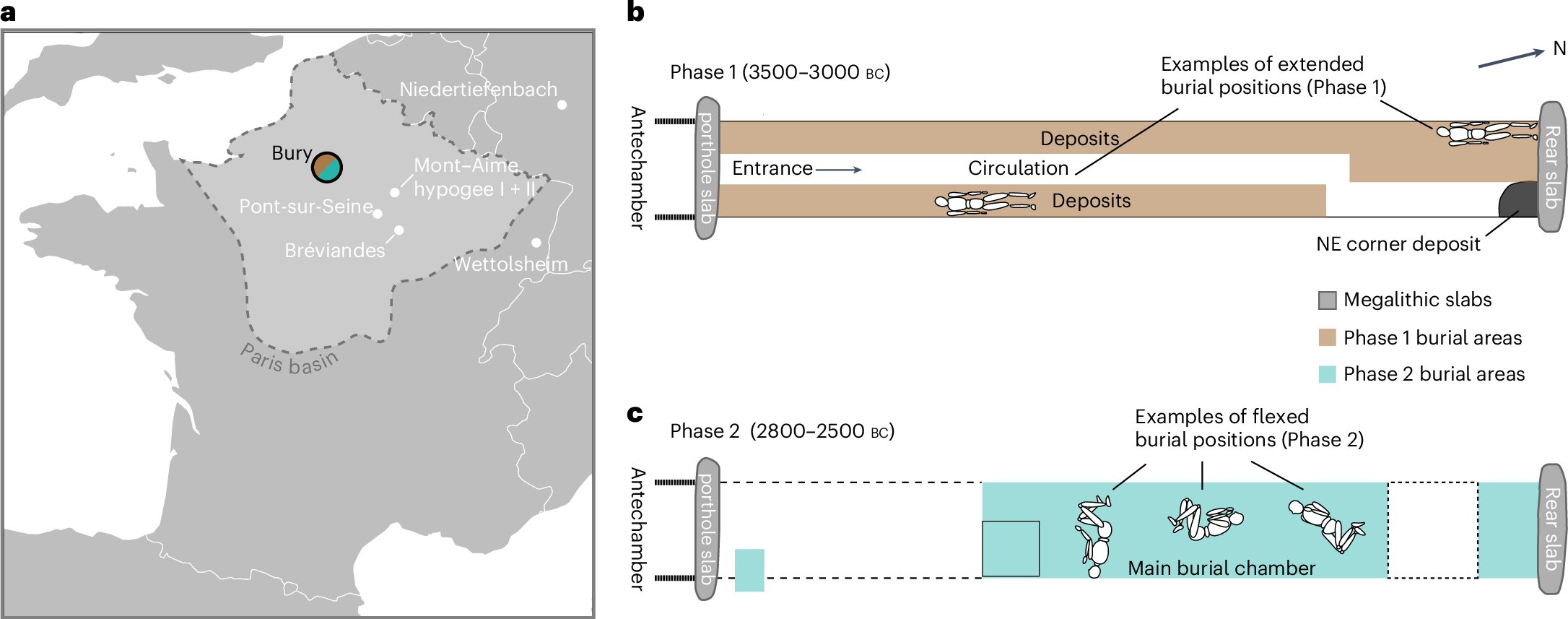
The mystery began with the DNA of 132 individuals who were laid to rest in the Bury burial site. When experts from the Lundbeck Foundation GeoGenetics Centre and various other institutions began peer into the past, they didn’t just find a single community. They found two entirely different worlds separated by a void. The site was used in two distinct phases, and between them lay a silence that lasted for centuries.
During the first phase, roughly between 3200 and 3100 BC, the tomb was filled with a vibrant, tightly-knit community. The analysis revealed a world built on the foundation of biological family ties. These were large, closely related families whose lineage could be traced through multiple generations within the same stone walls. They were the pioneers of the soil, the people who had cleared the thick forests to make way for grain and livestock.
However, the bones told a tragic tale. The mortality pattern at Bury during this early era was haunting. Researchers noticed an unusually high mortality rate, particularly among younger individuals. This was not the fingerprint of a healthy, thriving society. It was the signature of a crisis. Whether it was the slow burn of famine, the sharp edge of conflict, or the invisible hand of disease, something was systematically cutting down the youth of the Paris Basin.
A Silence Over the Land
Then, the record stopped. Following this period of high death, the Bury site was abandoned. The farmers who had once called this land home seemingly vanished, leaving their fields to the elements. This was the local manifestation of the Neolithic decline, a massive population collapse that sent ripples across northwestern Europe.
The evidence of this abandonment is etched into the very environment. Environmental data and the study of ancient pollen, known as palynology, reveal a landscape in retreat. As human activity plummeted, the farmland was reclaimed by the wild. Forest regrowth occurred across the region, as trees grew over the abandoned pastures and the hearths of the early farmers went cold. For several centuries, the Paris Basin became a place of shadows and silence, where the pulse of human society had slowed to a near-halt.
The Strangers from the South
When the tomb at Bury was finally reopened and used again, the people who stepped into the landscape were strangers. The DNA analysis revealed a shocking truth: there was a clear genetic break between the two burial phases. The people who inhabited the region after the collapse were not the descendants of those who lived there before. They were a completely different population.
These newcomers were travelers. Their genetic signatures showed strong ties to Southern France and Iberia, suggesting a massive northward migration. As the original population withered away, it created a vacuum—a “space” for new groups to expand into the region. These migrants brought more than just different genes; they brought a different way of living.
In this second phase of the tomb, the family structures that had once been so central were fundamentally altered. Gone were the vast, multi-generational clans of the earlier era. Instead, the researchers found fewer close relatives, and those who were present were mostly connected through a single paternal line. The very fabric of society, and how people chose to honor their dead, had undergone a radical transformation. The Bury site in this later period was characterized by burials spread out over time, reflecting either a highly reduced population or perhaps a select group of people who moved through a transformed landscape.
The Invisible Killers in the Bone
To understand why the first society collapsed so dramatically, the researchers turned their attention to the microscopic level. By using advanced techniques, they identified the DNA from several pathogens lingering in the ancient remains. They found Yersinia pestis, the infamous bacterium that causes plague, and Borrelia recurrentis, which triggers louse-borne relapsing fever.
The plague was present in both phases of the burial site, but it was notably more common in the earlier population—the one that suffered the catastrophic decline. While the researchers are careful to note that plague alone might not have caused the entire collapse, the total disease load likely played a devastating role. Infectious diseases, circulating through these early settled communities, acted as a contributing factor alongside other stresses like environmental change or social upheaval.
Why This Ancient Tragedy Matters
The story uncovered at Bury is much more than a local history of a single French village; it is a vital piece of the puzzle of European prehistory. This research provides concrete evidence that the Neolithic decline was a far-reaching phenomenon that fundamentally reshaped the continent. By combining genetics, archaeology, radiocarbon dating, and strontium analyses, this interdisciplinary effort shows how fragile early civilizations truly were.
Understanding this population replacement helps scientists realize that the transition into the modern world was not a smooth line of progress, but a series of dramatic breaks, collapses, and migrations. It highlights how infectious diseases have been shaping human destiny for over 5,000 years, influencing who stayed, who perished, and who eventually moved in to rebuild on the ruins of the past. The ancient struggle of the Paris Basin serves as a powerful reminder of the complex interplay between biology, environment, and the enduring human drive to find a new home in the wake of disaster.
Study Details
Frederik V. Seersholm et al, Population discontinuity in the Paris Basin linked to evidence of the Neolithic decline, Nature Ecology & Evolution (2026). DOI: 10.1038/s41559-026-03027-z. www.nature.com/articles/s41559-026-03027-z