Researchers have demonstrated a nondestructive method for collecting genetic material from historic parchment manuscripts, opening a new path for studying the past without harming priceless artifacts. Using a simple cytology brush technique, the team successfully sampled 91 manuscripts spanning regions from England to Ethiopia and dating from the late eighth to early 20th centuries. The approach could unlock new genetic clues about trade, agriculture, and domesticated animal history hidden in ancient documents.
For centuries, parchment manuscripts have been treated as fragile cultural treasures—objects to preserve, not probe. But a new study suggests these documents may also be biological archives, quietly carrying genetic traces of the animals they came from and the environments they passed through.
And now, researchers say they’ve found a way to access that information without damaging the manuscripts themselves.
Ancient Documents Made From Animal Skin Hold Genetic Clues
Parchment, unlike paper, is made from animal skins. It has been used for thousands of years across Europe, the Middle East, and parts of Africa to create everything from legal records to maps.
That biological origin matters more than historians once realized.
“Because they are made from animal skins, it is often possible to extract genetic information from parchments,” said Tim Stinson, corresponding author of the research and an associate professor of English at North Carolina State University.
According to Stinson, the genetic data contained in parchment can serve as a window into history, potentially answering questions about when and where a manuscript was made.
The Biggest Challenge Wasn’t Science—It Was Access
While genetic analysis of parchment has been gaining interest, one major obstacle has repeatedly slowed progress: museums and libraries have been reluctant to allow sampling.
The fear is understandable. Historic parchments are culturally significant artifacts, often irreplaceable. Any method that removes material—even tiny fragments—can raise serious concerns.
“This paper is particularly important because one of the biggest challenges for this emerging field of genetic analysis has been gaining access to historic parchments, due to concerns that collecting samples would damage these culturally significant artifacts,” Stinson said.
The researchers argue their work directly addresses that concern by showing sampling can be done safely.
A Pap Smear Tool Becomes a Manuscript Sampling Device
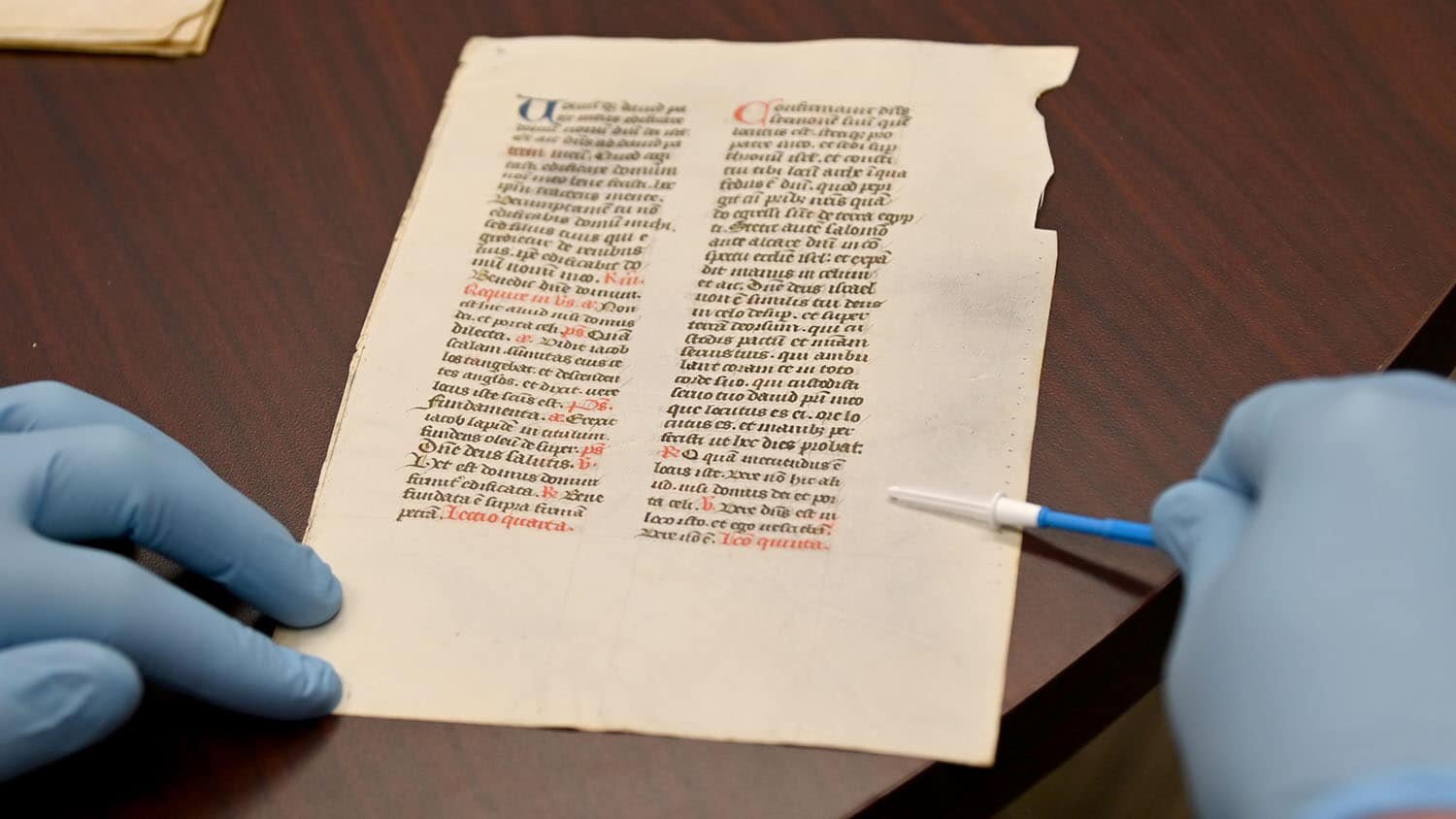
To collect cellular material without harming the parchment, the team used a surprisingly simple tool: a cytology brush, the same type used for Pap smears.
The technique involves rubbing the parchment surface gently with the brush while dry, allowing the bristles to pick up microscopic cellular traces.
“Cytology brushes can be used when dry and do an excellent job of harvesting cellular material without damaging the integrity of the artifact being sampled,” said Matthew Breen, a co-author of the paper and the Oscar J. Fletcher Distinguished Professor of Comparative Oncology Genetics at NC State’s College of Veterinary Medicine.
The approach is designed to avoid cutting, scraping, or removing visible material—methods that would be unacceptable for many archival collections.
Testing the Method on 91 Manuscripts From England to Ethiopia
To demonstrate the method’s effectiveness, the researchers applied it to 91 manuscripts housed at the Rubenstein Library at Duke University.
The documents came from a wide geographic range, spanning areas from England to Ethiopia, and covered an enormous time period—from the late eighth century through the early 20th century.
This broad sample set helped show the technique could work across different parchment sources and historical contexts.
Sequencing Ancient DNA With Forensic-Level Technology
After collecting the cellular material, the researchers extracted what the brushes had gathered and used next-generation sequencing methods to isolate and amplify genetic sequences.
They described the sequencing process as being at a forensic-level, meaning it is sensitive enough to work with small and potentially degraded biological samples.
The goal was not just to prove DNA could be recovered, but to show that meaningful genetic information could be obtained without harming the manuscript itself.
“We’re essentially using state-of-the-art technologies and genetic analytical techniques to get new, empirical information regarding historical cultural and agricultural practices,” Stinson said.
What This Could Reveal About Farming, Breeds, and Disease
The team argues that parchment genetics could contribute to far more than manuscript dating.
Because parchments come from domesticated animals, their genetic signatures may help researchers understand how farm species evolved, how breeds changed over time, and even how livestock diseases may have emerged and spread.
“Because parchments have been in use for so long, and often record detailed historical information, the genetic information they contain can also shed light on the evolution of domesticated farm species, how breeds developed over time, livestock diseases and so on,” Breen said.
In other words, a manuscript may carry biological evidence of agricultural history embedded directly in the skin it was made from.
A New Field Built on Trust Between Scientists and Archivists
The researchers emphasize that proving the method is nondestructive is not just a technical detail—it’s the foundation for building cooperation with institutions that protect these documents.
Libraries and museums control access to manuscripts, and without their approval, genetic research on parchment cannot scale.
“We’ve shown that we’re able to extract a tremendous amount of new information from these parchments without harming them,” Breen said. “This will hopefully engender trust with those organizations that are responsible for preserving these historic documents.”
That trust could determine whether genetic analysis becomes a niche experiment or a widespread research tool.
Researchers Say the Parchment Archive Is Vast and Untapped
The authors describe their findings as only the beginning.
They argue that parchments represent an enormous and largely unexplored biological record of human history—one sitting quietly in libraries around the world.
“We’re excited about the potential of this field and are seeking funding that will allow us to explore that potential,” Stinson said. “We’ve demonstrated that this is a vast, untapped source of historical information, and we want to continue this pioneering work.”
Breen echoed that sense of possibility, calling it an emerging area that could unite multiple disciplines.
“We have a remarkable opportunity here,” he said. “It is essentially a whole new field, bringing together a truly interdisciplinary range of expertise spanning fields from genetics to medieval history.”
Why This Matters
Historic manuscripts have long been valued for the words written on them. This research suggests they may be equally valuable for what they are physically made of. By using a nondestructive sampling method and modern next-generation sequencing, researchers can potentially unlock genetic evidence that reveals where manuscripts originated, how animals were bred, and what agricultural practices shaped societies across more than 1,300 years of history.
Most importantly, the technique could remove the biggest barrier to this work—fear of damaging priceless artifacts—making it possible for libraries and scientists to collaborate at a scale that was previously unrealistic. If widely adopted, parchment DNA analysis could turn archival collections into a new kind of historical dataset: one that is biological, empirical, and hidden in plain sight.
Study Details
Timothy L. Stinson et al, Adventures in the Animal Archive: New Techniques for the Genetic Analysis of Parchment Manuscripts, Manuscript Studies: A Journal of the Schoenberg Institute for Manuscript Studies (2026). DOI: 10.1353/mns.2026.a990234