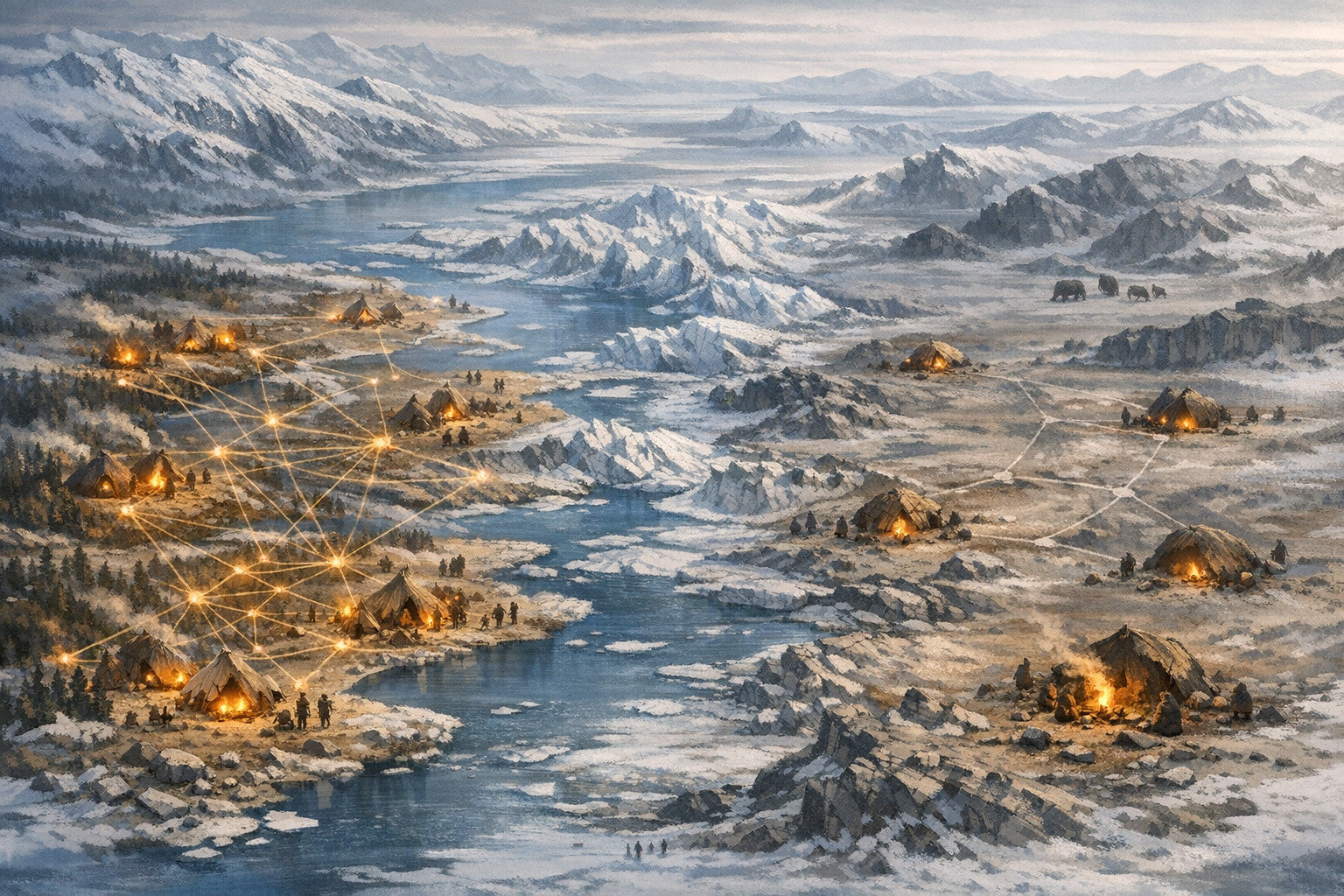
A new modeling study reveals that superior geographic connectivity and more robust social networks likely gave Homo sapiens a critical survival advantage over Neanderthals in prehistoric Europe. By adapting digital ecology tools to archaeological data, researchers found that while both species faced intense climate instability, the ability of modern humans to maintain a “safety net” of interconnected groups allowed them to endure shocks that fractured and eventually isolated Neanderthal populations.
The disappearance of the Neanderthals remains one of the most enduring mysteries in the story of human evolution. For millennia, these resilient hunters thrived across the rugged landscapes of Europe, surviving multiple ice ages and harsh environmental shifts. Yet, between 60,000 and 35,000 years ago, as the first populations of Homo sapiens began to appear in the European archaeological record, the Neanderthals vanished. While previous theories have blamed everything from inferior intelligence to direct violent conflict, a new study led by Ariane Burke at the Université de Montréal suggests the answer lies not in how we fought, but in how we moved and stayed connected.
Using an innovative approach inspired by digital ecology and conservation biology, Burke and her team at the Hominin Dispersals Research Group have provided a fresh perspective on this ancient cold case. By treating archaeological sites as “presence points”—similar to how a biologist might track the sightings of a rare plant or animal—the researchers built sophisticated habitat suitability models to map how these two species navigated a rapidly changing world.
Mapping the Ancient Wilderness
The study, published in Quaternary Science Reviews, focused on the last glacial cycle, a period characterized by extreme climate variability. The environment frequently swung between cold phases, known as stadials, and shorter, warmer intervals called interstadials. To understand how these swings affected human ancestors, Burke’s team incorporated ethnographic data from well-documented modern hunter-gatherer groups to set the parameters for their digital tools.
The researchers operated on the baseline that a typical local group of 25 to 50 individuals would require an annual territory of roughly 2,500 square kilometers. By layering this demographic data over climate indices and geographical maps, the team identified “core” regions—areas of land productive enough to support stable populations over long periods. However, the most telling discovery wasn’t just where these groups could live, but how those pockets of habitability were linked across the continent.
The analysis indicates that the regions favorable to Homo sapiens were significantly more connected than those inhabited by Neanderthals. While Neanderthals were certainly capable of forming social bonds, the models suggest their interregional connections were relatively tenuous, particularly in Central and Eastern Europe.
The Social Safety Net
In the context of prehistoric survival, connectivity is far more than a social luxury; it is a biological imperative. Burke describes these interconnected populations as forming a “safety net” that protected groups from sudden environmental or demographic crises. When a local territory suffered a collapse in animal migrations or a sudden shift in weather, a well-connected group could migrate to join allied or partner groups in more favorable areas.
These networks facilitated a constant exchange of information regarding resource locations and seasonal fluctuations. They allowed for the formation of partnerships and temporary access to neighboring territories during times of hardship. For Homo sapiens, this high degree of connectivity meant that even when a local population took a hit, the species as a whole remained resilient.
In contrast, the Neanderthal networks appeared more fragmented. The study found that the Neanderthal population in Europe was effectively divided into two distinct groups: one in the west and one in the east. In Eastern Europe, limited connectivity likely isolated these groups as climatic conditions deteriorated, leaving them vulnerable to local extinction without the possibility of reinforcement or relocation.
A Complex Interplay of Pressures
The research clarifies that no single factor, such as temperature or direct competition, can be blamed for the Neanderthals’ end. Instead, their extinction resulted from a complex interplay of geography, climate, and social organization. Interestingly, the study found that absolute temperature or precipitation levels were less important than climate variability—the speed and unpredictability of environmental change.
Neanderthals had survived earlier glacial cycles, but the specific combination of stressors during this period may have been unique. On the Iberian Peninsula, at the western edge of their range, better-connected core regions may have allowed Neanderthal populations to persist longer than their eastern counterparts. However, the arrival of Homo sapiens in these western refuges likely introduced a final, insurmountable pressure.
Because the two species were capable of producing offspring together, their interactions were likely subtle and multi-faceted. The presence of modern humans potentially added demographic stress to already vulnerable Neanderthal groups, involving a mix of occasional interbreeding, competition for resources, and complex population dynamics that eventually tipped the scales in favor of the newcomers.
Why This Matters
This research suggests that the defining characteristic of human success is not found in individual strength or even technological superiority, but in the power of the collective. The ancient dynamics revealed by this study mirror the fundamental human need for mobility and social integration that persists today.
Throughout history, humans have used migration and social networks to seek out more favorable environments and reunite with mutual aid systems. These findings serve as a reminder that the ability to forge and maintain connections across vast distances is a cornerstone of human resilience. As we face modern challenges, the lesson from the late Pleistocene is clear: our survival has always depended on our capacity to remain connected in the face of a changing world.
Study Details
Ariane Burke et al, Spatial resilience and population replacement in Europe during MIS 3: a comparative study of Neanderthals and H. sapiens, Quaternary Science Reviews (2026). DOI: 10.1016/j.quascirev.2026.109850