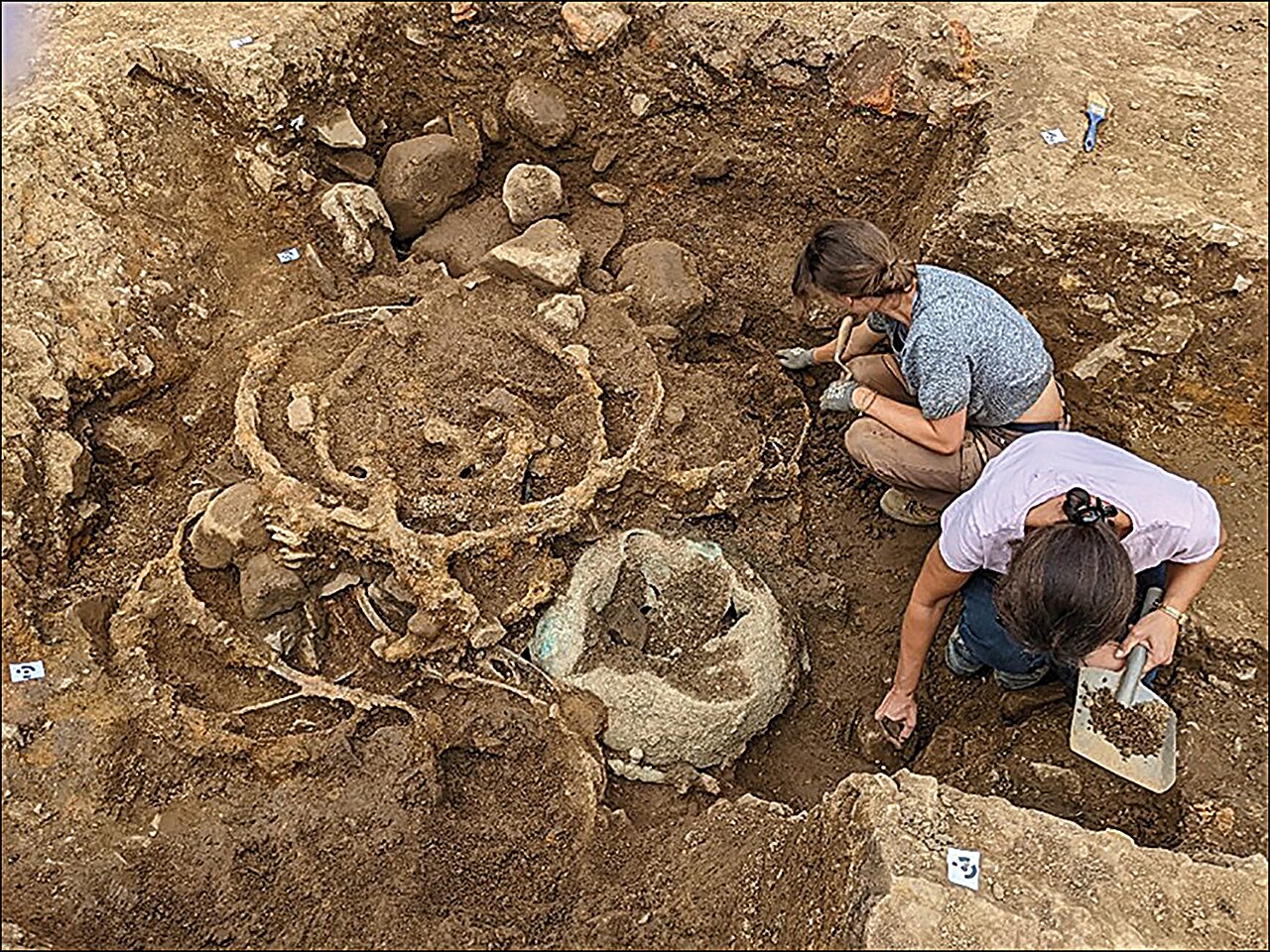
The rolling hills of Melsonby, North Yorkshire, have long held the secrets of ancient Britain beneath their soil, but it took the rhythmic hum of a metal detector in 2021 to wake them. When Peter Heads felt that familiar tug of a discovery, he had no idea he was unearthing a chapter of history that would rewrite our understanding of Iron Age technology.
What he pulled from the earth was not just a collection of metal, but a high-stakes mystery that eventually landed on the desk of Tom Moore at Durham University. The site, located near the Stanwick “royal site”—a massive seat of power during the Late Iron Age—revealed two distinct hoards of metallic treasure. But as archaeologists began to brush away the dirt, they realized these weren’t just discarded tools or random trinkets. They were looking at the shattered remains of a revolution on wheels.
The Ghostly Fleet of the North
The scale of the find was staggering. Researchers identified over 950 objects, which were found tucked away in two separate hoards. While many were fragments, the team concluded they represented approximately 300 whole objects that had been systematically broken down. In an act that felt both deliberate and haunting, these items had been dismantled, damaged, and then deposited into ditches.
As the team analyzed the composition, they found a wealth of materials: roughly two-thirds of the artifacts were crafted from copper alloy, while the remaining one-third consisted of iron. The sheer volume of the find suggested that this wasn’t a casual disposal. Most of the artifacts—nearly three-quarters of the items in both hoards—belonged to vehicles.
Before this discovery, the image of Iron Age Britain was one of two-wheeled chariots and light carts. However, the Melsonby hoards told a different story. The presence of kingpins, which are essential for steering mechanisms on larger vehicles, along with massive iron tires, brackets, and linchpins, pointed toward something much heavier: four-wheeled wagons. This find represents the first concrete evidence of such substantial vehicles in Britain, suggesting a level of engineering and logistics previously unimagined for the era.
A Puzzle of Wealth and Destruction
The inventory of the hoards reads like the cargo manifest of an ancient elite. Alongside the yoke fittings, bolts, and rein rings of the wagons, archaeologists found tubular adornments, vessels, and even a large cauldron. There were weapons of war, like spears and a shield boss, but also items of personal vanity and domestic life, including an iron mirror, box components, and edge bindings.
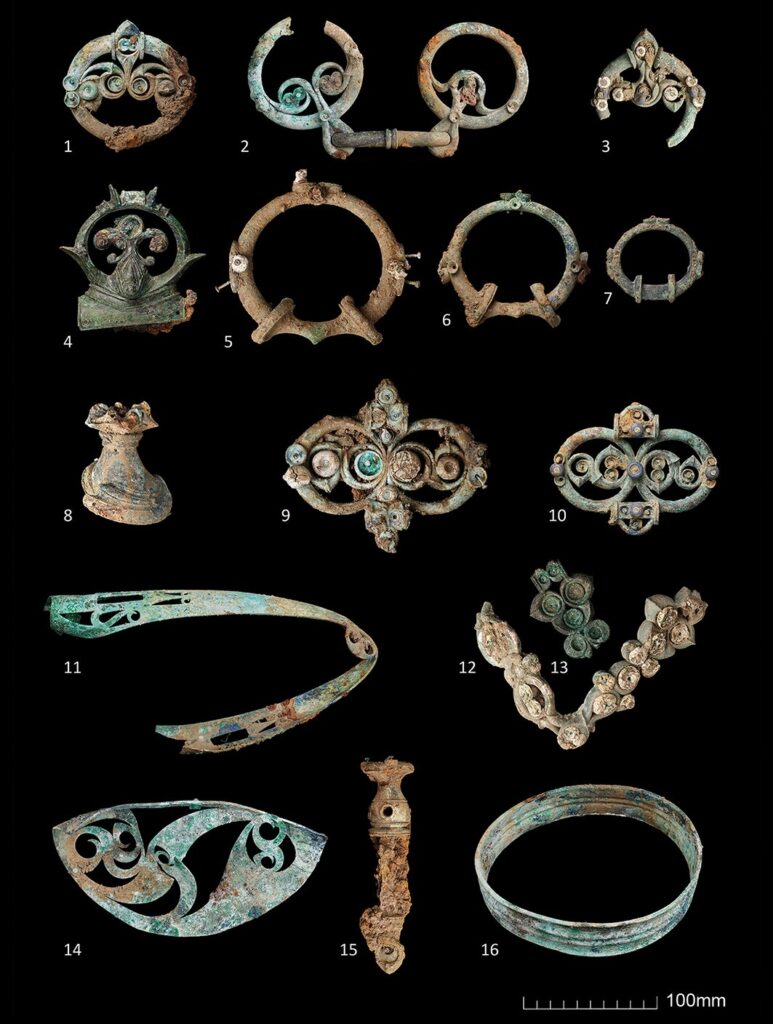
The researchers estimated the remains accounted for a minimum of seven wagons, though the number could be much higher if some were two-wheeled. What puzzled the team was the state of the metal. While some copper-alloy fragments appeared melted, other items, such as the harness fittings, were decorated with well-preserved coral and glass adornments. The bits used for the horses showed almost no signs of wear, suggesting these weren’t old, exhausted tools being thrown away, but rather high-status items in their prime.
Timing the Roman Shadow
To understand why these wagons were broken and buried, the researchers turned to radiocarbon dating. The results placed the hoards in a volatile window of time: the late 1st century BC to the early 1st century AD. This timeline is crucial, as it aligns with a period of massive upheaval—the Roman conquest of southern Britain in AD 43.
The style of several objects mirrors Roman designs from the same era, hinting at a society that was deeply connected to the expanding empire, either through trade, imitation, or conflict. The hoards represent a “huge amount of portable wealth,” and their sudden burial suggests a significant event or a rapid sequence of events that forced the local elite to decommission their most prized possessions.
The Ritual of the Broken Wheel
If these items weren’t just trash, what were they? One theory suggests the site was a metalworker’s collection, intended to be retrieved later for recycling. However, the archaeology argues against this. There were no crucibles or metalworking tools found nearby. Furthermore, if someone intended to recycle the metal, they likely would have removed the precious coral and glass decorations first.
Instead, the evidence points toward something more symbolic. The structured nature of the deposits and the selective composition of the materials suggest a ritual destruction. The team believes the burial could have been part of a funerary event, even though no human remains were found.
In the Late Iron Age, cremation was becoming common in southern Britain, but it was less documented in North Yorkshire. The researchers posited that the wagons and feasting vessels might have been offered up during a funeral pyre or a commemorative ceremony. Even if the human remains were disposed of elsewhere or in a way that left no archaeological trace, the “killing” of the objects—the deliberate breaking of the wagons—served as a powerful statement of loss or transition.
Why This Discovery Changes Everything
The Melsonby hoards are more than just a collection of old iron and copper; they are a window into the sophistication of Iron Age Britain. By proving the existence of four-wheeled transportation, this research shatters the image of a technologically isolated society. It reveals an elite class capable of building and maintaining complex machinery, adorned with international materials like coral and glass.
This discovery matters because it highlights the connectivity and ritual complexity of the people living in the shadow of the Roman Empire. It shows us that technology—in this case, the steering mechanism of a heavy wagon—was not just a tool for labor, but a symbol of wealth and status so significant that it had to be ritually “retired” when its owners passed or when their world began to change. As study of these 950 objects continues, we are slowly learning that the ancient roads of Yorkshire were far busier, and far more advanced, than we ever dared to dream.
Study Details
Sophia Adams et al, Vehicles of change: two exceptional deposits of destroyed chariots or wagons from Late Iron Age Britain, Antiquity (2026). DOI: 10.15184/aqy.2026.10311