Ion thrusters sound like something pulled straight from the pages of science fiction. The phrase alone conjures images of silent spacecraft gliding between stars, propelled by glowing blue exhaust and elegant, invisible forces. For decades, such engines were imagined as futuristic dreams—beautiful, impossible, and far beyond the reach of real engineering. And yet, today, ion thrusters are not only real, they are among the most reliable and transformative propulsion systems ever used in space exploration.
They do not roar like chemical rockets. They do not hurl spacecraft forward with explosive violence. Instead, ion thrusters whisper. They push gently, patiently, almost imperceptibly, accelerating spacecraft over months and years until they reach extraordinary speeds. In that quiet persistence lies their power. Ion propulsion represents a profound shift in how humanity moves through space, trading brute force for elegance, efficiency, and time.
To understand ion thrusters is to understand a new philosophy of exploration—one that embraces physics at its most subtle and trusts the long arc of motion rather than instant acceleration.
The Fundamental Challenge of Space Propulsion
Space is unforgiving. There is no air to push against, no surface to grip, no friction to exploit. Movement in space depends entirely on one principle: conservation of momentum. To move forward, a spacecraft must throw something backward. Traditional rockets achieve this by burning propellant in violent chemical reactions, producing hot gases that rush out of the exhaust nozzle at tremendous speed. The spacecraft recoils in the opposite direction, surging forward with enormous thrust.
Chemical rockets are powerful, but they are also inefficient. They consume vast amounts of fuel in a short time, limiting how much mass a spacecraft can carry and how long it can maneuver once it reaches space. For deep space missions—journeys to asteroids, comets, or distant planets—this limitation becomes severe. Carrying enough chemical fuel for long-term propulsion quickly becomes impractical.
Ion thrusters approach this problem from an entirely different angle. Instead of maximizing thrust, they maximize efficiency. They use physics not to explode fuel outward, but to accelerate tiny particles to astonishing speeds, extracting as much momentum as possible from every atom of propellant.
The Basic Principle Behind Ion Thrusters
At their core, ion thrusters operate on a simple idea. If you eject particles at extremely high velocity, you can generate thrust even if the number of particles is very small. The faster the exhaust, the less mass you need to expel to achieve the same change in momentum.
Ion thrusters use electrically charged atoms—ions—as their exhaust. These ions are typically created from a neutral gas, most commonly xenon, chosen for its heavy atomic mass, chemical inertness, and ease of ionization. Inside the thruster, xenon atoms are stripped of one or more electrons, giving them a positive electric charge.
Once ionized, these atoms are accelerated using electric fields. Because electric forces can be incredibly strong and precisely controlled, ions can be pushed to velocities far greater than those achievable by chemical combustion. The ions stream out of the thruster at speeds that can exceed tens of kilometers per second. As they exit, the spacecraft experiences a small but continuous push in the opposite direction.
This thrust is tiny—far weaker than that of chemical rockets—but it never stops as long as power is supplied. Over time, this gentle acceleration adds up, allowing spacecraft to reach velocities that chemical propulsion alone could never sustain.
The Quiet Power of Continuous Acceleration
One of the most emotionally striking aspects of ion propulsion is its patience. Chemical rockets embody urgency and violence. They explode into action, burn brightly, and then fall silent. Ion thrusters embody endurance. They start softly, barely nudging the spacecraft, and continue working day after day, month after month, year after year.
This difference fundamentally changes how missions are planned. With chemical propulsion, most of a spacecraft’s speed is achieved in a few dramatic minutes. With ion propulsion, speed is accumulated gradually. A spacecraft may accelerate for thousands of hours, slowly but steadily increasing its velocity until it is moving faster than any chemical rocket stage could manage.
The result is a form of motion that feels almost philosophical. Ion thrusters reward patience and foresight. They reflect a deep trust in the mathematics of motion and the inevitability of accumulation. In a universe governed by precise laws, even the smallest force, applied consistently, can produce astonishing results.
Early Ideas and the Long Road to Reality
The concept of electric propulsion is not new. Scientists began imagining ion-based engines in the early twentieth century, shortly after the discovery of the electron and the development of basic plasma physics. Visionaries recognized that electricity could, in principle, accelerate charged particles far more efficiently than chemical reactions.
For decades, however, ion thrusters remained theoretical curiosities. The challenges were immense. Generating and controlling plasmas in space, preventing erosion of engine components, and supplying sufficient electrical power all seemed beyond reach. Early space missions focused on more immediate goals, relying on proven chemical propulsion to escape Earth’s gravity.
As space exploration matured, priorities shifted. Long-duration missions became more common, and the limitations of chemical propulsion grew increasingly apparent. Advances in materials science, power generation, and plasma physics slowly transformed ion thrusters from science fiction into engineering reality.
How Ion Thrusters Actually Work Inside
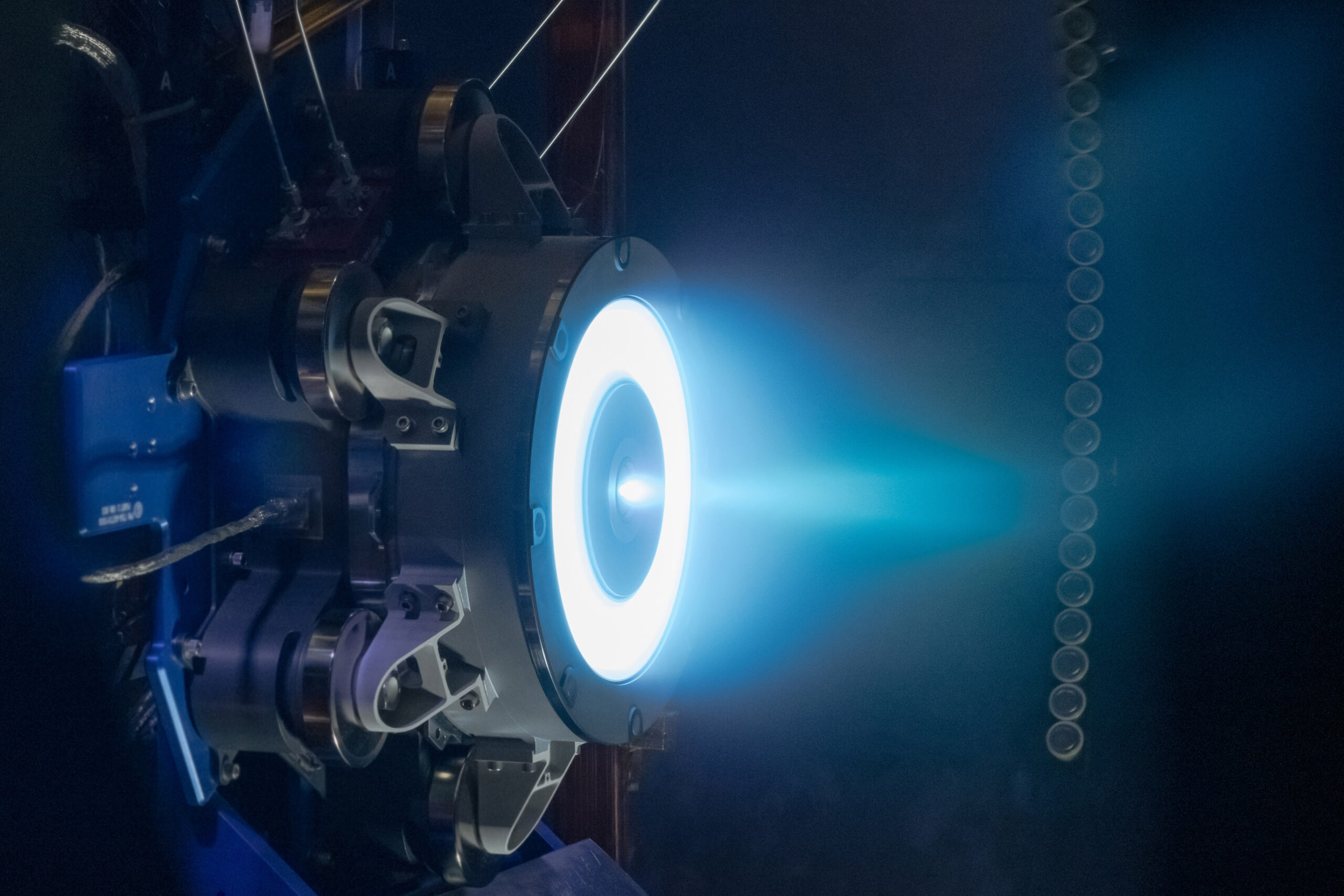
Inside an ion thruster, the environment is a carefully orchestrated dance of particles and fields. Xenon gas is fed into a chamber where electrons are introduced, often from a cathode. These electrons collide with xenon atoms, knocking loose additional electrons and creating positively charged xenon ions.
Once ionized, the xenon ions are guided toward a set of electrically charged grids. These grids create a powerful electric field that accelerates the ions to extreme velocities. The ions pass through tiny holes in the grids and shoot out of the engine as a narrow, high-speed beam.
To prevent the spacecraft from building up a negative charge as positive ions leave, a separate stream of electrons is emitted to neutralize the exhaust. This step is crucial. Without it, the accumulating charge would eventually pull the ions back toward the spacecraft, canceling the thrust.
The entire process is remarkably precise. Every ion is guided, accelerated, and expelled with exquisite control. Unlike chemical engines, where turbulence and chaos dominate, ion thrusters operate in a regime of quiet order, governed by electric fields and probability.
Efficiency and the Concept of Specific Impulse
In propulsion physics, efficiency is often measured using a quantity known as specific impulse. This value reflects how effectively an engine uses its propellant to produce thrust. Higher specific impulse means more momentum per unit mass of fuel.
Ion thrusters have extraordinarily high specific impulse compared to chemical rockets. This means they can achieve the same total change in velocity using a fraction of the propellant. For deep space missions, where every kilogram matters, this advantage is transformative.
The trade-off is thrust. Ion thrusters produce very little force, often comparable to the weight of a sheet of paper resting on your hand. This makes them unsuitable for launching spacecraft from Earth or performing rapid maneuvers. They shine instead in the vacuum of space, where even tiny forces can shape trajectories over time.
Powering Ion Thrusters in Deep Space
Ion thrusters require electricity, and providing that power in space is a central engineering challenge. Near Earth and within the inner solar system, solar panels are often sufficient. Large, efficient arrays can generate the continuous electrical power needed to sustain ion propulsion.
As missions venture farther from the Sun, solar power becomes less practical. In these regions, nuclear power sources may be used to provide electricity. The combination of ion thrusters and long-lived power systems opens the door to missions that can operate far from Earth for decades.
The dependence on power rather than fuel represents a profound shift. Traditional rockets are limited by how much propellant they can carry. Ion-powered spacecraft are limited by how much power they can generate and manage. This changes mission design from a question of mass to a question of energy.
Ion Thrusters in Action: Real Missions, Real Impact
Ion thrusters are not experimental novelties. They have been used successfully on numerous missions, proving their reliability and versatility. These engines have guided spacecraft through intricate orbital dances, allowed repeated encounters with multiple celestial bodies, and extended mission lifetimes far beyond original expectations.
What makes these achievements emotionally compelling is their quiet nature. There are no fiery launches or dramatic burns once the spacecraft is on its way. Instead, there is a steady, invisible push, shaping the spacecraft’s destiny with relentless consistency.
Ion propulsion has enabled missions that would have been impractical or impossible with chemical engines alone. It has allowed spacecraft to rendezvous with asteroids, orbit distant bodies, and adjust their trajectories with exquisite precision over many years.
The Plasma State and the Physics of Ions
Ion thrusters rely on plasma, often described as the fourth state of matter. In plasma, atoms are ionized, and electrons move freely among charged particles. This state is common in the universe, found in stars, lightning, and the tenuous gas between galaxies.
Working with plasma is both powerful and challenging. Plasmas are sensitive to electromagnetic fields and can behave in complex ways. Engineers designing ion thrusters must manage these behaviors carefully, preventing instabilities and minimizing erosion of engine components caused by high-energy ions.
The success of ion propulsion reflects decades of progress in plasma physics. It is a testament to humanity’s ability to harness one of the most fundamental and energetic states of matter for peaceful exploration.
Why Ion Thrusters Feel Like Science Fiction
Ion thrusters resonate with science fiction not because they are flashy, but because they embody a future-oriented mindset. They suggest a civilization that has learned to think long-term, to value efficiency over spectacle, and to trust in subtle forces.
In popular imagination, space travel is loud and dramatic. Ion thrusters subvert this expectation. They operate almost silently, their exhaust invisible, their progress measured not in seconds but in months. They feel alien, not because they defy physics, but because they reveal aspects of physics that everyday life hides from us.
This sense of quiet futurism is emotionally powerful. It invites us to imagine space travel not as conquest, but as patience and precision, a slow and thoughtful expansion into the cosmos.
Limitations and Engineering Challenges
Despite their advantages, ion thrusters are not a universal solution. Their low thrust makes them unsuitable for missions requiring rapid acceleration or heavy payloads under strong gravity. They cannot replace chemical rockets for launch or landing.
They also face challenges related to power generation, component wear, and system complexity. The high-speed ions can erode engine grids over time, limiting operational lifespan. Engineers continuously refine materials and designs to mitigate these effects.
These limitations highlight an important truth about physics: no technology is perfect. Every solution involves trade-offs. Ion thrusters succeed not by being superior in all contexts, but by excelling where patience and efficiency matter most.
The Emotional Dimension of Ion Propulsion
There is something deeply human in the way ion thrusters work. They mirror aspects of our own experience. Small efforts, applied consistently, can lead to profound change. Progress does not always come in bursts of drama. Sometimes it comes in quiet persistence.
Ion propulsion teaches a lesson written into the fabric of physics itself. Time matters. Accumulation matters. The universe rewards those who understand its rhythms and work with them rather than against them.
For scientists and engineers, watching an ion-powered spacecraft gradually build speed over years can be an emotional experience. It is a reminder that exploration is not always about speed or spectacle, but about endurance and trust in fundamental principles.
Ion Thrusters and the Future of Space Exploration
As humanity looks toward more ambitious missions, ion thrusters are poised to play an even greater role. Deep space exploration demands propulsion systems that can operate reliably for decades, make fine adjustments over vast distances, and use limited resources wisely.
Ion propulsion aligns perfectly with these needs. It supports missions that can visit multiple targets, adapt their paths over time, and remain active long after chemical fuel would have been exhausted.
In the long term, ion thrusters may become stepping stones toward even more advanced propulsion concepts. They represent a bridge between the explosive chemistry of early rocketry and a future dominated by electromagnetic and possibly even more exotic forms of propulsion.
A New Way of Moving Through the Cosmos
Ion thrusters redefine what it means to travel through space. They challenge our instinctive association between force and speed, reminding us that motion is not just about how hard you push, but how long you keep pushing.
They embody a scientific truth that is easy to overlook in a world obsessed with immediacy. In the vacuum of space, where resistance is minimal and time stretches endlessly, gentle forces can shape destinies.
As deep space probes glide silently under ion propulsion, they carry not only instruments and sensors, but a message about humanity’s relationship with the universe. We are learning to move not by shouting at nature, but by listening to it, understanding its rules, and applying them with patience and care.
The Legacy of Ion Thrusters
Ion thrusters may never capture public imagination in the way towering rockets do, but their legacy is profound. They have expanded the reach of exploration, reshaped mission design, and demonstrated the power of efficiency over brute force.
They remind us that science fiction often becomes science not through dramatic leaps, but through steady refinement and deep understanding. What once seemed like a futuristic fantasy is now a trusted tool, quietly pushing humanity’s robotic explorers farther into the unknown.
In their faint glow and invisible thrust, ion thrusters embody a future where exploration is measured not in explosions, but in endurance, precision, and faith in the fundamental laws of physics.
The Whisper That Carries Us Farther
Ion thrusters do not announce themselves. They do not demand attention. They simply work, day after day, converting electricity into motion with unwavering discipline. In doing so, they reveal a profound truth about the universe and about ourselves.
Sometimes, the most powerful force is not the loudest one. Sometimes, progress comes not from burning brightly and briefly, but from glowing softly and enduringly. Ion thrusters are the whisper that carries our machines across the vast silence of space, proving that even the gentlest push, guided by understanding, can take us farther than we ever imagined.