For centuries, Mars has haunted the human imagination. It glows in the night sky like a coal that refuses to cool, a red world that feels strangely familiar and yet impossibly distant. Long before telescopes could reveal its valleys and polar caps, people wondered whether something might be living there—watching, growing, surviving under alien skies. In modern times, that ancient curiosity has transformed into a serious scientific mission. NASA has spent decades sending orbiters, landers, and rovers to Mars, each one designed to peel back another layer of mystery.
And now the question has returned with renewed intensity: Did NASA finally find signs of life on Mars?
The honest answer is both thrilling and frustrating. NASA has discovered multiple clues that Mars was once habitable and has found chemical and geological evidence that could be consistent with life. Some findings are among the most exciting in the history of Mars exploration. But NASA has not confirmed life—past or present—on Mars yet. What has been found is something more subtle and more scientifically careful: signs that Mars once had the right conditions for life, and possible traces that demand deeper investigation.
The difference between “possible signs” and “proof” is where the real story lies.
What NASA Is Actually Looking For
When people imagine “life on Mars,” they often picture walking creatures or at least visible organisms. But NASA’s search is far more realistic. Scientists do not expect Martian forests or animals. If life ever existed on Mars, it was most likely microbial—tiny organisms similar to early bacteria on Earth.
So NASA is not searching for footprints in the dust. It is searching for biosignatures, subtle fingerprints that living organisms might leave behind. These biosignatures could be chemical, mineral-based, or structural. They might include complex organic molecules, unusual isotope ratios, or rock textures that resemble fossilized microbial mats.
NASA’s rovers are not designed to declare, with absolute certainty, “Life existed here.” Instead, they are designed to narrow down the search to the most promising places and collect evidence strong enough to justify returning samples to Earth.
This is crucial. Mars is not easy to read. It is a world shaped by time, radiation, chemistry, and erosion. Any signs of ancient life could be faint, damaged, or hidden in rock layers that have been altered for billions of years.
The search is not like opening a door and seeing what’s inside. It is like trying to reconstruct a forgotten story from fragments of burnt paper.
Mars Was Once a Different World
To understand why scientists are excited, you need to understand one of the most important discoveries of modern planetary science: ancient Mars was not the dry desert we see today.
Billions of years ago, Mars had rivers. It had lakes. It had minerals that only form in water. It may even have had an ocean. It had a thicker atmosphere and a warmer climate than it has now. Some parts of Mars once looked more like Earth than like the dead planet we know today.
This discovery alone changed everything.
Because on Earth, where there is stable liquid water, there is life. Water is not just a nice ingredient—it is the chemical environment where biology becomes possible. Life depends on water because water is an incredible solvent. It allows molecules to move, collide, combine, and form the complex chemistry that biology requires.
If Mars once had water for long periods of time, then Mars was once potentially habitable.
And if it was habitable, then the possibility of life becomes more than imagination. It becomes a scientific question.
The Viking Missions: The First Great Martian Mystery
NASA’s first serious attempt to detect life on Mars happened in the 1970s, when the Viking landers arrived on the planet. These landers carried experiments specifically designed to search for microbial life in Martian soil.
The results were shocking.
Some experiments produced chemical reactions that looked like biological activity. But other instruments failed to detect organic molecules in the soil. Scientists ultimately concluded that the reactions were likely caused by unusual Martian chemistry rather than life.
Still, Viking left behind a haunting possibility: what if the experiments were right, and life was present, but misunderstood?
The Viking debate never fully died. Instead, it became a warning. Mars could produce life-like chemical signals without life. That means every discovery today must be interpreted with extreme caution.
Mars does not hand out easy answers.
The Rise of the Rovers: Curiosity Changes the Conversation
In 2012, NASA landed the Curiosity rover in Gale Crater, a region that once held a lake. Curiosity was built not to directly detect life, but to answer a different question: Was Mars ever habitable?
Curiosity’s findings were groundbreaking. It confirmed that ancient Mars had the chemical ingredients necessary for life, including carbon, hydrogen, oxygen, nitrogen, sulfur, and phosphorus. It also confirmed that the environment in Gale Crater could have supported microbial life long ago.
Then Curiosity found something even more exciting: organic molecules.
Organic molecules are carbon-based compounds. They are not automatically proof of life, because they can form through non-biological processes. But they are essential building blocks. On Earth, organic chemistry is deeply connected to biology. Life is built from organic molecules.
Curiosity discovered organic compounds preserved in ancient rocks, suggesting Mars once had the kind of chemical complexity that could support life’s development.
It was a turning point. Mars was no longer just “maybe habitable.” Mars was revealing evidence of a rich chemical history.
What Organic Molecules Really Mean
When headlines say “NASA found organic molecules on Mars,” many people assume this means life has been discovered. But that is not what organic means in scientific terms.
Organic molecules can form in many ways. They can be produced by volcanic activity, chemical reactions between rocks and water, ultraviolet light interacting with carbon dioxide, or even delivered by meteorites. In fact, meteorites and comets carry organic compounds across the solar system all the time.
So organic molecules are not proof of biology.
But they are extremely important because they show that Mars had the raw chemical ingredients needed for life. Even more importantly, the organic molecules Curiosity found were preserved for billions of years inside rock. That means Mars can preserve ancient chemical signatures, which is essential if we ever want to find ancient biosignatures.
A planet that destroys organic evidence quickly is a planet where life might be impossible to detect, even if it existed. Mars appears to be a planet that can preserve history like a fossil vault.
That alone makes it worth searching.
Methane on Mars: The Chemical Whisper That Won’t Go Away
Another major reason scientists remain fascinated is methane.
Methane is a gas made of carbon and hydrogen. On Earth, methane is often produced by living organisms, especially microbes in wetlands, digestive systems, and ocean sediments. But methane can also be produced by geological processes, such as chemical reactions between water and certain rocks.
Over the years, NASA and other space agencies have detected trace amounts of methane in the Martian atmosphere. Even more intriguing, methane levels appear to rise and fall, sometimes seasonally or in localized spikes.
This is strange because methane does not last long in Mars’ atmosphere. It breaks down due to sunlight and chemical reactions. If methane is present, something must be producing it relatively recently.
That “something” could be geology. It could be chemical reactions deep underground. Or it could be microbial life.
Methane on Mars is not proof of life. But it is like a faint signal in the dark—a whisper that suggests Mars may not be completely inactive.
It suggests Mars may still have secrets moving beneath its surface.
Perseverance: The Rover Built to Hunt Ancient Life
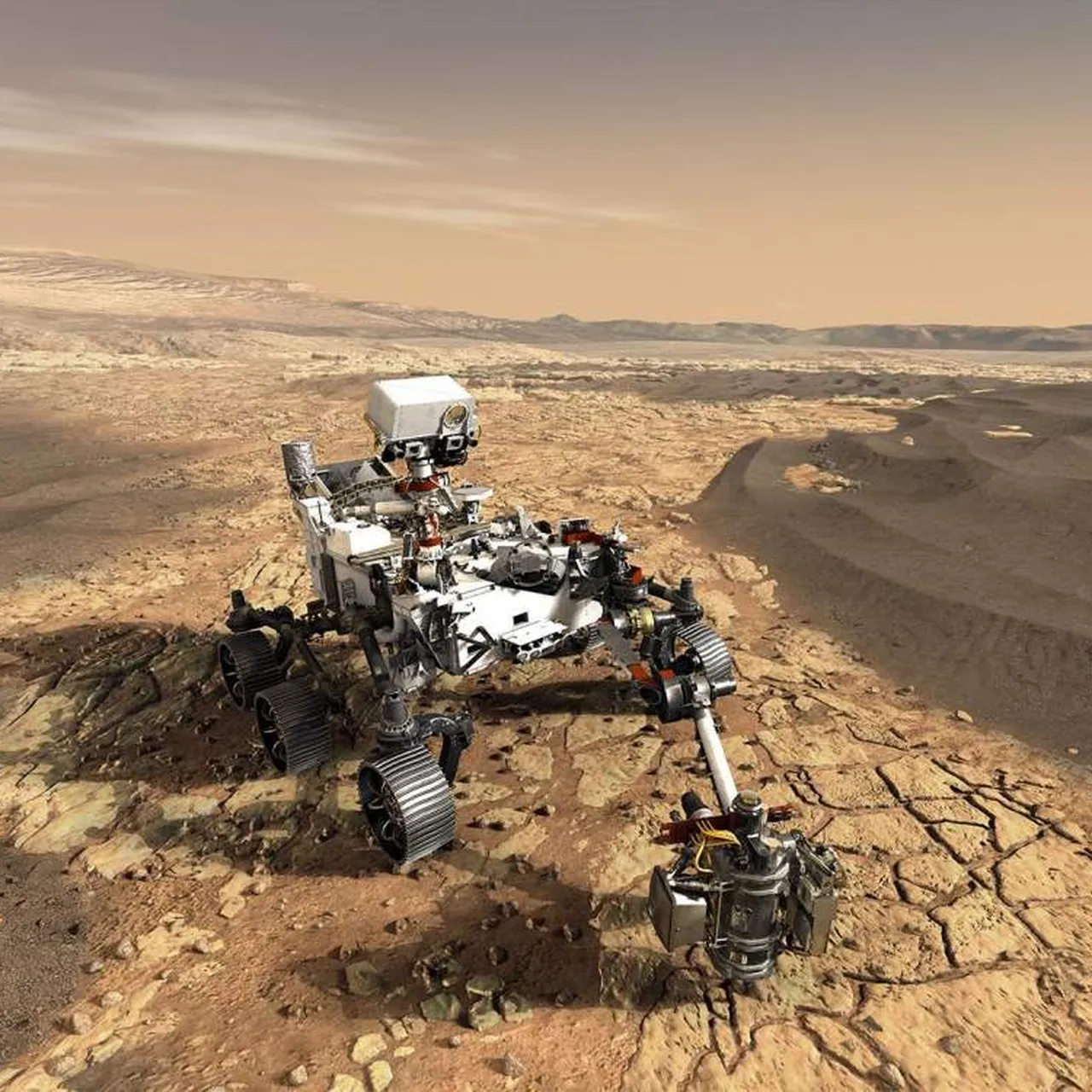
In 2021, NASA landed Perseverance rover in Jezero Crater, one of the most promising places on Mars to search for ancient life. Jezero Crater was once a lake, fed by rivers that carried sediments into a delta. On Earth, river deltas are excellent places to preserve signs of life because they bury organic matter quickly under layers of sediment.
Perseverance was designed for a more specific mission than Curiosity: not just to determine habitability, but to search for possible biosignatures and collect samples for return to Earth.
This is one of the most important steps NASA has ever taken. Perseverance is not just exploring. It is building a physical archive of Mars, sealing samples into tubes that could one day be brought back to Earth for detailed laboratory analysis.
If Mars holds evidence of life, Perseverance is hunting in the right place.
The “Leopard Spots” and the Rock That Raised Eyebrows
One of Perseverance’s most widely discussed discoveries involved unusual rock features sometimes described as spot-like patterns, leading to intense scientific interest. These features were found in rocks believed to have interacted with water long ago.
Some scientists suggested these patterns could resemble chemical changes associated with microbial activity on Earth. On our planet, microbes can leave behind mineral patterns and chemical signatures when they metabolize substances like iron and sulfur.
The key word is “could.”
Because Mars is a master of imitation. Non-biological processes can produce patterns that look like life. Water flowing through rock can create mineral staining. Heat and pressure can alter chemistry. Radiation can change organic molecules. Simple chemical reactions can mimic the fingerprints of biology.
Still, these discoveries matter because they show that Jezero Crater contains chemically active rocks shaped by water, and that these rocks preserve textures and mineral changes that are worth studying in far greater detail.
In the world of astrobiology, such a discovery is like finding a suspicious footprint in ancient stone. It does not prove who made it, but it proves the story is not over.
What NASA Has Found So Far: Strong Evidence of Habitability
If we step back from the hype and focus on what NASA can confidently say, the most accurate statement is this:
NASA has found strong evidence that Mars was once habitable.
This includes ancient lakebeds, river channels, sedimentary rocks, clay minerals, salts, and chemical elements essential for life. NASA has found organic molecules preserved in rocks. NASA has found signs that water existed long enough to form stable environments, not just brief floods.
Mars was once a planet where microbial life could have survived, at least in theory.
That is not a minor discovery. That is enormous.
Because it means Mars was not always dead. Mars once had the ingredients that made life possible on Earth.
But Did NASA Find Actual Life?
This is where the answer becomes careful.
NASA has not confirmed life on Mars.
There has been no direct detection of a Martian microbe. No fossil has been officially identified. No chemical signature has been universally accepted as biological. No discovery has met the extremely high scientific standard required to declare life exists or existed.
And that caution is not weakness. It is strength.
The scientific community knows that claiming life is one of the most serious announcements in history. If NASA ever says “We found life,” it must be supported by overwhelming evidence. It must withstand global scrutiny. It must survive every alternative explanation.
So far, every promising clue has had at least one plausible non-biological explanation.
That means the evidence is exciting, but not final.
Why It’s So Hard to Prove Life Existed on Mars
Mars is harsh. Today, its surface is bombarded by radiation because the planet lacks a strong magnetic field and has a thin atmosphere. Over millions of years, radiation breaks down organic molecules. It can erase the delicate chemical traces life leaves behind.
Even if Mars had life billions of years ago, those organisms may have been microscopic and short-lived. Fossils of microbes are hard to detect even on Earth, where we can use advanced tools and collect unlimited samples. On Mars, we are limited to robotic instruments.
The rocks themselves may also have been altered by time. Water can both preserve and destroy evidence. Chemical reactions can rewrite the story.
In other words, Mars might have been alive once, and still leave behind only a faint ghost of evidence.
That is why NASA’s strategy is increasingly focused on sample return.
The Mars Sample Return Dream: The Mission That Could Change History
Perseverance has been collecting rock cores and sealing them into sample tubes. The plan is to return these samples to Earth in a future mission.
This is essential because Earth laboratories are far more powerful than anything we can send to Mars. Scientists on Earth can use high-resolution microscopes, isotope analysis, chemical separation techniques, and multiple independent methods to test whether the samples contain biosignatures.
On Earth, scientists can test for patterns that strongly suggest life, such as carbon isotope ratios typical of biological processes, complex organic structures, or microscopic fossil-like shapes.
If Mars ever hosted life, these samples may be the key to proving it.
Mars Sample Return is not just another mission. It could become one of the most important scientific events in human history.
It could finally allow us to answer the question that has echoed through centuries: Are we alone?
Could Life Still Exist on Mars Today?
Another fascinating possibility is that Mars might still host life—not on the surface, but underground.
The surface is cold, dry, and heavily irradiated. But beneath the ground, conditions could be different. Underground environments might contain water ice, salty brines, or geothermal heat. On Earth, microbes survive deep underground in rock, feeding on chemical energy rather than sunlight.
Mars could theoretically host similar underground microbial ecosystems.
However, NASA has not discovered active life today. No direct biological activity has been detected. The methane mystery keeps the possibility alive, but methane alone is not enough.
Still, many scientists believe that if life exists on Mars now, it would most likely be hidden underground, protected from radiation and extreme temperature swings.
Mars might not be dead. It might simply be quiet.
The Danger of Misinterpretation: Mars Is a Chemical Trickster
Mars is full of chemicals that complicate life detection.
For example, Martian soil contains perchlorates, reactive compounds that can break down organic molecules when heated. This may have interfered with earlier life-detection experiments. Mars also experiences intense ultraviolet radiation, which can create complex chemical reactions at the surface.
Even minerals can mimic biological patterns. Some geological processes produce shapes that resemble microbial fossils. Certain crystal growth patterns can look like biological structures.
Because of this, astrobiology has learned a painful lesson: you cannot rely on a single clue.
You need a network of evidence. You need chemistry, geology, and context all pointing in the same direction.
That is why NASA remains cautious even when discoveries look extremely promising.
What Would Count as Real Proof?
If NASA ever confirms life on Mars, it will likely require multiple discoveries working together.
A strong case might involve complex organic molecules that cannot be easily explained by geology, found in an environment known to be habitable, paired with isotope ratios strongly associated with biology, combined with microscopic structures consistent with fossilized microbes.
In other words, proof would look like an overwhelming convergence of evidence.
Right now, NASA has several pieces of the puzzle. But the final picture is not complete.
So, Did NASA Finally Find Signs of Life?
If we define “signs of life” as direct evidence of organisms, then no.
If we define “signs of life” as evidence that Mars once had the right conditions for life and may preserve possible biosignatures, then yes—NASA has found extremely compelling signs that Mars could have supported life in the past.
NASA has found ancient lakebeds and river deltas. NASA has found organic molecules preserved in rock. NASA has found mineral changes and rock textures that might have formed through microbial processes. NASA has found chemical clues that make Mars look less like a dead rock and more like a planet with a complicated, dynamic history.
These discoveries do not confirm life.
But they do something almost as powerful.
They keep the question alive.
Why the Search for Life on Mars Matters So Much
The search for life on Mars is not only about Mars.
It is about understanding how life begins. If life arose independently on both Earth and Mars, then life might be common in the universe. It would mean biology is not a miracle but a natural outcome of chemistry under the right conditions.
That would transform our understanding of the cosmos. It would suggest that the galaxy might be filled with worlds where life emerged, perhaps even intelligent life.
But if Mars was habitable and still never developed life, that would also be important. It would suggest that life might be rare, fragile, and dependent on special conditions we still do not fully understand.
Either answer reshapes our place in the universe.
Mars is like a mirror held up to Earth’s past. It may show us what Earth could have become if things had gone differently. It may reveal the thin line between a living world and a silent one.
The Most Honest Conclusion
NASA has not found definitive proof of life on Mars.
But NASA has found something extraordinary: a growing body of evidence that Mars was once a world of water, chemistry, and potential. The planet is no longer a simple desert in our imagination. It is a world with ancient lakes, river deltas, organic molecules, and complex geological processes that could have supported microbial life.
The most accurate conclusion is that NASA has found some of the strongest possible hints that Mars might once have hosted life, but the final confirmation requires deeper analysis, likely through returned samples studied in Earth laboratories.
Mars is still keeping its ultimate secret.
But the evidence is getting louder.
And the truth may already be waiting, sealed inside a small tube of rock collected by Perseverance—waiting to be brought home, opened, and understood.