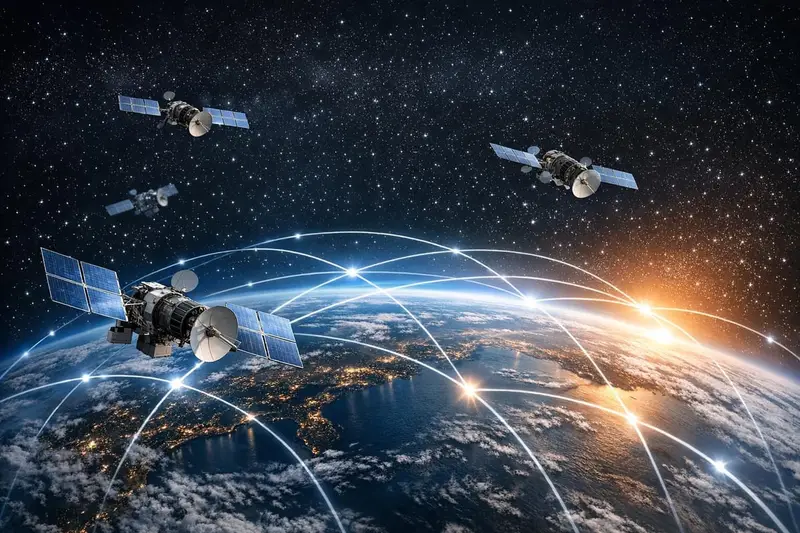
Satellite internet is one of humanity’s boldest attempts to defeat distance. It is the idea that information—our words, images, voices, and ideas—can travel not just across land and under oceans, but up into space and back again, linking people who may live thousands of kilometers apart or far beyond the reach of cables and cell towers. At its core, satellite internet is a system that delivers internet access using satellites orbiting Earth rather than relying solely on ground-based infrastructure.
But to understand satellite internet only as a technical solution is to miss its deeper significance. Satellite internet is about connection in the most literal and emotional sense. It exists because humans want to speak to one another across deserts, oceans, mountains, and political borders. It is the internet’s answer to isolation, a promise that even the most remote village, ship at sea, research station in Antarctica, or spacecraft in orbit can still be part of the global conversation.
To fully understand satellite internet, we must explore how it works, why it exists, what it can and cannot do, and how it is reshaping the way humanity connects with itself and with the planet.
The Basic Idea Behind Satellite Internet
Satellite internet works by transmitting data as radio signals between Earth and space. Instead of sending information through underground fiber-optic cables or cellular towers, satellite internet beams data upward to a satellite orbiting Earth. That satellite then relays the data back down to another point on the ground, such as a data center connected to the wider internet.
This process happens at the speed of light, yet the vast distances involved introduce unique challenges. Even when signals move incredibly fast, traveling tens of thousands of kilometers into space and back takes time. This physical reality shapes the strengths and limitations of satellite internet in ways that are deeply rooted in physics.
At the user’s location, satellite internet typically requires a dish or flat antenna pointed toward the sky. This device communicates directly with satellites overhead. From the user’s perspective, the experience can feel similar to any other internet connection—web pages load, videos stream, messages send—but beneath the surface, the data is taking a journey far beyond Earth’s surface.
Why Satellite Internet Exists at All
To appreciate satellite internet, it helps to understand why traditional internet infrastructure cannot reach everyone. Fiber-optic cables deliver astonishingly fast and reliable internet, but they are expensive and difficult to install in remote or rugged terrain. Cellular networks rely on towers that must be built, powered, and maintained, which becomes impractical in sparsely populated regions.
Large portions of the world still lack reliable internet access not because of lack of demand, but because of geography and economics. Mountains, forests, islands, deserts, and polar regions pose enormous logistical challenges. In some places, political instability or conflict further complicates infrastructure development.
Satellite internet exists because it bypasses these obstacles. A single satellite can cover vast areas of Earth’s surface, reaching places where cables may never go. From space, national borders and natural barriers lose much of their significance. This makes satellite internet uniquely suited for connecting the unconnected.
The Physics of Sending Internet Into Space
At the heart of satellite internet lies electromagnetic radiation, specifically radio waves. These waves are a form of energy that can travel through empty space, unlike sound, which requires a medium like air. Radio waves are ideal for long-distance communication because they can carry information and penetrate the atmosphere with relatively low energy loss.
When you send data through satellite internet, that data is encoded into radio signals. These signals are transmitted upward from your ground antenna to a satellite. The satellite receives the signal, amplifies it, and retransmits it back toward Earth, either to a ground station or directly to another user.
The entire process is governed by well-understood physical laws. Signal strength decreases with distance, atmospheric conditions can affect transmission, and interference must be carefully managed. Engineers design satellite systems with these constraints in mind, balancing power, frequency, and coverage.
The Different Orbits That Shape Satellite Internet
Not all satellites orbit Earth in the same way, and these differences have profound consequences for satellite internet performance. The orbit determines how far signals must travel, how quickly data can be exchanged, and how many satellites are required for global coverage.
Some satellites orbit far from Earth, maintaining a fixed position relative to the planet’s surface. Others orbit much closer, racing across the sky in complex patterns. Each approach reflects trade-offs between coverage, latency, cost, and technical complexity.
Understanding satellite internet means understanding how these orbits influence the user experience, from connection speed to responsiveness.
Geostationary Satellites and the Early Era of Satellite Internet
For decades, satellite internet relied primarily on satellites placed in geostationary orbit. These satellites orbit Earth at a distance of approximately 36,000 kilometers above the equator. At this altitude, they orbit at the same speed Earth rotates, appearing to hover motionless over a single point on the planet’s surface.
This stationary position makes geostationary satellites incredibly useful. A ground antenna can point at one spot in the sky and maintain a constant connection. A single satellite can cover an enormous portion of Earth, making it efficient for broadcasting and wide-area communication.
However, physics imposes a cost. The vast distance means that signals must travel tens of thousands of kilometers up and back down. Even at the speed of light, this introduces noticeable delay, known as latency. For basic web browsing or email, this delay may be tolerable. For real-time applications like video calls or online gaming, it can feel sluggish and frustrating.
Early satellite internet services struggled with this limitation, along with constraints on bandwidth and susceptibility to weather conditions. Yet they provided a lifeline for people with no other options, demonstrating the power and promise of internet from space.
Low Earth Orbit and a New Vision for Connectivity
In recent years, satellite internet has undergone a transformation driven by satellites placed in low Earth orbit. These satellites orbit much closer to Earth, often just a few hundred kilometers above the surface. At these altitudes, the distance signals must travel is dramatically reduced.
Lower distance means lower latency. Data can move between user and satellite far more quickly, making the internet feel more responsive and closer to terrestrial broadband experiences. This change is not just technical; it reshapes what satellite internet can be used for and who it can serve.
Low Earth orbit satellites move rapidly across the sky, completing an orbit in about 90 minutes. Because they do not remain fixed over one location, many satellites are required to provide continuous coverage. These satellites work together as a coordinated network, handing off connections seamlessly as they move.
This approach represents a shift from a few large, expensive satellites to constellations of many smaller ones. It reflects advances in manufacturing, launch technology, and network design that have made such systems feasible.
How Satellite Internet Data Actually Travels
From the user’s perspective, satellite internet may feel invisible, but the journey of each packet of data is extraordinary. When you request a webpage, that request is converted into digital data and sent from your device to your satellite antenna. The antenna transmits the data as radio waves toward the satellite overhead.
The satellite receives the signal and forwards it either to a ground station connected to the global internet or directly to another satellite through inter-satellite links. The data then travels across the terrestrial internet to reach the server hosting the information you requested.
The response follows the same path in reverse, racing through fiber networks, leaping into space, and returning to your antenna. All of this can happen in fractions of a second, a testament to the precision and coordination of modern communication systems.
Latency, Speed, and the Human Experience of Time Online
One of the most important qualities of any internet connection is latency, the delay between sending a request and receiving a response. Latency shapes how natural online interactions feel. High latency can make conversations awkward, games unplayable, and cloud-based tools frustrating.
Satellite internet has historically been associated with high latency because of the long distances involved. Geostationary systems, in particular, face unavoidable delays imposed by the speed of light. Low Earth orbit systems reduce this delay significantly, bringing latency closer to that of ground-based networks.
Speed, often measured in terms of data transfer rates, is another critical factor. Satellite internet speeds have improved dramatically over time, thanks to better modulation techniques, more efficient use of spectrum, and increased satellite capacity. Yet speed alone does not define quality. Consistency, reliability, and responsiveness matter just as much to users.
Weather, Atmosphere, and the Fragility of Signals
Satellite internet signals must pass through Earth’s atmosphere, and this introduces vulnerability to weather conditions. Rain, snow, and atmospheric moisture can absorb or scatter radio waves, weakening the signal. This phenomenon, often called rain fade, can temporarily degrade service.
Engineers mitigate these effects through careful frequency selection, adaptive power control, and error correction techniques. Even so, extreme weather can still affect performance. This sensitivity highlights the intimate connection between satellite internet and the physical environment, reminding us that digital connectivity ultimately depends on natural conditions.
Satellite Internet and Global Inequality
One of the most powerful promises of satellite internet is its potential to reduce global inequality in access to information. In many parts of the world, lack of internet access limits education, healthcare, economic opportunity, and political participation.
Satellite internet can bring connectivity to rural schools, remote clinics, and isolated communities. It can support disaster response when ground infrastructure is damaged. It can enable farmers to access weather data, students to attend virtual classes, and entrepreneurs to reach global markets.
Yet this promise is not automatic. Satellite internet services must be affordable, accessible, and supported by local policies and education. Technology alone cannot solve inequality, but it can remove one of its most stubborn barriers.
The Environmental Footprint of Satellite Internet
Satellite internet exists at the intersection of Earth and space, and its environmental impact spans both domains. Launching satellites requires rockets, which consume fuel and produce emissions. Satellites themselves eventually reach the end of their operational lives and must be managed to avoid contributing to space debris.
On Earth, satellite internet can reduce the need for extensive ground infrastructure, potentially minimizing environmental disruption in sensitive ecosystems. At the same time, increased connectivity can drive energy consumption through data centers and devices.
Balancing the benefits of global connectivity with environmental responsibility is an ongoing challenge. It requires thoughtful design, regulation, and international cooperation.
Satellite Internet and National Security
Because satellite internet operates beyond national borders, it raises complex questions about security and sovereignty. Satellites transmit data across vast areas, potentially crossing multiple jurisdictions. Protecting data from interception, interference, or misuse is a critical concern.
Encryption, authentication, and network resilience are essential components of secure satellite internet systems. Governments and organizations must also consider how satellite networks interact with existing laws and international agreements.
The dual-use nature of satellite technology, serving both civilian and military purposes, adds another layer of complexity. Satellite internet is not just a commercial service; it is part of the strategic infrastructure of the modern world.
The Role of Ground Infrastructure
Despite its reliance on space-based assets, satellite internet still depends on Earth-based infrastructure. Ground stations connect satellite networks to the wider internet, routing traffic to data centers and servers around the world.
User terminals, whether dishes or flat-panel antennas, must be installed, powered, and maintained. These components are the physical interface between human users and orbital systems. Their design affects ease of use, reliability, and adoption.
As satellite internet evolves, ground infrastructure continues to play a vital role, blending space technology with terrestrial networks into a unified system.
Satellite Internet in Motion: Ships, Planes, and Remote Travel
One of the unique strengths of satellite internet is its ability to provide connectivity in motion. Ships crossing oceans, aircraft flying at high altitudes, and vehicles traveling through remote regions can remain connected through satellite links.
This capability transforms industries and experiences. Crews can communicate with shore, passengers can access information and entertainment, and real-time data can improve safety and efficiency. Satellite internet turns the planet itself into a connected space, not just its fixed locations.
Scientific Exploration and Satellite Internet
Satellite internet is also a tool for science. Research stations in remote environments rely on satellite links to transmit data, collaborate with colleagues, and access resources. Space missions use satellite communication to relay information from orbiters, landers, and rovers.
In these contexts, satellite internet is not about convenience but about possibility. It enables exploration of places that would otherwise be isolated from the scientific community, expanding humanity’s ability to study Earth and beyond.
The Economics of Satellite Internet
Building and operating satellite internet systems requires enormous investment. Satellites must be designed, manufactured, launched, and maintained. Ground infrastructure must be deployed and supported. Pricing must balance sustainability with accessibility.
Economic models for satellite internet are still evolving. Some services focus on underserved markets willing to pay a premium for connectivity. Others aim for scale, reducing costs through mass production and widespread adoption.
The long-term success of satellite internet depends on aligning economic incentives with social benefits, ensuring that connectivity is not limited to those who can afford high prices.
Regulation and the Shared Sky
The space above Earth is a shared resource governed by international agreements. Satellite internet operators must coordinate frequency use, orbital slots, and collision avoidance. Regulators face the challenge of encouraging innovation while protecting the orbital environment.
As the number of satellites increases, concerns about congestion and interference grow. Responsible stewardship of space is essential to ensure that satellite internet remains viable for future generations.
The Emotional Meaning of Connection from Space
Beyond technology and policy, satellite internet carries emotional weight. For someone living in a remote area, it can mean connection to family, education, and opportunity. For travelers at sea or in the air, it can mean continuity, the ability to remain part of everyday life despite physical distance.
Satellite internet shrinks the world in a deeply human way. It allows voices to cross oceans, ideas to leap continents, and communities to form across vast distances. It reminds us that even as we look outward to space, we do so to bring people closer together.
The Future of Satellite Internet
The story of satellite internet is still unfolding. Advances in satellite design, launch technology, and network intelligence continue to push boundaries. Future systems may offer higher speeds, lower latency, and greater resilience.
At the same time, society must grapple with questions of access, sustainability, and governance. Satellite internet has the potential to be a force for inclusion and empowerment, but only if it is guided by thoughtful choices.
A Network That Reaches the Sky
Satellite internet is more than a technical achievement. It is a symbol of humanity’s refusal to accept isolation as inevitable. By sending our messages into space and back again, we extend the reach of human connection beyond the limits of geography.
It is a reminder that the internet, often taken for granted, is built on layers of ingenuity, physics, and cooperation. From the quiet hum of a satellite antenna to the silent motion of satellites overhead, satellite internet weaves space itself into the fabric of everyday life.
In understanding satellite internet, we glimpse not just a technology, but a vision of a connected world that refuses to be constrained by distance—a world where even the sky is part of the network.