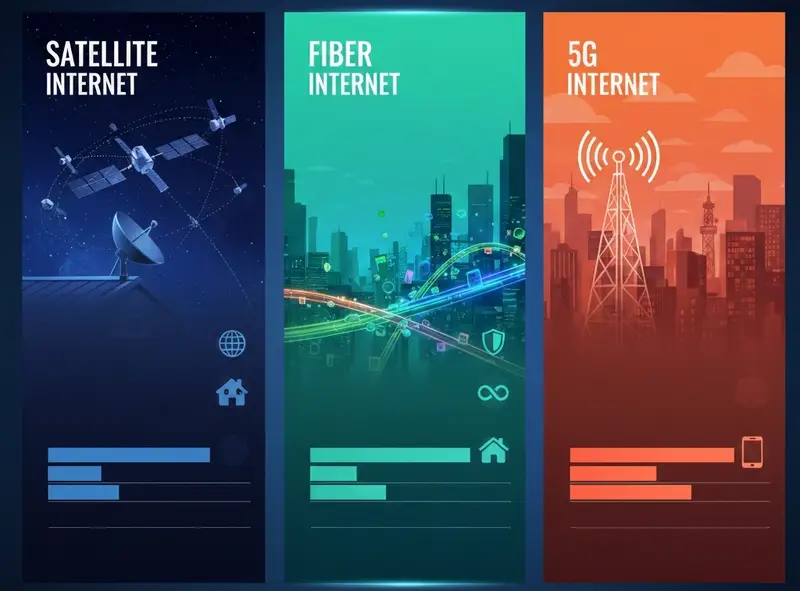
The internet is no longer a luxury or a background convenience humming quietly behind daily life. It is the nervous system of modern society, carrying conversations, livelihoods, education, entertainment, and even medical care across invisible pathways. Choosing how that connection reaches your home or device has become an unexpectedly personal decision, shaped by geography, expectations, and how deeply the digital world is woven into your life. Satellite internet, fiber-optic broadband, and 5G wireless all promise fast, reliable access, yet they deliver it in profoundly different ways. Understanding those differences is not just a technical exercise; it is about understanding how you want to live, work, and connect in a world that increasingly assumes you are always online.
Each of these technologies reflects a different philosophy of connectivity. Satellite internet looks outward to the sky, using orbiting machines to blanket the Earth. Fiber looks inward, relying on glass strands buried beneath streets and fields to carry pulses of light. 5G moves through the air around us, transforming radio waves into high-speed data highways. None of them is universally “best.” Each shines under certain conditions and struggles under others. To choose wisely, it helps to understand not just the speeds advertised, but the science, trade-offs, and lived experience behind each option.
How Internet Connections Actually Work
Before comparing satellite, fiber, and 5G, it helps to understand what an internet connection really is. At its core, the internet is a global network of networks, moving data in small packets from one device to another. Whether you are sending an email, streaming a movie, or joining a video call, your device breaks information into packets, sends them across a chain of connections, and reassembles them at the destination.
The key differences between internet technologies lie in how those packets travel the first and last mile between your device and the wider network. Fiber uses light traveling through glass. 5G uses radio waves traveling through the air. Satellite internet sends signals thousands of kilometers into space and back. These physical realities shape everything from speed and reliability to latency and cost.
Fiber-Optic Internet and the Power of Light
Fiber-optic internet is often described as the gold standard of connectivity, and there are solid scientific reasons for that reputation. Fiber cables are made of extremely thin strands of glass or plastic, designed to guide light along their length through a phenomenon known as total internal reflection. When data is sent over fiber, it is encoded into pulses of light that travel at a significant fraction of the speed of light itself.
This method offers extraordinary capacity. Light can carry enormous amounts of information, far more than electrical signals in copper wires. Fiber connections are capable of delivering symmetrical speeds, meaning downloads and uploads can be equally fast. This is not just a marketing advantage; it reflects the fundamental physics of light-based communication.
Because fiber signals are confined within the cable, they are largely immune to electromagnetic interference, weather conditions, and signal congestion from neighboring users. Once installed, fiber networks can be upgraded by changing equipment at either end, without replacing the cables themselves. This makes fiber remarkably future-proof.
The experience of using fiber internet often feels effortless. Video calls are crisp and stable. Large files upload and download quickly. Online games respond instantly. For households with multiple people working, studying, and streaming at the same time, fiber’s consistency can feel like a quiet luxury that fades into the background because it simply works.
The Limitations and Realities of Fiber Deployment
Despite its technical excellence, fiber internet has a major limitation that has nothing to do with physics and everything to do with infrastructure. Fiber must be physically installed, which means digging trenches, running cables along poles, and navigating rights-of-way. In dense urban areas, this investment often makes economic sense. In rural or remote regions, the cost can be prohibitive.
As a result, fiber availability is uneven. Many people live tantalizingly close to fiber lines but cannot access them because extending the network to their home is too expensive. Others enjoy fiber speeds that far exceed their needs, while neighboring communities rely on older, slower technologies.
This uneven distribution creates a digital divide that fiber alone cannot easily solve. While fiber is technologically superior, its reach is limited by geography, economics, and policy decisions. For those who have access, it can feel like the internet at its best. For those who do not, it can feel like an unattainable ideal.
5G and the Reinvention of Wireless Connectivity
5G represents the latest evolution in cellular wireless technology, building on decades of research into radio communication. Unlike fiber, which requires physical cables, 5G uses radio waves to transmit data between devices and nearby base stations. From there, data enters the wired internet backbone, often carried by fiber.
What sets 5G apart from previous generations is its use of a wider range of frequencies, advanced antenna technologies, and sophisticated signal processing. By using higher-frequency bands and techniques like beamforming, 5G can deliver much higher data rates and lower latency than earlier cellular networks.
The promise of 5G extends beyond smartphones. It aims to provide home internet, connect vehicles, support virtual reality, and enable massive networks of sensors and devices. In theory, 5G can offer fiber-like speeds without the need to run cables to every building.
For many users, 5G internet feels liberating. It can be installed quickly, sometimes with little more than a modem and a nearby cell tower. It can be portable, allowing connectivity in places where wired options are unavailable or inconvenient. This flexibility is a core part of 5G’s appeal.
The Physics Behind 5G Performance
The performance of 5G is deeply influenced by the physics of radio waves. Higher-frequency signals can carry more data but travel shorter distances and are more easily blocked by obstacles like walls, trees, and even rain. Lower-frequency signals travel farther and penetrate buildings more easily but offer lower data rates.
To balance these trade-offs, 5G networks use a mix of frequencies. In some areas, 5G relies on relatively low frequencies that offer modest speed improvements over previous generations but cover large areas. In others, especially dense urban environments, 5G uses very high frequencies that can deliver astonishing speeds but require many closely spaced antennas.
This means that the 5G experience can vary dramatically depending on location. One person may enjoy gigabit-class speeds, while another just a few kilometers away sees performance similar to older technologies. Unlike fiber, which tends to deliver consistent performance once installed, 5G is more sensitive to environmental factors and network congestion.
Satellite Internet and the View from Space
Satellite internet takes a fundamentally different approach, bypassing terrestrial infrastructure almost entirely. Instead of relying on local cables or cell towers, satellite internet sends data from a user’s dish to a satellite orbiting Earth, which then relays the data to a ground station connected to the internet backbone.
Historically, satellite internet suffered from high latency and limited speeds because satellites were placed in geostationary orbit, tens of thousands of kilometers above Earth. The long distance signals had to travel introduced noticeable delays, making real-time applications like video calls and online gaming frustrating.
In recent years, however, satellite internet has undergone a transformation with the deployment of low Earth orbit satellites. These satellites orbit much closer to Earth, reducing latency and increasing potential speeds. By using large constellations of satellites, providers can offer coverage to vast areas, including regions where fiber and 5G are impractical or unavailable.
For people in remote locations, satellite internet can feel like a lifeline. It offers a way to participate in the digital world without waiting for infrastructure that may never arrive. The sense of connection it provides can be emotionally powerful, shrinking distances and opening opportunities that were previously out of reach.
The Science of Satellite Latency and Bandwidth
Even with modern advancements, satellite internet faces unavoidable physical constraints. Signals must still travel from Earth to space and back, covering hundreds or thousands of kilometers. While low Earth orbit reduces this distance dramatically compared to older systems, latency remains higher than fiber or local wireless connections.
Bandwidth is another challenge. Satellites have limited capacity, and that capacity must be shared among many users. As more people connect, speeds can fluctuate, especially during peak usage times. Weather can also affect signal quality, particularly heavy rain or snow.
These factors do not make satellite internet unusable, but they shape the experience. Activities that require consistent, low-latency connections may feel less smooth. Large downloads may take longer during busy periods. Understanding these realities helps set realistic expectations.
Comparing Speed in Real Human Terms
Speed is often the first metric people consider, but raw numbers do not tell the whole story. Fiber can deliver extremely high speeds with remarkable consistency, making it ideal for households that rely heavily on cloud services, high-resolution streaming, and large file transfers. The experience is often described as instant, with little perceptible delay.
5G speeds can rival fiber under optimal conditions, especially in areas with strong signal coverage and modern infrastructure. However, performance can vary depending on distance from the tower, network load, and physical obstacles. For some users, 5G feels fast and responsive. For others, it can be inconsistent.
Satellite internet generally offers lower speeds than fiber and high-end 5G, though modern systems can still support everyday activities like browsing, streaming, and video calls. The key difference is variability. Speeds may fluctuate more, and latency can introduce a subtle but noticeable delay in interactive tasks.
In practical terms, the “right” speed depends on how you use the internet. A single user browsing and streaming occasionally has different needs than a household with multiple remote workers and gamers. Speed is not just about numbers; it is about whether the connection fades into the background or demands constant attention.
Latency and the Feeling of Responsiveness
Latency, the time it takes for data to travel from your device to a server and back, plays a crucial role in how the internet feels. Low latency makes interactions feel immediate. High latency introduces a sense of lag that can be frustrating, even if download speeds are high.
Fiber excels in this area, offering very low and stable latency. Actions like clicking a link or speaking during a video call feel natural and synchronous. 5G can also achieve low latency, especially in well-designed networks, making it suitable for real-time applications.
Satellite internet, even with low Earth orbit systems, has higher latency due to the longer signal path. While this latency is much improved compared to older satellite services, it can still affect activities that require rapid back-and-forth communication. The delay may be small, but humans are remarkably sensitive to timing, especially in conversation and interactive media.
Reliability, Weather, and the Environment
Reliability is about more than uptime percentages. It is about how often your connection works as expected, without surprises. Fiber is generally the most reliable, largely unaffected by weather and less prone to interference. Outages do occur, often due to physical damage to cables, but they are relatively rare.
5G reliability depends on network design and environmental conditions. Heavy rain, physical obstructions, and network congestion can affect performance. However, cellular networks are designed with redundancy, and outages are often localized and temporary.
Satellite internet is most vulnerable to weather-related issues. Heavy rain, snow, or storms can weaken signals. Modern systems use advanced error correction and adaptive techniques to mitigate these effects, but they cannot eliminate them entirely. For users in regions with frequent severe weather, this can be an important consideration.
Installation, Accessibility, and the Human Experience
The process of getting connected matters more than many people expect. Fiber installation can be disruptive, involving construction and coordination. Once installed, however, it often requires little attention. The connection feels permanent, like a utility.
5G installation is typically quick and minimally invasive. A modem or receiver connects wirelessly to the network, making it appealing for renters or people who move frequently. This ease of setup can be emotionally reassuring, offering flexibility and control.
Satellite internet installation requires a clear view of the sky and proper alignment of equipment. While modern systems are designed to be user-friendly, installation can still feel more involved. The presence of a dish can also be a visible reminder of reliance on space-based infrastructure, which some find fascinating and others find intrusive.
Cost, Value, and Long-Term Considerations
Cost is a complex factor, involving not just monthly fees but equipment costs, installation charges, and long-term value. Fiber often offers excellent value where available, with competitive pricing for high performance. However, access can be limited, and installation costs may be high in some areas.
5G pricing varies widely depending on provider and region. It can be cost-effective, especially when bundled with mobile services. Performance variability means that value depends heavily on local conditions.
Satellite internet often has higher upfront costs and monthly fees, reflecting the expense of building and maintaining space-based infrastructure. For users with no other options, the value lies not in raw performance but in access itself. The ability to connect can outweigh higher costs.
Choosing Based on Where You Live
Geography plays a decisive role in determining which technology makes sense. In dense urban areas, fiber and 5G are often both available, offering a choice between stability and flexibility. In suburban areas, fiber may be available in some neighborhoods but not others, making 5G an attractive alternative.
In rural and remote regions, satellite internet often stands alone. While performance may not match fiber, it provides connectivity where none would otherwise exist. The emotional impact of this cannot be overstated. Access to information, education, and communication can transform lives.
Matching Technology to Your Digital Life
The right internet connection aligns with how you live and work. If your days are filled with video meetings, large file transfers, and collaborative online work, fiber’s reliability and low latency can feel essential. If you value mobility, quick setup, and flexibility, 5G may fit your lifestyle better.
If you live far from urban centers and crave connection to the wider world, satellite internet can be a bridge across isolation. It may require patience and understanding of its limits, but it offers something profoundly human: the ability to reach beyond physical boundaries.
The Emotional Dimension of Connectivity
Internet access is not just technical; it is emotional. A reliable connection can reduce stress, support relationships, and open opportunities. An unreliable one can create frustration, anxiety, and a sense of being left behind.
Fiber often provides peace of mind through consistency. 5G offers a sense of freedom and adaptability. Satellite internet offers inclusion and possibility. Recognizing these emotional dimensions helps clarify why different people value different technologies, even when technical specifications suggest a clear winner.
The Future of Internet Technologies
The future is likely to be hybrid rather than exclusive. Fiber will continue to expand where feasible, forming the backbone of global connectivity. 5G and future wireless technologies will grow more capable, filling gaps and supporting mobility. Satellite constellations will evolve, improving performance and expanding coverage.
Rather than replacing one another, these technologies will coexist, each serving roles shaped by physics, economics, and human needs. The choice between them will remain context-dependent, influenced by where you live and how you connect to the world.
Finding the Right Connection for You
Choosing between satellite internet, fiber, and 5G is ultimately about alignment. It is about matching the physical realities of technology with the rhythms of your life. The best choice is not the one with the highest advertised speed, but the one that meets your needs reliably and comfortably.
Understanding the science behind these technologies empowers you to make that choice with confidence. It turns a confusing marketplace into a meaningful decision about how you want to experience the connected world.
A Final Reflection on Connection
At its deepest level, the question of which internet technology is right for you is a question about connection itself. Humans have always sought ways to bridge distance, to share stories, knowledge, and presence. Satellite internet reaches for the sky, fiber threads light through the Earth, and 5G fills the air with invisible signals. Each represents a different answer to the same ancient desire.
In choosing how you connect, you are choosing how the world reaches you and how you reach back. The right choice is the one that makes that exchange feel natural, reliable, and human.