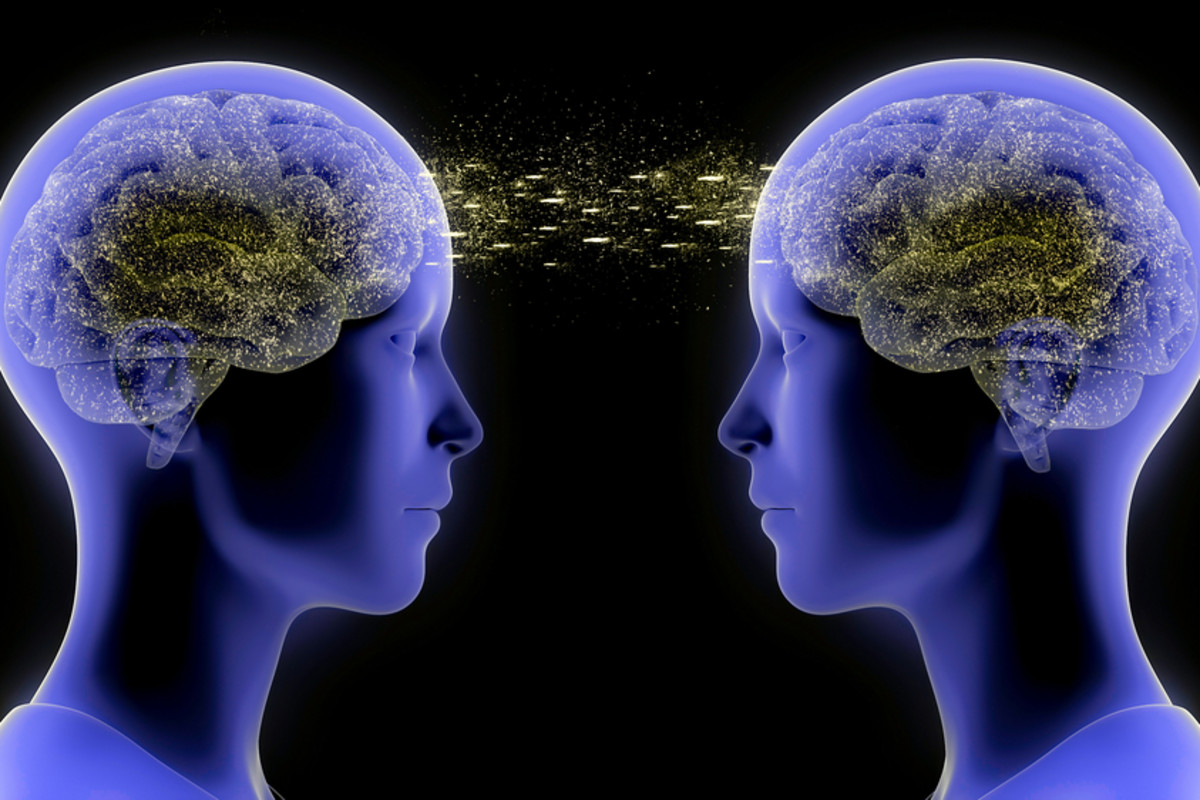
For most of human history, telepathy has lived in the realm of myth, magic, and science fiction. It has appeared in ancient legends, religious visions, and futuristic novels as a mysterious power that allows minds to speak directly to one another without words, gestures, or technology. Telepathy has long symbolized the ultimate intimacy of understanding: a connection so deep that thoughts themselves can travel freely between people. For centuries, science dismissed this idea as fantasy. And yet, in recent decades, something extraordinary has begun to happen. Carefully designed experiments, grounded in neuroscience and engineering, have demonstrated that limited forms of brain-to-brain communication are no longer purely imaginary. They are real, measurable, and scientifically verifiable.
This does not mean that humans can read each other’s thoughts in the way fictional characters do. The reality is far more subtle, fragile, and constrained. But it is also far more profound. For the first time in history, information has been transmitted directly from one human brain to another without passing through spoken language, typed text, or physical movement. These early steps toward brain-to-brain communication force us to reconsider what communication means, how minds relate to each other, and where the boundary between individual consciousness and shared understanding truly lies.
The Ancient Dream of Mind-to-Mind Connection
The idea of communicating directly through the mind is as old as humanity itself. Long before neuroscience existed, people sensed that thoughts and emotions could somehow leap from one person to another. A mother feels a sudden fear for her child far away. Twins report knowing when the other is in distress. Lovers speak of understanding each other without words. Whether these experiences are coincidence, intuition, or emotional attunement, they have fueled the belief that minds are not entirely isolated.
Philosophers and mystics throughout history imagined consciousness as something that could transcend the body. In many traditions, thought itself was treated as a kind of energy or substance capable of traveling beyond the skull. While modern science rejects supernatural explanations, it acknowledges that these intuitions reflect a deep human longing: the desire to overcome isolation and share inner experience directly.
This longing did not disappear with the rise of scientific rationality. Instead, it transformed. As knowledge of the brain grew, the question shifted from “Is telepathy mystical?” to “Could communication between brains be physically possible?”
Understanding the Brain as an Information System
To understand brain-to-brain communication, one must first understand the brain itself. The human brain is not a mystical black box but a biological organ that processes information. Neurons communicate through electrical impulses and chemical signals. When you think, feel, or decide, specific patterns of neural activity unfold across vast networks of cells.
Every thought corresponds to physical processes. This realization is crucial. If mental states have physical correlates, then in principle, they can be measured, recorded, and interpreted. Modern neuroscience has developed tools that can detect brain activity without opening the skull. Techniques such as electroencephalography measure electrical signals on the scalp, while other methods detect changes in blood flow associated with neural activity.
These tools do not read thoughts in a rich, subjective sense. They detect patterns that correlate with certain intentions or mental states. But correlation is enough to build a bridge. If a specific brain signal reliably corresponds to a specific intention, that signal can be translated into information. Once information exists, it can be transmitted.
From Brain Reading to Brain Writing
Early brain-computer interfaces focused on one direction of communication: from brain to machine. A person imagines moving their hand, and a computer detects the neural signal and moves a robotic arm. This technology has transformed lives, allowing paralyzed individuals to interact with the world in ways once thought impossible.
But brain-to-brain communication requires something more. It requires not only reading information from one brain but delivering information into another. This second step is often called brain stimulation. By applying carefully controlled signals to specific regions of the brain, it is possible to influence neural activity in predictable ways.
This influence does not insert complex thoughts. It produces simple sensations, flashes of light, or subtle motor impulses. Yet even this limited capability is enough to carry information. If one brain sends a signal that another brain receives and interprets, communication has occurred.
The First Demonstrations of Brain-to-Brain Communication
The earliest successful demonstrations of brain-to-brain communication were astonishing in their simplicity and significance. In controlled experiments, one participant generated a specific mental signal by focusing on a task. That signal was recorded by a brain-monitoring device, translated into digital data, and transmitted electronically to another location. There, the data triggered brain stimulation in a second participant, producing a conscious experience or action.
In these experiments, the receiving person did not hear a sound or see a message on a screen. The information arrived as a direct neural effect. For example, a brief visual sensation might appear, or a finger might move involuntarily. The receiver could then interpret that effect as meaningful information.
The amount of information transmitted was extremely limited. Often it was equivalent to a binary signal, such as yes or no. But the principle was revolutionary. Information had traveled from one brain to another without using the senses in the traditional way.
Why This Is Not Mind Reading
It is important to confront a common misunderstanding. Brain-to-brain communication is not mind reading. No experiment has ever extracted complex thoughts, memories, or emotions from one person and implanted them into another. The brain does not encode thoughts as neatly packaged messages waiting to be decoded.
Thoughts are distributed across neural networks and shaped by personal experience, context, and emotion. What scientists can detect are patterns associated with simple intentions or states. Even these detections require training, cooperation, and repeated calibration.
The sender must actively participate, intentionally generating the signal. The receiver must learn how to interpret the induced sensation or response. This is communication, not intrusion. It is closer to learning a new language than having one’s mind exposed.
The Emotional Impact of Direct Neural Connection
Despite its limitations, brain-to-brain communication carries immense emotional weight. The idea that one person’s intention can directly alter another person’s brain activity challenges deeply held intuitions about individuality and privacy. The brain has long been considered the final sanctuary of the self. The possibility of direct access, even limited access, feels both thrilling and unsettling.
For participants in these experiments, the experience can be strangely intimate. Knowing that a sensation in your mind originated in someone else’s thoughts creates a sense of connection unlike any other. It bypasses voice, gesture, and expression. It feels raw and immediate, even when the content is simple.
This emotional dimension is not incidental. Communication is not just about transmitting data; it is about sharing experience. Brain-to-brain communication hints at a future where understanding could become more direct, more embodied, and potentially more empathetic.
The Role of Technology as a Mediator
It is crucial to recognize that current brain-to-brain communication is not telepathy in the mystical sense. Technology is the mediator. Machines record, translate, transmit, and stimulate. Without these devices, no connection occurs.
In this sense, brain-to-brain communication is an extension of existing technologies rather than a radical departure. Writing externalized thought onto paper. Telephones externalized voice. The internet externalized presence. Brain-to-brain communication externalizes neural signals themselves.
What makes it different is not that technology is involved, but that the interface lies at the boundary between mind and machine. This boundary is where ethical, philosophical, and emotional questions become unavoidable.
Scientific Challenges and Limitations
The path toward more advanced brain-to-brain communication is filled with challenges. The brain is extraordinarily complex and variable. Signals differ from person to person and even from moment to moment. Noise, interference, and ambiguity are constant obstacles.
Brain stimulation is also limited in resolution. Current techniques cannot target individual neurons with precision in non-invasive ways. They influence broad regions, producing generalized effects rather than specific thoughts.
There is also the problem of interpretation. A sensation induced in the brain does not carry inherent meaning. Meaning arises from learning and context. Both sender and receiver must agree on a shared code, and building such codes is slow and fragile.
These limitations ensure that science fiction visions of effortless mind sharing remain far from reality. Yet limitations do not diminish significance. They define the contours of what is possible and guide future research.
Ethical Questions at the Edge of the Mind
As soon as the brain becomes a communication channel, ethical concerns arise. Who controls access to neural data? How is consent ensured? What happens if brain signals are recorded, stored, or transmitted without full understanding?
Even simple experiments require careful ethical oversight. Participants must know exactly what is being transmitted and how it will affect them. The potential for misuse, though currently remote, cannot be ignored.
There is also the question of identity. If information enters your brain directly, does it become part of you? How does this affect responsibility, agency, and autonomy? These questions may seem abstract now, but they will grow more urgent as technology advances.
Brain-to-Brain Communication and Disability
One of the most promising applications of brain-to-brain communication lies in assisting people with disabilities. For individuals who cannot speak or move, direct neural communication could offer new pathways to connection. Instead of relying on muscle control or sensory output, communication could occur at the level of intention.
This possibility carries profound emotional significance. Communication is a fundamental human need. The ability to share thoughts, even in limited form, can restore dignity and agency. Brain-to-brain interfaces could complement existing assistive technologies, creating richer and more flexible forms of interaction.
Importantly, these applications emphasize collaboration rather than replacement. The goal is not to bypass humanity but to extend it.
Redefining Communication Itself
Brain-to-brain communication forces a reconsideration of what communication is. Traditionally, communication involves encoding thoughts into symbols, transmitting those symbols, and decoding them. Language, writing, and images all follow this pattern.
Direct neural communication blurs these boundaries. The encoding and decoding occur within biological systems, mediated by technology but grounded in neural activity. This challenges the assumption that communication must pass through shared sensory channels.
It also raises the possibility that future communication could be more embodied, relying less on abstract symbols and more on shared neural experiences. While this remains speculative, the mere possibility expands the imagination.
The Difference Between Sharing Information and Sharing Experience
A critical distinction in understanding brain-to-brain communication is the difference between information and experience. Information can be transmitted digitally with perfect fidelity. Experience cannot. Experience is subjective, shaped by memory, emotion, and context.
Current brain-to-brain experiments transmit information, not experience. A signal corresponds to a decision or command, not to the feeling associated with it. Sharing experience would require recreating complex neural patterns across multiple brain regions, a task far beyond current capabilities.
This limitation underscores the uniqueness of individual consciousness. Even with direct neural links, minds remain distinct. Communication can bridge gaps, but it cannot erase individuality.
The Role of Learning and Adaptation
One fascinating aspect of brain-to-brain communication is how much it relies on learning. Participants often improve their performance over time, learning how to generate clearer signals or interpret induced sensations more accurately.
This adaptability reflects the brain’s remarkable plasticity. The brain is not a fixed machine but a dynamic system that reorganizes itself in response to new demands. Brain-to-brain communication becomes a collaborative dance between biology and technology, shaped by practice and feedback.
This learning process also highlights the active role of participants. Communication is not something done to them; it is something they do together.
Cultural and Philosophical Implications
The idea of connecting minds directly touches deep cultural themes. It resonates with ancient dreams of collective consciousness and shared understanding. At the same time, it challenges modern values of individuality and mental privacy.
Philosophically, brain-to-brain communication invites reflection on what separates one mind from another. Is the boundary purely biological, or is it defined by communication barriers? If those barriers shift, does the nature of selfhood shift as well?
These questions do not have simple answers. But they illustrate how scientific developments can reshape philosophical inquiry, not by providing answers but by changing the questions we ask.
Why Telepathy Remains a Misleading Word
The word telepathy carries heavy baggage. It suggests effortless, spontaneous mind reading without technology or consent. This image does not match scientific reality and can create unrealistic fears and expectations.
Brain-to-brain communication is better understood as a technological extension of communication, not a paranormal ability. It requires cooperation, equipment, and interpretation. It is limited, fragile, and carefully controlled.
Yet the emotional power of the word telepathy reveals something important. It captures the human yearning for deeper connection. Science does not fulfill that yearning in magical ways, but it approaches it through careful, incremental progress.
The Future Horizons of Brain-to-Brain Research
Looking ahead, research will likely focus on improving signal clarity, stimulation precision, and usability. Advances in neuroscience, engineering, and computation may allow more nuanced information to be exchanged.
Future systems may enable groups of people to collaborate in new ways, sharing intentions or decisions more efficiently. They may deepen our understanding of how brains encode meaning and how communication shapes cognition.
At the same time, progress will remain cautious. The brain is not just another organ. It is the seat of personhood. Any technology that touches it must respect that profound reality.
A Mirror Held Up to Humanity
Brain-to-brain communication is as much a mirror as it is a tool. It reflects humanity’s deepest hopes and fears. The hope of being understood without distortion. The fear of losing mental autonomy. The desire to connect and the need to remain oneself.
Science does not promise utopia or dystopia. It offers possibilities shaped by human choices. Brain-to-brain communication will not define the future on its own. How we use it, regulate it, and interpret it will matter far more than what it can technically achieve.
The First Steps, Not the Destination
It is tempting to see early brain-to-brain experiments as the dawn of a new era of telepathy. In truth, they are first steps on a long and uncertain path. Their significance lies not in what they already do, but in what they reveal: that the brain can be both a source and a destination of communication.
This realization expands the horizon of what it means to connect. It shows that communication is not limited to voices and screens. It is rooted in the physical processes of the mind itself.
Conclusion: A Quiet Revolution at the Edge of Thought
Brain-to-brain communication does not announce itself with spectacle. It advances quietly, through careful experiments and modest results. Yet its implications are profound. It challenges assumptions about communication, individuality, and the boundaries of the self.
These first steps toward telepathy are not about reading minds or dissolving privacy. They are about understanding the brain as a communicative organ and exploring new ways to share intention and meaning.
In doing so, science touches something deeply human. The longing to be understood. The hope that connection can be made deeper, clearer, and more direct. Brain-to-brain communication does not fulfill that hope completely, but it brings it into the realm of possibility. And in that possibility lies both wonder and responsibility, guiding humanity as it listens ever more closely to the quiet language of the mind.