The simple act of doing a load of laundry feels like a closed loop—water goes in, clothes get clean, and the waste vanishes down a dark pipe. Yet, for years, oceanographers have been haunted by a missing piece of a global puzzle. We know that every time a synthetic shirt or a pair of yoga pants tumbles in the wash, thousands of tiny polyester microfibers break loose. These invisible threads are among the most prolific forms of microplastic pollution on Earth. Conventional wisdom suggested these fibers were sweeping out into the blue expanse of the open ocean, but new evidence suggests they are actually staging a quiet occupation much closer to home.
In a recent study published in the Journal of Geophysical Research: Oceans, a team of researchers led by Ph.D. scientist Jose Valentí-Muelas set out to track the odyssey of these fibers. What they discovered challenges our understanding of how plastic moves through the world. Instead of a one-way highway to the deep sea, the journey of a microfiber is a frantic, stuttering crawl through the Salish Sea—a complex network of coastal waters stretching between British Columbia and Washington state. It turns out that the vast majority of our laundry waste never makes it to the Pacific; instead, it is being caught in a coastal trap.
The Invisible Drifters of the Kitchen Sink
To understand where the plastic goes, we first have to understand how it behaves in the water. Tracking a polyester fiber isn’t as simple as tracking a floating bottle. While polyester is technically denser than seawater—meaning it should sink—its physical shape changes the rules of physics. Because these fibers are incredibly long and thin, they possess a high surface-area-to-weight ratio. This allows them to remain suspended near the surface for days, fluttering in the currents like underwater dust motes.
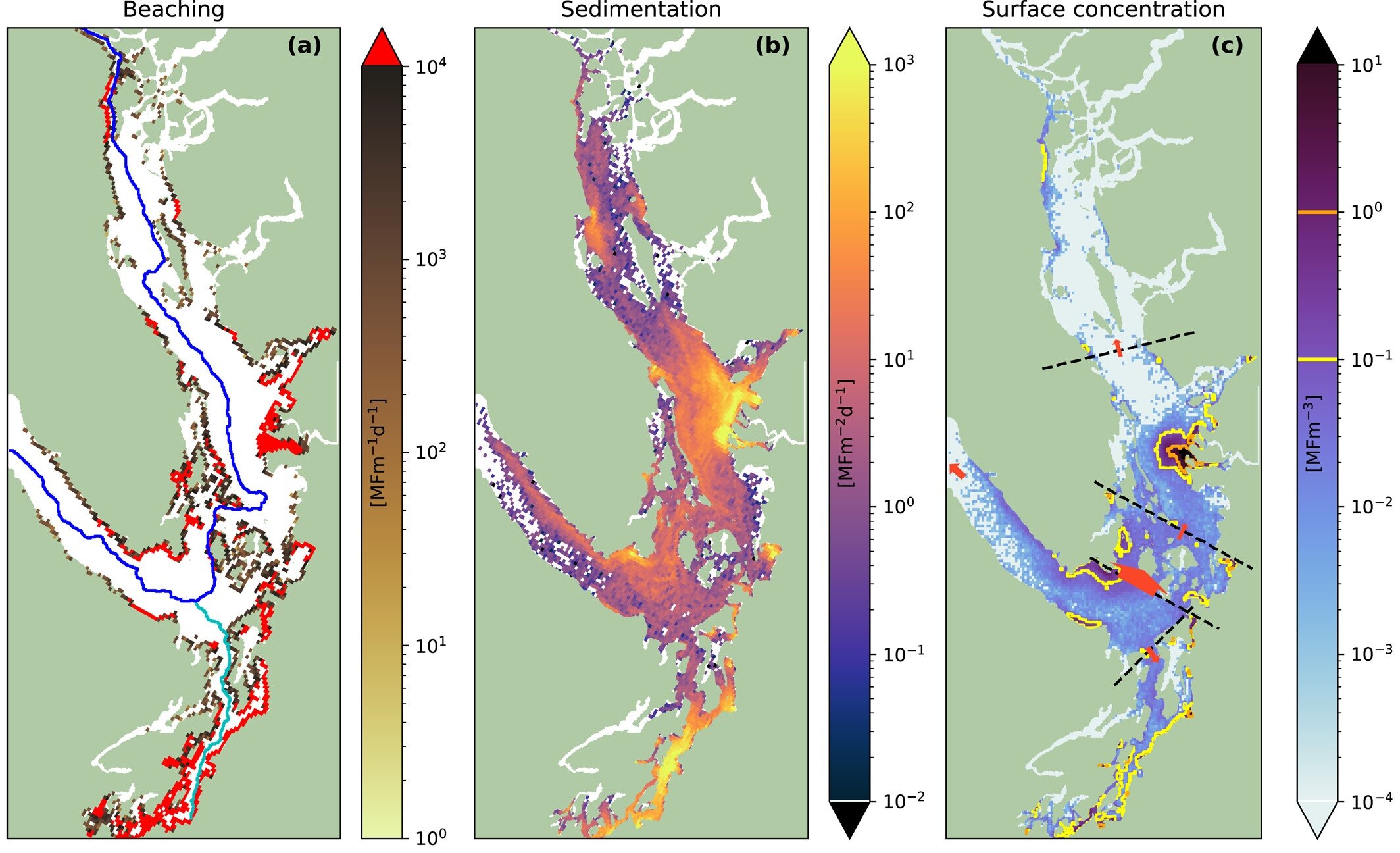
To map this ghostly migration, the research team employed a sophisticated computer model known as SalishSeaCast. This digital twin of the ocean simulates tides, river flows, and currents in three dimensions. The scientists released millions of virtual particles from wastewater treatment plant outlets—the primary exit points for laundry water—and watched them move hour by hour. They didn’t just rely on the digital world, either; they took to the cold waters near the Fraser River in Canada, pulling water samples from ten different locations to see if the real-world fiber counts matched their simulations. The results were striking: the model and the reality were in lockstep, revealing that the “great escape” to the ocean is actually a rare event.
Caught in the Grasp of the Tide
The secret to why these fibers stay put lies in the architecture of the coast itself. The study revealed that estuarine circulation—the chaotic dance where fresh river water meets salty ocean inflows—creates what the scientists call retention zones. These are natural traps where the water slows down or circles back on itself. In these areas, fibers accumulate behind natural barriers like sills and within narrow channels and basins.
In places where the currents are sluggish, the fibers have the luxury of time. They linger for days or even weeks, slowly losing their battle with gravity until they settle onto the seabed. The researchers found that roughly 31% of the microfibers underwent sedimentation, sinking into the mud and silt of the seafloor near their original source. Rather than being diluted by the vastness of the Pacific, the pollution is being concentrated in the very places where marine life is often most abundant: our shallow bays and estuaries.
When the Shoreline Becomes a Filter
It isn’t just the deep mud that claims these fibers; the land itself reaches out to grab them. The study found that beaching plays a surprisingly dominant role in the life cycle of a microplastic. About 14% of the simulated fibers ended up washed up along the coastlines. They are pushed onto the sand and pebbles by horizontal mixing and tidal shifts. Once they hit the shore, they stay there—buried in the beach or tangled in coastal debris—until a major event move them again.
The weather and the seasons also dictate the speed of this journey. During periods of high freshwater flow from rivers, the surface water moves faster, acting like a conveyor belt that shoves fibers toward the beaches more efficiently. In calmer seasons, the fibers are more likely to dally in the water column, traveling only short distances from the treatment plants before they find a permanent home in the local environment. The geography of the exit point matters, too; fibers released near the fast-moving mouth of the Juan de Fuca Strait traveled much further than those released in the sheltered, slow-moving waters of Puget Sound.
The Ghostly Reservoirs of the Deep
Perhaps the most startling revelation of the research is just how little of our laundry waste actually escapes. The study estimated that a mere 0.13% of the polyester microfibers released from treatment plants actually make it out into the open Pacific Ocean. The rest—roughly 80% of the total—are trapped in the rivers, estuaries, and coastal sediments of the Salish Sea.
This creates a hidden environmental legacy. While the fibers are “captured,” they do not disappear. Instead, the coastal sediments act as long-term reservoirs. These areas become hotspots of pollution that can haunt the ecosystem for decades. During intense storms or powerful tidal events, these buried fibers can be “resuspended,” kicked back up into the water column to be swallowed by fish or moved to a new stretch of beach. This cycle makes the sea floor a persistent source of pollution that continues to leak plastic long after the original laundry load has been forgotten.
Why the Coastal Trap Matters for the Future
This research is a vital turning point because it shifts our gaze from the distant “Great Pacific Garbage Patch” back to our own backyards. Understanding that microplastics are a local problem with local sinks allows policymakers and scientists to be more surgical in their response. We now know that estuaries and shallow bays are acting as natural filters, protecting the open ocean but at a high cost to local wildlife and sediment health.
The discovery emphasizes that the most effective way to protect the ocean is to stop the flow at the beginning of the pipe. Whether through improved laundry filtration systems in our homes, more advanced wastewater treatment technologies, or a fundamental shift in how the textile industry produces synthetic fabrics, the goal is clear: prevent the fibers from ever entering the water.
Ultimately, this study proves that our local actions have immediate, local consequences. The journey of a single polyester fiber may be short, but its impact on the coast is enduring. By mapping these “invisible” pathways, we gain the knowledge needed to clean up our shores and ensure that the legacy of our modern convenience doesn’t remain buried in the sand forever.
Study Details
J. Valentí‐Muelas et al, Polyester Microfiber Dynamics in an Estuarine Semi‐Enclosed Basin, Journal of Geophysical Research: Oceans (2026). DOI: 10.1029/2025jc023366