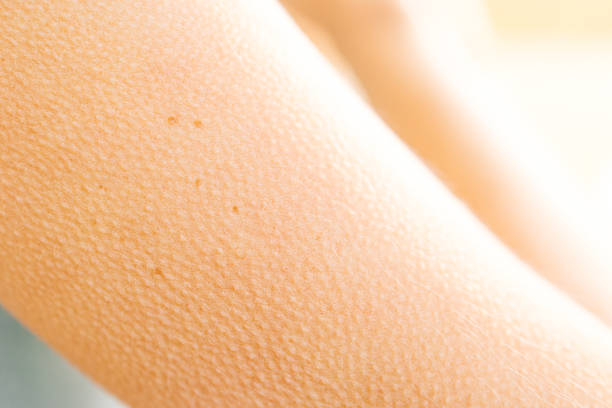
Goosebumps are one of the strangest little surprises the human body can produce. One moment your skin is smooth and ordinary, and the next it looks like a plucked chicken—tiny bumps rising across your arms, your neck, or your legs as if your body has suddenly decided to transform itself.
They appear when you step into cold air, when you hear a haunting piece of music, when fear creeps up your spine, or when someone whispers something emotionally powerful. Sometimes they come with a chill. Sometimes they come with a rush of excitement. And sometimes they arrive for no clear reason at all, like an ancient reflex waking up inside you.
But goosebumps are not random. They are not meaningless. They are a biological echo from deep evolutionary history—a physical reaction that once served a clear purpose, even if it seems almost useless in modern human life.
To understand why humans get goosebumps, you have to look beneath the skin—into the nervous system, the muscles attached to hair follicles, and the ancient survival strategies inherited from our animal ancestors.
What Goosebumps Actually Are
Goosebumps are medically known as piloerection. The term comes from Latin roots meaning “hair standing up.” It describes the exact physical process happening when your skin suddenly becomes bumpy.
Your body is covered with tiny hair follicles. Even if the hairs are so fine that you barely notice them, each follicle is still connected to a microscopic muscle called the arrector pili muscle. These muscles are smooth muscles, meaning they work automatically without conscious control, similar to the muscles that regulate digestion or blood vessel diameter.
When these tiny muscles contract, they pull on the base of the hair follicle. That pulling action causes two things to happen at once: the hair stands more upright, and the surrounding skin puckers upward, creating a small bump.
That bump is the goosebump.
So goosebumps are not the hair itself rising. They are the skin being tugged upward by muscles that evolved to manipulate hair.
Even though it looks like a minor skin reaction, it is actually a coordinated physiological response triggered by the nervous system.
The Nervous System Behind Goosebumps
Goosebumps are controlled by the autonomic nervous system, the part of your nervous system that runs in the background, regulating involuntary functions like breathing rate, heart rate, sweating, digestion, and pupil dilation.
More specifically, goosebumps are driven by the sympathetic nervous system, the branch responsible for the famous “fight-or-flight” response. When your brain senses danger, cold, or intense emotion, it activates sympathetic pathways to prepare the body for survival.
That activation triggers the release of neurotransmitters, including norepinephrine, which signals the arrector pili muscles to contract. Within seconds, the skin tightens and the hair follicles rise.
This happens without any deliberate decision. You cannot command your body to produce goosebumps at will in the same way you can move your fingers. It is a reflex—a biological program running automatically.
The fact that goosebumps are tied to the sympathetic nervous system is a major clue to their real purpose. They are not merely a response to cold. They are part of a larger survival mechanism.
Goosebumps and Cold: The Insulation Theory
The most widely understood reason for goosebumps is temperature regulation. When you feel cold, your body is trying to conserve heat and prevent your internal temperature from dropping.
In animals with thick fur, piloerection makes the hair stand up, trapping a thicker layer of air close to the skin. That trapped air acts as insulation, reducing heat loss. It is similar to how a winter jacket works. The jacket itself is not always warm, but the air it traps becomes a protective thermal barrier.
This mechanism is still highly effective in many mammals today. A cat fluffs up its fur in the cold. A wolf’s coat thickens. A monkey’s hair can rise to trap warmth.
In humans, however, this effect is almost useless. We have far less body hair than our ancestors and far less than most mammals. When our fine hairs stand up, they do not create a meaningful insulating layer. The bumps appear, but the warmth benefit is minimal.
Still, the reflex remains because evolution does not erase traits instantly. If a biological mechanism does not harm survival, it can persist for millions of years even if it becomes less useful.
Goosebumps in response to cold are therefore a leftover adaptation—an old strategy from a time when humans had more body hair and relied on it for warmth.
Goosebumps and Fear: The Intimidation Theory
Cold is not the only trigger for goosebumps. Fear is another powerful cause. If you have ever felt goosebumps during a terrifying moment, you have experienced a deeper evolutionary function.
In many mammals, piloerection is a defensive display. When an animal is threatened, raising its fur makes it appear larger and more intimidating. A frightened cat’s fur rises. A porcupine’s quills lift. A bear’s coat can puff up.
This makes predators hesitate. It signals strength. It communicates readiness to fight.
The same reflex exists in humans, even though it does not make us look significantly bigger. Our bodies still respond as if hair-raising could provide an advantage.
This reveals something fascinating: goosebumps are not just about temperature. They are about survival readiness. They are part of the body’s instinctive preparation for confrontation.
When fear triggers goosebumps, your body is acting like an ancient mammal preparing to either defend itself or flee. Your nervous system is switching into high alert mode, even if the threat is psychological rather than physical.
That is why goosebumps often appear alongside other fight-or-flight symptoms like a racing heart, tightened muscles, widened eyes, and shallow breathing.
They are a small visible sign of a much larger internal alarm system.
Goosebumps and Emotion: Why Music Can Raise Your Skin
One of the most mysterious things about goosebumps is that they can appear during moments of deep emotion—especially when listening to music, watching a powerful scene in a film, hearing a moving speech, or experiencing awe.
This seems strange because emotional goosebumps do not clearly relate to warmth or intimidation. Yet they are extremely common, and they feel intensely meaningful. People often describe them as “chills,” even when they are not cold.
This phenomenon is sometimes called frisson, a French word meaning “shiver.” It refers to a sudden wave of sensation that can include goosebumps, a shiver down the spine, and a feeling of emotional intensity.
Biologically, emotional goosebumps occur because the brain processes strong emotional stimuli using pathways that overlap with survival circuits. Deep emotion is not treated as trivial by the nervous system. Certain emotional experiences can activate the sympathetic nervous system in a way similar to fear or surprise.
Music, for example, can build tension and then release it. That tension-release pattern resembles anticipation and resolution, which the brain is highly sensitive to. Sudden changes in volume, harmony, rhythm, or melody can trigger the brain’s prediction systems, creating a powerful burst of neural activity.
That burst can stimulate the release of dopamine, a neurotransmitter strongly associated with reward, motivation, and pleasure. Research suggests that dopamine plays a major role in the pleasurable chills people experience during music.
But dopamine is not acting alone. The sympathetic nervous system becomes activated as well, leading to physiological effects such as goosebumps and slight shivering.
In other words, emotional goosebumps may occur because your brain is interpreting the moment as significant, powerful, and worth reacting to. The body responds physically to match the psychological intensity.
Your skin becomes a canvas for your nervous system’s excitement.
The Role of the Brain: The Amygdala and Hypothalamus
To fully understand goosebumps, you have to understand the brain structures that help trigger them.
The amygdala is a region involved in processing fear, threat detection, and emotional memory. When the amygdala senses danger or intense emotional meaning, it signals other brain areas to prepare the body.
The hypothalamus is another critical region. It acts like a command center for homeostasis—the process of maintaining stable internal conditions. It regulates body temperature, hunger, thirst, and many autonomic responses.
When the hypothalamus detects cold, it initiates responses such as shivering, constriction of blood vessels near the skin, and piloerection. When emotional signals from the amygdala or other brain regions indicate strong arousal, the hypothalamus can also activate sympathetic pathways.
This means goosebumps can be triggered by two major categories of signals: physical signals like cold, and emotional signals like fear or awe. Both pathways converge through the autonomic nervous system.
The result is the same physical reaction, even though the cause is completely different.
This is why goosebumps are such a powerful symbol of the connection between body and mind. Your skin is literally responding to what your brain believes matters.
Goosebumps and Evolution: A Fossil Reflex in the Skin
Human goosebumps are best understood as an evolutionary remnant, a trait that once had a strong advantage but has become less useful as our species changed.
Early human ancestors were much hairier than modern humans. Hair coverage helped regulate temperature, especially before clothing existed. It also served as a visual display in social or defensive situations, much like it does in other primates.
As humans evolved, body hair became less dense, likely due to a combination of environmental adaptation, sweating efficiency, parasite reduction, and sexual selection. Clothing and shelter also reduced the need for heavy insulation.
But the neural circuitry controlling hair-raising remained. The arrector pili muscles remained. The reflex remained.
Evolution does not redesign organisms from scratch. It modifies what already exists. Traits can persist even when their original function fades, especially if they do not create serious disadvantages.
Goosebumps are a perfect example of this. They are a biological relic—like an old tool still hanging in the workshop, no longer essential, but still functional enough to activate.
The bumps on your skin are like a whisper from prehistory, a reminder that your body is not only a modern human body. It is also an ancient mammal body, still carrying millions of years of inherited survival programming.
Why Goosebumps Often Come With Shivering
Goosebumps frequently appear alongside shivering, especially in cold conditions. This is not coincidence. Both are controlled by thermoregulation systems.
Shivering is a method of heat production. It involves rapid involuntary muscle contractions that generate warmth through metabolic activity. When your muscles move repeatedly, they burn energy and release heat.
Goosebumps, as described earlier, are meant to increase insulation by raising body hair. In fur-covered mammals, this can significantly reduce heat loss.
In humans, shivering is far more effective than goosebumps for warming the body, but both responses are still triggered together because they are part of the same cold-defense program.
Your brain does not evaluate whether goosebumps will actually help you. It simply activates the full set of reflexes that evolved to handle cold. It is a built-in routine, and goosebumps are one of its visible components.
Why Goosebumps Can Happen in Warm Weather
Many people assume goosebumps are strictly a cold response, but they can occur even in warm environments. This is common when someone feels sudden fear, hears an unexpected sound, experiences emotional intensity, or even feels disgust.
This happens because goosebumps are not directly caused by temperature. They are caused by sympathetic nervous system activation. Cold is only one trigger that activates that system.
Fear can activate it. Excitement can activate it. A sudden memory can activate it. Even a surprising smell or sound can cause a quick sympathetic spike.
In that sense, goosebumps are like a physical signature of nervous system arousal. They show that your body has shifted from a calm state into a heightened alert state, even if only briefly.
That is why goosebumps are sometimes described as the body’s “alarm bell” reaction. The body is preparing for something important.
Goosebumps and Social Meaning: A Hidden Communication Signal
Goosebumps may also have had a social role in human evolution. In primates and other mammals, raised fur is often linked to emotional display. It can signal fear, aggression, or excitement to others.
In early humans with thicker body hair, goosebumps might have been more visible and may have communicated internal emotional states to a group. This could have been valuable for survival, allowing group members to sense danger or tension without words.
Even today, while goosebumps are not a major communication signal, they still carry social meaning. When someone says, “That gave me goosebumps,” it is universally understood as a statement of emotional impact. It means the experience was powerful enough to reach the body, not just the mind.
That shared understanding hints at something deeply human: we recognize goosebumps as evidence of authenticity. They are involuntary. They cannot be easily faked. They reveal a genuine emotional reaction.
In a way, goosebumps have become a kind of truth-teller, an honest reaction from the nervous system that bypasses social performance.
The Biology of Skin: How Goosebumps Form So Fast
The speed of goosebumps is one of their most remarkable features. They can appear within seconds of a trigger.
This is because the sympathetic nervous system is designed for rapid response. Its job is to prepare the body for urgent action. It does not waste time with slow, gradual changes.
When sympathetic neurons are activated, they send signals through nerve fibers that reach the skin and stimulate the arrector pili muscles. These muscles contract almost instantly.
At the same time, other sympathetic effects may occur: sweat glands may activate, blood vessels in the skin may constrict, and heart rate may increase.
The skin is therefore not just a protective covering. It is an active organ tightly connected to the nervous system, constantly responding to internal and external conditions.
Goosebumps demonstrate that your skin is alive with neural communication. It is constantly listening.
Goosebumps and Adrenaline: The Hormonal Connection
When you experience fear, surprise, or intense excitement, the adrenal glands release hormones such as adrenaline (epinephrine) and norepinephrine. These hormones circulate through the bloodstream and amplify the fight-or-flight response.
Adrenaline increases heart rate, boosts blood flow to muscles, expands airways, and heightens alertness. Norepinephrine plays a major role in raising blood pressure and sharpening focus.
These hormones also contribute to the physiological conditions that can produce goosebumps. Even though goosebumps are triggered mainly through direct nerve signaling, hormonal surges intensify the overall sympathetic state.
That is why goosebumps often come with a feeling of electricity in the body. It is not just your skin reacting—it is your entire system being chemically and neurologically tuned for heightened awareness.
Your body is not merely responding to what is happening. It is preparing for what might happen next.
Why Goosebumps Feel So Intense
Goosebumps are not painful, yet they can feel deeply intense. Sometimes they are accompanied by a tingling sensation. Sometimes they feel like waves across the skin. Sometimes they feel like a chill running through the spine.
Part of this intensity comes from the fact that goosebumps often happen during moments of heightened emotion or surprise. The brain is already paying attention, already alert, already in an amplified sensory state.
Another reason is that goosebumps involve changes in the skin, which is filled with sensory receptors. Even small muscle contractions and hair follicle movements can create noticeable sensations, especially in sensitive areas like the neck or arms.
Goosebumps can also trigger a psychological feedback loop. When you notice them, you become more aware of the emotion or the stimulus that caused them. That awareness increases the emotional impact, which can deepen the physical reaction.
This is why goosebumps can feel almost spiritual during moments of awe. The body and mind are reinforcing each other, producing a sensation that feels larger than the sum of its parts.
It is a reminder that humans are not purely rational creatures. We are creatures of biology, wired for meaning.
Goosebumps and Memory: The Body’s Emotional Archive
Goosebumps are strongly tied to memory because the brain stores emotional experiences differently from ordinary information.
The amygdala plays a key role in encoding emotional memories. When something feels significant—beautiful, terrifying, heartbreaking, inspiring—the brain tags it as important. That tag strengthens memory formation.
When you later encounter something similar, the brain may re-activate that emotional network. Sometimes the response is so strong that the body reacts physically, producing goosebumps.
This is why a familiar song can cause chills decades later. It is not just sound. It is a key that unlocks an emotional archive inside your nervous system.
Goosebumps, in this sense, are a physical footprint of memory. They are your body remembering what your mind might not fully explain.
Are Goosebumps Unique to Humans?
Humans are not unique in getting goosebumps. Most mammals experience piloerection, and in many species it is far more dramatic than in humans.
Cats, dogs, rodents, primates, and many other mammals raise their fur in cold conditions or when threatened. In animals with thick coats, the response is visible and functional.
Humans are unique mainly in how symbolic goosebumps have become. Because the physical function is reduced, goosebumps in humans are more often associated with emotion and meaning. They have become tied to music, storytelling, art, and social experience.
In many ways, goosebumps are an animal reflex that has been repurposed by the human mind. The same mechanism that once served warmth and intimidation now becomes a signal of beauty, awe, and deep feeling.
It is evolution meeting culture.
When Goosebumps Become a Medical Symptom
Most goosebumps are completely normal. They are part of healthy nervous system function. However, in rare cases, unusual goosebump patterns can be associated with medical issues.
Some neurological conditions can cause abnormal piloerection. Certain seizures, particularly those involving the temporal lobe, can sometimes trigger sudden goosebumps. In these cases, the goosebumps are caused by abnormal electrical activity in the brain rather than normal emotional or temperature triggers.
Goosebumps can also occur during withdrawal from certain drugs, as the autonomic nervous system becomes dysregulated. This is one reason the phrase “cold turkey” exists, describing the goosebump-like skin appearance seen in withdrawal.
Fever and chills can also cause goosebumps because the body is attempting to regulate temperature, often shivering to raise internal heat.
In ordinary life, though, goosebumps are not a sign of illness. They are simply proof that your nervous system is responsive and alive.
Goosebumps as a Window Into Human Nature
Goosebumps may look like a small, silly reaction. But they are actually a remarkable biological story compressed into the surface of your skin.
They reveal that humans are still mammals, still governed by ancient survival systems. They reveal that the body does not separate emotion from physical reality. Fear is not just a thought. Awe is not just an idea. Beauty is not just a concept.
These experiences have weight in the nervous system. They create measurable responses. They leave fingerprints on the skin.
Goosebumps remind us that we are built from evolution, shaped by ancestors who needed every advantage they could get. And they remind us that even when a trait becomes less useful, it can remain as a trace of history—an old mechanism still firing, still doing its job, even if the world has changed.
They also remind us of something else: humans are creatures who feel deeply. Our bodies respond not only to cold air and danger, but to meaning. A melody can reach into the nervous system. A powerful moment can cause the skin to rise as if the body itself is saying, “Pay attention. This matters.”
The Real Biological Reason Humans Get Goosebumps
The real biological reason humans get goosebumps is that they are an inherited survival reflex controlled by the sympathetic nervous system. This reflex originally evolved to raise body hair for two main purposes: to trap warmth in cold environments and to make an animal appear larger and more threatening during danger.
Even though modern humans have relatively little body hair and gain little practical benefit from this response, the underlying mechanism remains. The arrector pili muscles still contract, the skin still puckers, and the body still performs its ancient routine.
Over time, this reflex also became tied to emotional experiences, because the same nervous system circuits that respond to fear and survival also respond to intense feelings like awe, excitement, and deep connection. Music, art, and powerful social moments can trigger the same biological machinery that once helped mammals survive predators and harsh climates.
Goosebumps are therefore not useless. They are not random.
They are a living fossil of evolution, a reflex written into your skin, a reminder that your body is older than your civilization. And when they rise during a beautiful song or a powerful moment, they prove something extraordinary: the human nervous system treats meaning as something real enough to touch the body.
Goosebumps are biology’s way of saying the world is not only cold or dangerous.
Sometimes, it is overwhelming. Sometimes, it is unforgettable.
And sometimes, it is so powerful that your skin remembers it before your mind can explain why.