There are abysses in the universe so profound that even light cannot climb out of them.
Black holes are not merely cosmic curiosities. They are engines of galaxy formation, sculptors of stellar orbits, and perhaps the most extreme laboratories of physics known to existence. Born from collapse or assembled through cosmic mergers, they represent gravity at its most merciless. Space and time bend toward them. Matter spirals inward. Radiation screams outward. And at their heart lies a mystery—an edge where Einstein’s equations strain and quantum reality begins to whisper.
Most galaxies harbor black holes at their centers. The Milky Way’s own central black hole, Sagittarius A*, weighs about four million times the mass of the Sun. That sounds immense—until you realize it is modest by cosmic standards.
Some black holes grow to billions or even tens of billions of solar masses. These are the titans. The monsters of the deep. The gravitational sovereigns that dominate galaxy clusters and shape the architecture of the cosmos itself.
Here are ten of the largest black holes ever discovered—colossal beings that redefine our sense of scale.
1. TON 618 – The Colossal Titan
At the heart of a distant quasar known as TON 618 lies one of the most massive black holes ever measured.
Estimated mass: roughly 66 billion times the mass of the Sun.
To grasp this number, imagine compressing sixty-six billion suns into a region smaller than our solar system. The event horizon of this black hole would stretch over 1,300 astronomical units—larger than the orbit of Pluto many times over.
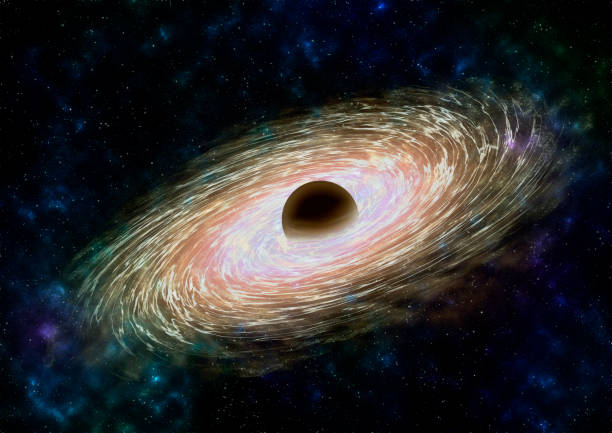
TON 618 is a quasar, meaning it shines brilliantly due to material accreting into its central black hole. As gas spirals inward, it forms an accretion disk heated to extraordinary temperatures. Friction and magnetic forces convert gravitational energy into radiation. The result is a beacon visible across billions of light-years.
The luminosity of TON 618 rivals that of trillions of stars combined.
Black holes themselves do not emit light. It is the infalling matter—compressed, accelerated, and heated—that produces such radiance. In quasars like TON 618, the black hole is not merely feeding; it is feasting.
Its existence challenges models of early black hole growth. How does something so massive assemble within the age of the universe? Did it begin from a massive seed? Did it grow through rapid accretion? Through mergers of smaller black holes?
TON 618 stands like a question mark written across the cosmos.
2. Holm 15A – The Giant at the Center of a Cluster
At the center of the galaxy cluster Abell 85 lies a massive elliptical galaxy called Holm 15A.
Embedded within it is a black hole estimated to weigh about 40 billion solar masses.
Unlike quasars, Holm 15A’s central black hole is relatively quiet. It does not blaze like a lighthouse across the universe. Instead, its presence is inferred from the motions of stars near the galactic core and from the enormous size of the galaxy’s central depleted region.
When black holes merge, they can eject stars from the central region through gravitational interactions. Over time, repeated mergers carve out a vast, low-density core. Holm 15A’s enormous core suggests a history of repeated galactic collisions.
In galaxy clusters, mergers are common. Over billions of years, galaxies fall together, and their central black holes eventually spiral inward and coalesce. Each merger builds something bigger.
Holm 15A’s central monster may be the product of many such cosmic unions—a black hole built not from a single birth, but from generations of collapse and collision.
3. IC 1101 – The Behemoth of the Largest Known Galaxy
The galaxy IC 1101 is one of the largest known galaxies in the observable universe. Stretching over several million light-years, it dwarfs the Milky Way.
At its heart lies a black hole estimated to exceed 40 billion solar masses.
IC 1101 resides at the center of the Abell 2029 galaxy cluster. Over cosmic time, it has grown by devouring smaller galaxies. Each merger delivered not only stars and gas, but central black holes.
When galaxies merge, their central black holes sink toward the common center through dynamical friction. Eventually, they merge as well, releasing gravitational waves—ripples in spacetime first directly detected in 2015.
The central black hole of IC 1101 likely formed through this hierarchical growth.
It is not merely large—it is ancient, assembled piece by piece over billions of years, shaped by the gravitational choreography of an entire cluster.
4. S5 0014+81 – The Distant Quasar King
The quasar S5 0014+81 lies more than 12 billion light-years away. That means we see it as it was when the universe was less than two billion years old.
Its central black hole is estimated to have a mass of about 40 billion Suns.
This raises a profound puzzle. How did such a massive black hole form so early in cosmic history?
Standard models suggest black holes grow either from the remnants of massive stars or from direct collapse of large gas clouds. But assembling tens of billions of solar masses in under two billion years requires extraordinarily efficient growth.
Possibilities include sustained near-Eddington accretion—where the black hole grows at close to the maximum stable rate—or the formation of massive seed black holes early in the universe.
S5 0014+81 is a window into cosmic infancy. Its existence suggests that black hole formation may be more rapid and dramatic than once thought.
5. H1821+643 – The Radiant Cluster Monarch
At the center of the galaxy cluster surrounding the quasar H1821+643 lies a black hole estimated at roughly 30 billion solar masses.
What makes H1821+643 particularly intriguing is its environment. It resides within a massive galaxy cluster filled with hot intracluster gas emitting X-rays.
Observations suggest that the black hole’s activity influences the cluster’s gas. Powerful jets, launched from near the event horizon, inject energy into surrounding matter. This process, known as active galactic nucleus feedback, regulates star formation and prevents runaway cooling of cluster gas.
In this sense, the black hole is not merely consuming—it is governing. It acts as a thermostat for its environment.
The largest black holes are not passive pits. They are engines that shape cosmic ecosystems.
6. NGC 4889 – The Quiet Giant
The galaxy NGC 4889 resides in the Coma Cluster, one of the nearest rich galaxy clusters to Earth.
At its center is a black hole estimated at around 21 billion solar masses.
Unlike quasars, NGC 4889’s black hole is relatively inactive. Its mass is measured through the motion of stars near the galactic core. By analyzing stellar velocities and applying gravitational models derived from general relativity, astronomers infer the mass required to explain observed dynamics.
Such measurements are delicate and require extremely high-resolution observations.
NGC 4889 demonstrates that supermassive black holes can remain dormant for long periods. Even in silence, their gravity sculpts stellar orbits and shapes galactic structure.
7. NGC 3842 – The Hidden Heavyweight
In the Leo Cluster lies NGC 3842, an elliptical galaxy harboring a black hole estimated at about 10 billion solar masses.
When first reported, its mass astonished astronomers. It suggested that some black holes grow far larger than previously predicted by scaling relations between black hole mass and galactic properties.
The discovery forced refinements in models linking black hole growth to galaxy evolution. It indicated that the most massive galaxies might host disproportionately massive black holes.
The relationship between black holes and their host galaxies remains one of the most important topics in astrophysics. Observations show a correlation between black hole mass and the velocity dispersion of stars in the galactic bulge, known as the M-sigma relation.
NGC 3842 stretches the upper boundary of that relation.
8. Phoenix A – The Cluster Core Titan
The galaxy Phoenix A lies at the center of the Phoenix Cluster, one of the most luminous X-ray clusters known.
Its central black hole is estimated at around 10–20 billion solar masses.
The Phoenix Cluster exhibits intense star formation and powerful black hole feedback. Observations from X-ray telescopes show cavities in the hot gas, inflated by jets from the active galactic nucleus.
These jets transport enormous amounts of energy across hundreds of thousands of light-years.
In galaxy clusters, black holes regulate cooling flows—streams of gas that would otherwise condense rapidly and form stars. The interplay between cooling and feedback determines cluster evolution.
Phoenix A’s black hole stands at the heart of one of the universe’s most energetic environments.
9. OJ 287 – The Binary Black Hole Colossus
The blazar OJ 287 is remarkable not only for its brightness but for harboring a binary black hole system.
Its primary black hole is estimated at around 18 billion solar masses.
OJ 287 exhibits periodic outbursts approximately every 12 years. These are believed to occur when a smaller companion black hole passes through the accretion disk of the primary, generating bursts of radiation.
The system provides a rare opportunity to test predictions of general relativity in strong gravitational fields. Orbital decay due to gravitational wave emission has been observed to match theoretical expectations with impressive precision.
OJ 287 is not just massive—it is dynamic, a gravitational duet spiraling slowly toward eventual merger.
10. Cygnus A – The Radio Powerhouse
The galaxy Cygnus A hosts a black hole estimated at about 2.5 billion solar masses—smaller than others on this list, yet still colossal.
What makes Cygnus A extraordinary is its radio emission. It is one of the most powerful radio galaxies in the nearby universe.
Twin jets of relativistic particles extend hundreds of thousands of light-years from its core, terminating in bright radio lobes. These jets are powered by the rotational energy of the black hole and magnetic fields threading the accretion disk.
Cygnus A demonstrates how black holes convert gravitational energy into kinetic and electromagnetic power.
Though not the largest, it is one of the most visually dramatic—an example of how black holes can shape space on intergalactic scales.
The Meaning of Immensity
These ten black holes represent extremes of gravitational architecture.
They are not merely massive objects. They are central engines of galaxies, regulators of star formation, sculptors of cluster environments. Their influence extends far beyond their event horizons.
General relativity, Einstein’s great achievement, describes how mass curves spacetime. Around these giants, curvature becomes profound. Time slows. Light bends. Tidal forces stretch matter into thin streams before consumption.
Yet even these titans are governed by physical law. They grow through accretion and merger. They emit jets through magnetohydrodynamic processes. They obey thermodynamic principles. They radiate energy in accordance with quantum predictions.
And still, mysteries remain.
How did the earliest supermassive black holes grow so quickly? Do intermediate-mass black holes bridge the gap between stellar remnants and giants? How do black hole mergers shape cosmic structure? What truly happens at the singularity where classical physics breaks down?
These monsters of the deep are not ends of understanding. They are beginnings.
To contemplate a black hole of tens of billions of solar masses is to confront scale beyond intuition. Yet their existence is not fantasy. It is confirmed through spectroscopy, stellar dynamics, X-ray measurements, and gravitational modeling.
The universe contains extremes beyond imagination—and yet they are real.
In the end, black holes remind us of a paradox.
They are regions from which nothing escapes, yet they illuminate the cosmos through the energy released at their edges.
They swallow light, yet they help us see.
And in studying them, we discover that even the darkest abysses can deepen human understanding.