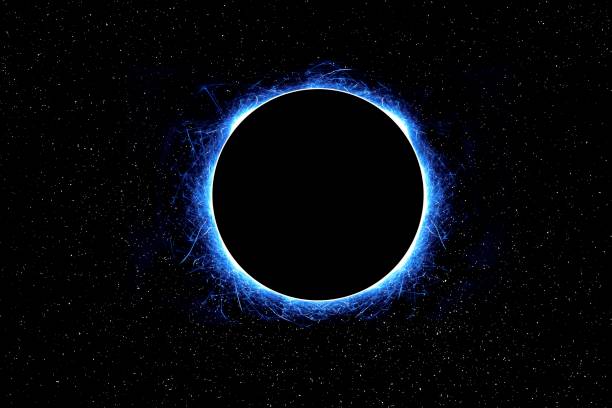
Few objects in the universe ignite the imagination like black holes. They are regions of spacetime where gravity becomes so intense that nothing—not even light—can escape once it crosses a boundary known as the event horizon. Born from the collapse of massive stars or found lurking at the centers of galaxies, black holes are among the most extreme predictions of Einstein’s theory of general relativity.
And yet, for all their fearsome reputation as cosmic devourers, black holes may not be simple dead ends.
Over the past century, physicists have uncovered surprising possibilities hidden within the mathematics of gravity and quantum theory. Some of these ideas suggest that black holes could, under specific conditions, act not as final graves of matter and information, but as gateways—bridges to distant regions of spacetime, tunnels into other universes, or conduits that reshape reality itself.
These ideas remain theoretical. No evidence currently confirms that black holes are portals in any practical sense. But the physics that motivates such speculation is grounded in real equations and real puzzles.
Here are nine scientifically plausible ways black holes could, in principle, function as portals—if nature allows it.
1. Einstein–Rosen Bridges: The Birth of Wormholes
In 1935, Albert Einstein and Nathan Rosen discovered something unexpected within the equations of general relativity. When describing a non-rotating black hole solution—now known as the Schwarzschild solution—they found that the mathematics permitted a “bridge” connecting two separate regions of spacetime.
This structure became known as an Einstein–Rosen bridge.
Today, we call such objects wormholes.
A wormhole is a hypothetical tunnel through spacetime that connects two distant points. Instead of traveling across vast cosmic distances in normal space, one could—in theory—enter one mouth of the wormhole and emerge somewhere else entirely.
However, there is a major obstacle. The original Einstein–Rosen bridge is not stable. It collapses too quickly for anything to pass through. The wormhole pinches off almost instantly.
Still, the discovery revealed something profound: the equations governing gravity do not forbid shortcuts through spacetime. Black holes, in certain mathematical descriptions, naturally contain structures resembling portals.
The question is not whether the equations allow it. The question is whether the universe does.
2. Traversable Wormholes and Exotic Matter
Decades after Einstein and Rosen, physicists such as Kip Thorne explored whether wormholes could be made stable and traversable.
The answer, intriguingly, is yes—but only under extraordinary conditions.
To hold a wormhole open, one would need a form of “exotic matter” with negative energy density. In classical physics, energy density is always positive. But quantum field theory allows small regions of negative energy under certain conditions, such as in the Casimir effect.
Negative energy could, in principle, counteract the gravitational collapse that would otherwise close the wormhole throat.
If a stable, traversable wormhole existed, a black hole might serve as one mouth of that tunnel.
However, no known mechanism can generate or sustain the required amount of exotic matter on macroscopic scales. Moreover, stability analyses suggest such wormholes would be extremely delicate.
Still, the mathematics remains consistent. Black holes could be endpoints of tunnels through spacetime—if exotic physics intervenes.
3. Rotating Black Holes and Inner Gateways
Not all black holes are simple, non-rotating objects. In reality, most astrophysical black holes spin, sometimes at rates approaching the speed of light at their event horizons.
The solution describing rotating black holes is known as the Kerr metric, developed by Roy Kerr in 1963.
Kerr black holes have more complex internal structures than their non-rotating counterparts. The mathematics predicts not just one event horizon, but two—an outer horizon and an inner horizon. Beyond the inner horizon lies a region where spacetime behaves in highly unusual ways.
In certain idealized models, the Kerr solution suggests that instead of ending at a simple singularity, spacetime might extend through a ring-shaped singularity into another region—or even another universe.
However, there are important caveats. Real black holes are unlikely to be perfectly symmetric. Small perturbations, infalling matter, or quantum effects may destabilize these inner structures, turning them into chaotic regions where classical descriptions fail.
Still, the Kerr geometry hints that black holes may not be one-way endpoints. They may hide deeper layers of spacetime topology beyond what classical intuition suggests.
4. Black Holes as Gateways to Baby Universes
One of the most intriguing possibilities arises when general relativity is combined with quantum cosmology.
Some theoretical models suggest that when matter collapses to extreme densities inside a black hole, instead of forming a true singularity of infinite density, quantum gravitational effects might cause a “bounce.”
Instead of terminating spacetime, the collapsing region could pinch off and expand into a new, separate region—a baby universe.
From the outside, the black hole would appear ordinary. But inside, a new expanding universe might unfold, causally disconnected from the parent cosmos.
This idea connects with speculative cosmological models in which our own universe might have originated as the interior of a black hole in another universe.
Although highly theoretical, such proposals attempt to resolve the singularity problem—where classical physics predicts infinities that signal breakdown.
If correct, black holes would not be endpoints but beginnings. They would be portals not merely across space, but into entirely new universes.
5. The Holographic Principle and Information Transfer
In the 1970s, Stephen Hawking discovered that black holes are not completely black. Quantum effects near the event horizon cause them to emit radiation, now known as Hawking radiation.
This discovery led to the black hole information paradox. If black holes evaporate over time, what happens to the information about the matter that fell inside?
Quantum mechanics forbids the destruction of information. But classical black hole theory seems to imply it.
In attempts to resolve this paradox, physicists developed the holographic principle. This idea suggests that all information contained within a volume of space can be encoded on its boundary surface.
If true, the event horizon of a black hole might store all information about what has fallen inside, much like a cosmic hologram.
While this does not imply a portal in the science fiction sense, it suggests that black holes are gateways for information transformation rather than annihilation. Information might re-emerge in Hawking radiation in highly scrambled form.
The portal, in this case, would not be spatial—but informational.
6. ER = EPR: Entanglement as a Wormhole
In 2013, physicists proposed a bold conjecture linking two seemingly separate ideas: Einstein–Rosen bridges and quantum entanglement.
The proposal, often summarized as ER = EPR, suggests that entangled particles may be connected by microscopic wormholes.
Einstein–Rosen bridges (ER) describe wormholes. Einstein–Podolsky–Rosen (EPR) describes quantum entanglement. The conjecture proposes that these two phenomena are deeply connected.
If entanglement and spacetime geometry are linked, then wormholes may not require exotic matter in the traditional sense. Instead, quantum entanglement itself might generate geometric connections.
In this view, spacetime could emerge from networks of entangled quantum states.
Black holes, which are deeply entangled with their Hawking radiation, might therefore be connected through hidden geometric structures.
This idea remains speculative, but it offers a radical possibility: that portals may exist at the quantum level, woven into the fabric of entanglement itself.
7. White Holes: The Time-Reversed Exit
General relativity allows for objects called white holes—time-reversed versions of black holes.
A white hole would expel matter and energy but not allow anything to enter. While no observational evidence for white holes exists, they emerge naturally in certain mathematical extensions of black hole solutions.
In some theoretical models, a black hole in one region of spacetime could be connected to a white hole in another.
Matter falling into the black hole might reappear elsewhere, emerging from the white hole.
This scenario is closely related to wormhole geometries, though stability and physical plausibility remain uncertain.
White holes may not exist in reality. But their presence in the equations suggests that gravity does not strictly forbid the idea of cosmic exits.
If they do exist, black holes might not consume matter forever—they might redirect it.
8. Quantum Gravity and the Resolution of Singularities
At the heart of every classical black hole lies a singularity—a point of infinite density where known laws of physics break down.
But infinities in physics usually signal incomplete theory.
Approaches to quantum gravity, such as loop quantum gravity, suggest that spacetime itself has a discrete structure at the Planck scale. Instead of infinite collapse, matter might reach a maximum density and then rebound.
In such models, the interior of a black hole could transition into an expanding region—a new spacetime domain.
These quantum corrections could effectively transform the black hole’s interior into a bridge rather than a dead end.
While experimental verification remains out of reach, such models aim to eliminate singularities and preserve physical law.
If successful, they would replace the idea of cosmic oblivion with cosmic transformation.
9. Multiverse Connections and Higher Dimensions
Some theories, particularly those inspired by string theory, suggest that our universe may exist within a higher-dimensional structure.
Black holes, in these frameworks, could interact with extra dimensions in ways not yet fully understood.
Certain models propose that black holes might connect branes—higher-dimensional surfaces—within a larger multiverse.
In this view, what we perceive as a black hole might be a localized intersection with a higher-dimensional geometry.
Such ideas are deeply theoretical and currently lack direct empirical support. Yet they arise from serious attempts to unify gravity with quantum theory.
If extra dimensions exist, black holes may provide clues to their structure.
They might not simply curve spacetime—they might pierce it.
The Portal Question
Are black holes truly portals?
At present, there is no observational evidence that any black hole allows passage to another universe or distant region of spacetime. The extreme tidal forces near an event horizon would likely destroy any ordinary object attempting entry.
Yet the mathematics of gravity, combined with quantum theory, continues to hint that black holes are more than simple cosmic traps.
They challenge our understanding of space, time, information, and reality itself.
In confronting black holes, physics confronts its own limits.
Perhaps the most profound possibility is not that black holes are literal gateways, but that they are conceptual portals—doorways into deeper laws of nature still waiting to be discovered.
Einstein showed us that gravity bends space and time. Modern physics suggests that space and time may bend into tunnels, bounce into new universes, encode information holographically, and emerge from entanglement.
Black holes sit at the center of these mysteries.
They may not yet be portals we can traverse.
But they remain portals of thought—thresholds where the known universe gives way to the unknown.