Science has a strange habit of sounding like fiction. The deeper we look into the universe, the more it seems to slip beyond common sense. We are creatures shaped by everyday experience: we expect solid ground beneath our feet, steady time ticking forward, and the sky above us to remain unchanged. Yet when science pulls back the curtain, it reveals a reality far more astonishing than imagination. Some truths feel so outrageous that they sound like pranks or exaggerated myths. And yet, they are not only real—they are supported by careful observation, experiment, and mathematical precision.
What follows are ten scientifically accurate facts that sound like complete lies at first hearing. Each one stretches intuition to its breaking point. Each one invites us to step outside the comfort of familiar logic and enter a universe that is stranger, deeper, and more beautiful than we ever expected.
1. You Are Made of Stardust
It sounds poetic, almost spiritual, like something written in a novel or whispered in a song. But it is a literal scientific fact: the atoms in your body were forged in stars.
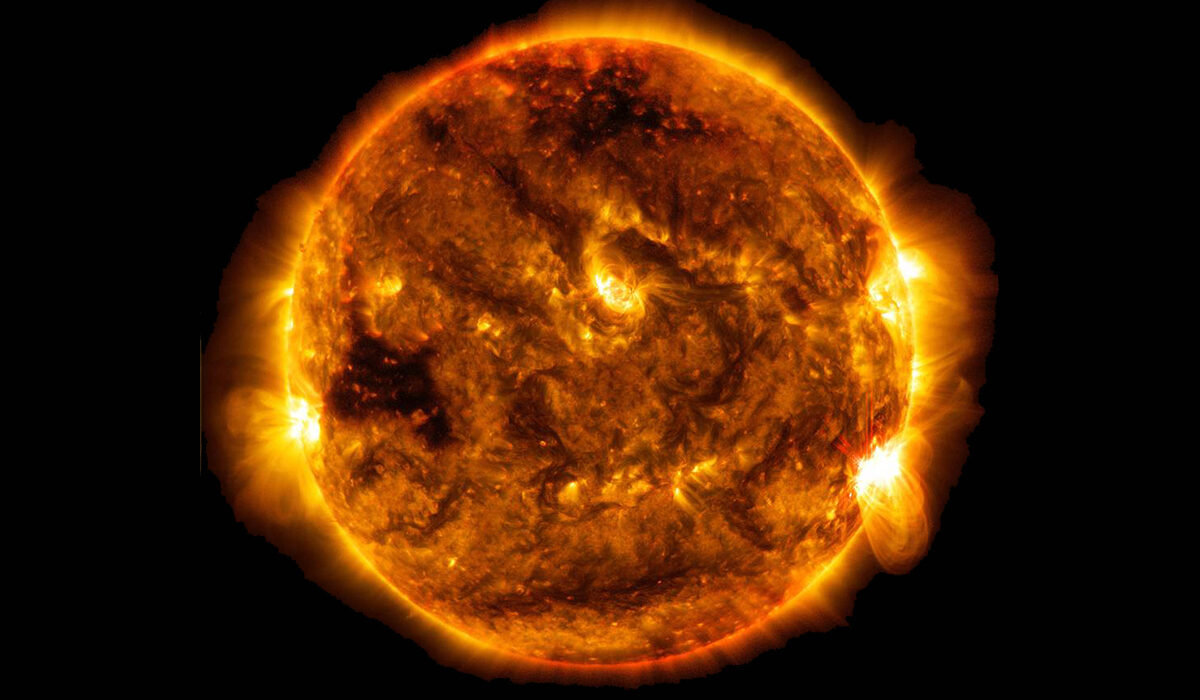
Hydrogen, the simplest element, formed shortly after the Big Bang. But the carbon in your cells, the oxygen you breathe, the iron in your blood, the calcium in your bones—those elements were created in the cores of massive stars through nuclear fusion. In these stellar furnaces, lighter elements fuse into heavier ones under immense pressure and temperature.
When massive stars exhaust their fuel, they explode in supernovae, scattering those newly formed elements into space. Over millions of years, this enriched cosmic debris gathers into new stars, planets, and eventually living organisms. Our solar system formed from such recycled material about 4.6 billion years ago.
Every breath you take includes atoms that once drifted between stars. Every heartbeat depends on iron atoms forged in stellar cores long before Earth existed. The phrase “we are stardust” is not metaphorical. It is astrophysical truth.
2. There Are More Trees on Earth Than Stars in the Milky Way
At first, this sounds impossible. The night sky appears endless, filled with stars stretching beyond imagination. Surely there cannot be more trees on our modest planet than stars in our entire galaxy.
Yet careful astronomical estimates suggest that the Milky Way contains roughly 100 to 400 billion stars. Meanwhile, a large-scale scientific analysis published in 2015 estimated that Earth holds about three trillion trees.
Three trillion. That is roughly ten times more trees than stars in our galaxy, even at the high end of stellar estimates.
This does not diminish the grandeur of the Milky Way. Rather, it reframes our perception. Our planet, small on a cosmic scale, is astonishingly rich and alive. Forests from the Amazon to Siberia hold a population that outnumbers the stellar inhabitants of our galactic home.
Sometimes the mind must adjust not because something is larger than expected, but because something closer to home is far more abundant than we realized.
3. Time Runs Slower on Your Feet Than on Your Head
It sounds absurd. Time is supposed to tick uniformly, steady and impartial. But according to Einstein’s theory of general relativity, time passes more slowly in stronger gravitational fields.
Gravity slightly weakens as you move farther from Earth’s center. Your head is a little farther from the center of Earth than your feet are. That tiny difference means your head experiences slightly weaker gravity than your feet. As a result, time runs ever so slightly faster for your head.
The difference is incredibly small—measured in tiny fractions of a billionth of a second—but it is real and measurable with precise atomic clocks.
This effect is not just theoretical. It must be accounted for in GPS satellites orbiting Earth. Because they are farther from Earth’s gravity and moving at high speeds, time for them passes differently than it does on the ground. Without correcting for relativity, GPS systems would quickly become inaccurate.
So while you stand reading this, time itself is flowing unevenly along your body. Reality is stranger than our senses suggest.
4. A Teaspoon of Neutron Star Would Weigh Billions of Tons
Neutron stars are the remnants of massive stars that have exploded as supernovae. After the explosion, the core collapses under gravity so intensely that protons and electrons combine to form neutrons. What remains is an object only about 20 kilometers in diameter but containing more mass than the Sun.
The density of such matter is beyond ordinary comprehension. A teaspoon of neutron star material would weigh billions of tons on Earth.
To picture this, imagine compressing Mount Everest into the size of a sugar cube. That is the level of density involved. The atoms are crushed so tightly that most of their empty space disappears. Neutron stars represent matter under extreme conditions, where the familiar structure of atoms no longer applies.
The universe allows such extremes. It builds objects that defy everyday understanding, then scatters them across space as quiet, spinning relics of stellar death.
5. Bananas Are Radioactive
It sounds like a joke from a science classroom, but bananas are indeed radioactive.
Bananas contain potassium, and a small fraction of natural potassium exists as the radioactive isotope potassium-40. This isotope undergoes radioactive decay. The radiation level is extremely low and completely harmless in everyday consumption.
In fact, scientists sometimes use the “banana equivalent dose” as an informal way to describe small amounts of radiation. Eating a banana exposes you to a tiny dose of natural radioactivity, but it is insignificant compared to everyday background radiation from the environment.
The truth is that radioactivity is not rare or exotic. It is woven into the natural world. Even your own body contains small amounts of radioactive elements. The idea sounds alarming only because the word “radioactive” carries dramatic associations. In reality, nature is gently radioactive all the time.
6. Water Can Boil and Freeze at the Same Time
It sounds like a contradiction. Boiling and freezing are opposites. How could they possibly happen simultaneously?
Under specific conditions of pressure and temperature, water can exist in a state known as the triple point. At this precise combination, water can coexist as solid, liquid, and gas at the same time.
If you lower the air pressure enough, you can create a situation where liquid water begins to boil. At the same time, the evaporation cools the remaining water so rapidly that part of it freezes.
In laboratory demonstrations, water placed in a vacuum chamber can appear to bubble vigorously while ice forms within it. Boiling and freezing occur together, not because physics is broken, but because phase transitions depend on both temperature and pressure.
The triple point is not a magic trick. It is a reminder that our everyday experience represents only a narrow slice of possible conditions.
7. There Are More Possible Games of Chess Than Atoms in the Observable Universe
The number of possible unique chess games is so vast that it defies comprehension. This number, often referred to as the Shannon number, is estimated to be around 10 to the power of 120.
By comparison, physicists estimate that the observable universe contains roughly 10 to the power of 80 atoms.
That means the possible variations of a 64-square board game exceed the number of atoms in the visible cosmos by many orders of magnitude.
This fact does not suggest that chess is physically larger than the universe. Instead, it reveals the explosive growth of possibilities in complex systems. Even with simple rules, combinations multiply exponentially.
The universe itself operates through combinations of particles and forces, creating staggering diversity from simple laws. Chess is a small echo of that generative power.
8. Sharks Existed Before Trees
This one feels backward. Trees seem ancient and primordial. Sharks seem like later, more complex creatures. But the fossil record tells a different story.
The earliest sharks appeared over 400 million years ago. The first true trees evolved around 350 million years ago.
That means sharks were swimming in the oceans tens of millions of years before the first forests rose on land.
The mental image is astonishing: ancient seas filled with sharks, while the continents were largely barren of towering trees. Earth’s history rearranges our intuitive timeline. The order of life’s emergence is not always what we assume.
Evolution unfolds in branching pathways, not in neat sequences. The ocean gave rise to complex predators long before terrestrial landscapes resembled what we now call forests.
9. You Can Fit All the Planets Between Earth and the Moon
The average distance from Earth to the Moon is about 384,400 kilometers. If you line up all eight planets of our solar system side by side at their equators—Mercury, Venus, Earth, Mars, Jupiter, Saturn, Uranus, and Neptune—their combined diameters total less than that distance.
In fact, they would fit with a small margin to spare.
The Moon often appears close in the sky, especially during a full moon. But space is vast. The gap between Earth and its natural satellite is enormous compared to planetary sizes.
This fact recalibrates our sense of scale. The solar system is not a crowded cluster of touching spheres. It is a spacious, mostly empty arena where distances dwarf the objects themselves.
10. Your Body Replaces Most of Its Cells Over Time
It is often said that every seven years your body completely replaces itself. That statement is oversimplified, but there is truth behind it.
Different types of cells in your body have different lifespans. Skin cells are replaced within weeks. The cells lining your gut may last only days. Red blood cells circulate for about four months before being replaced. Bone tissue is constantly remodeled. Even parts of your liver can regenerate.
Some cells, such as many neurons in the cerebral cortex, can last a lifetime. So you are not entirely new every few years. Yet a significant portion of your body’s cells are continuously replaced through natural biological processes.
You are both stable and dynamic. The structure of your identity persists, yet the physical matter composing much of your body is gradually renewed.
In a profound sense, you are a flowing system rather than a static object. Life is not a frozen sculpture. It is a process.
The Universe Beyond Intuition
Each of these facts challenges something fundamental in our intuition. We expect time to be constant, matter to be solid and unchanging, boiling and freezing to be opposites, ancient creatures to appear in a certain order. Science disrupts these expectations not to confuse us, but to refine our understanding.
The universe does not conform to human common sense. Our intuition evolved for survival on the African savanna, not for comprehending neutron stars or spacetime curvature. Science extends our perception beyond its biological limits.
It replaces assumption with measurement. It replaces guesswork with experiment. And sometimes, it replaces disbelief with wonder.
The deeper we look, the stranger reality becomes. And yet, this strangeness is not chaos. It is governed by consistent laws. It is predictable, testable, measurable. It is real.
Science facts that sound like lies are often invitations. They invite us to step beyond habit and embrace a broader vision of existence. They remind us that truth does not depend on what feels familiar. It depends on evidence.
In accepting these truths, we do not lose our sense of reality. We expand it.